

Why in news?
Kerala Agricultural University has begun a specialised programme against giant African snails in Bison Valley panchayat, Idukki district. The Hindu reported the initiative on 18 September, following a request from agricultural authorities. The infestation affects crops and residential areas near Munnar, where damp, shaded plantations provide favourable conditions for snails. The university's reported aim is eradication over two to three years, supported by awareness activities and ward-level monitoring. That is a programme objective, not an achieved result. Alongside agricultural damage, there is a potential health concern because infected snails can carry rat lungworm. However, the presence of snails alone does not establish human infection.
An introduced land mollusc with a wide appetite
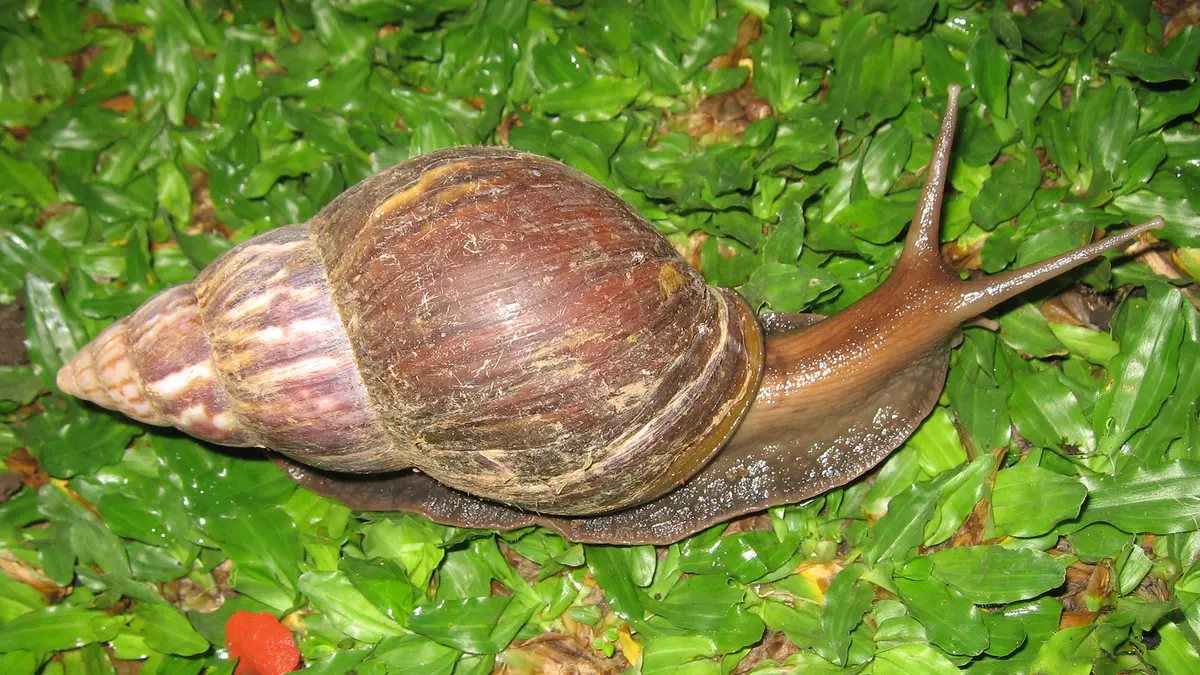
The species commonly discussed in this context is Lissachatina fulica, formerly called Achatina fulica. It is a terrestrial gastropod: a land-dwelling mollusc that moves using a muscular foot. Its native origin is East Africa, but human movement has helped establish it across many tropical and subtropical regions. The common name can also describe other large African snails, so identification matters before control measures are directed at a population.
The United States Department of Agriculture identifies it as a serious plant pest, capable of feeding on hundreds of plant species. Its diet is not restricted to rotting waste. It can damage living vegetation and agricultural plants, which explains its economic significance. Large size and a pointed, brownish shell may help recognition, but appearance alone is not a reliable substitute for expert identification. Native snails should not automatically be treated as the same pest.
Why Bison Valley provides favourable conditions
Bison Valley lies in Kerala's Idukki district, near Munnar in the Western Ghats. The reported infestation occurs within a plantation landscape rather than only around urban rubbish. Agricultural officials described damp shade in cardamom-growing areas as a particular difficulty. Such conditions can provide shelter and reduce drying. When feeding sites and hiding places are spread across adjoining properties, clearing snails from one small plot may not prevent their return.
Reproduction and concealed eggs add to the challenge. These snails are hermaphrodites, possessing male and female reproductive organs, and can produce substantial egg clutches. Eggs and small individuals are easier to miss than conspicuous adults. Human-assisted movement is also important: infested plants, produce, containers or vehicles can carry snails beyond the distance they would crawl themselves. Prevention therefore includes attention to material movement, not just removal of visible animals.
The health connection requires an infected host
Rat lungworm, Angiostrongylus cantonensis, is a parasitic worm whose life cycle normally involves rats and molluscs. Rats pass larvae in their faeces, and snails or slugs can ingest them. The larvae develop in these intermediate hosts but do not become adult worms there. The cycle is completed when a rat eats an infected mollusc. A giant African snail can participate in this cycle, but it is not automatically infected.
People are accidental hosts. Infection can follow eating infected raw or undercooked snails or slugs, including small fragments accidentally present on raw produce. Merely seeing a snail beside a house is not the same exposure. Some infections cause eosinophilic meningitis, an inflammation involving the protective membranes around the brain and spinal cord. The disease mechanism is different from infection by Naegleria fowleri, despite both sometimes appearing in alarming reports about brain illness.
Why sustained community control is necessary
The Bison Valley initiative includes local monitoring and repeated follow-up, according to the university officials quoted in the report. This approach recognises that one collection drive is unlikely to eliminate every adult, juvenile and egg. Monitoring can show where populations persist or reappear. Coordination between neighbouring landholders matters because boundaries between farms and houses do not restrict the pest. A longer programme also needs to detect fresh introductions after numbers decline.
Eradication is a stronger claim than temporary reduction. It requires evidence that the population has been eliminated from the defined area, supported by continued surveillance. Experience elsewhere shows that organised programmes can succeed, but it does not guarantee the same outcome in every landscape. Bison Valley's shaded plantations, residential spread and movement of agricultural material make the local conditions central to evaluating progress.
Public guidance should connect caution with the actual route of harm. The United States Centers for Disease Control and Prevention (CDC) advises washing produce and avoiding raw snails. Gloves are recommended when handling molluscs. Suspected infestations should be reported to local agricultural authorities for identification and appropriate management. Indiscriminate chemical use can create separate risks to people, crops and other organisms. A supervised programme can combine pest control with safer handling and protection of non-target species.
Conclusion
The intervention is important because an invasive plant pest has become a shared problem across farms and homes. Success will depend on sustained detection, coordinated control and prevention of renewed spread, rather than the number collected on one day. Health communication must remain equally precise. Infected snails can transmit a parasite through particular exposures, but an infestation is not proof of a human outbreak. Clear explanations support participation without creating unnecessary fear.