

Why in news?
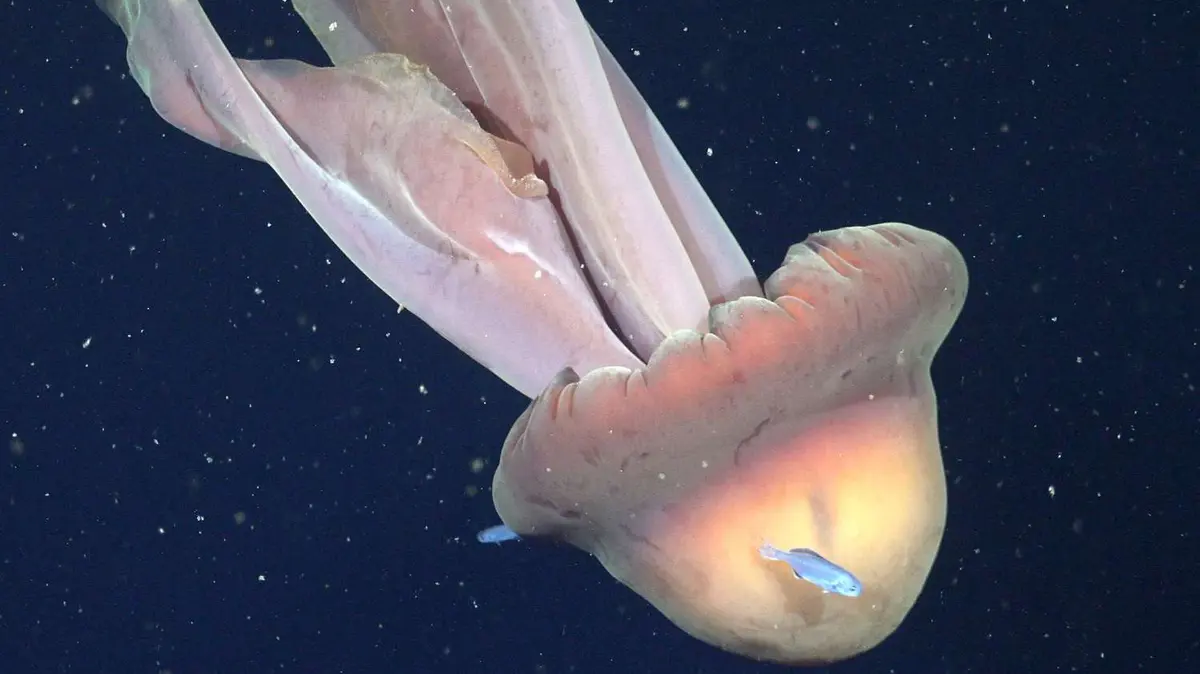
Scientists on a month‑long deep‑sea expedition off the coast of Argentina filmed a giant phantom jellyfish for the first time in the South Atlantic. Only about 120 sightings of this species have been reported worldwide since it was first described in 1899.
Background
The giant phantom jellyfish (Stygiomedusa gigantea) is one of the most enigmatic creatures of the deep ocean. Belonging to the family Ulmaridae, it inhabits the ocean’s “midnight zone,” a lightless realm between 1,000 and 4,000 metres deep. Unlike most jellyfish, it has no stinging tentacles. Instead, four ribbon‑like oral arms, each many metres long, sweep through the water to ensnare plankton and small fish.
Characteristics and adaptations
- Size: Adults can have a bell more than one metre across, and their oral arms may extend over 10 metres. Despite their size, they move gracefully through the water.
- Transparency: The jellyfish’s body is almost entirely translucent, making it difficult for predators to see it in the dim depths.
- Pressure tolerance: Its gelatinous tissues withstand pressures of more than 40,000 kilopascals, equivalent to thousands of tonnes per square metre.
- Global distribution: Sightings come from all oceans except the Arctic, but they are extremely rare because the animal lives at great depth. Advances in remotely operated vehicles have increased our ability to observe it.
Significance of the recent sighting
- Deep‑sea biodiversity: The discovery highlights the rich and largely unexplored life of the deep ocean. Researchers on the expedition documented dozens of other species, including several believed to be new to science.
- Methane seeps: The team also found active methane vents supporting unique communities of microbes and animals. Such ecosystems are important for understanding biogeochemical cycles and climate processes.
- Human impact: Alongside rare animals, the researchers saw human‑made debris even at these depths, underscoring the reach of marine pollution.
Conclusion
The giant phantom jellyfish is a reminder of how little we know about the deep sea. As technology allows us to explore further, each new encounter can teach us about adaptation, ecology and the need to protect fragile ocean habitats.
Source: NDTV