
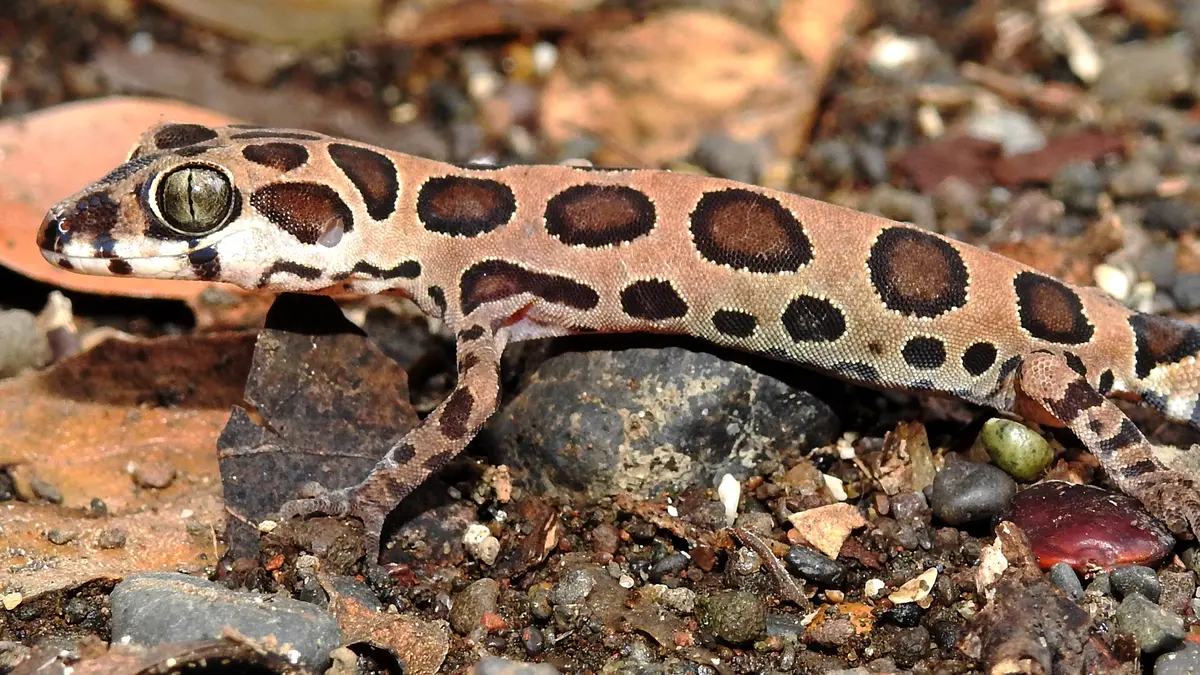
Why in news?
Naturalists in Mumbai’s Aarey forest recently reported the presence of Cyrtodactylus varadgiri, a rare ground‑dwelling gecko named after herpetologist Varad Giri. Although the species is widely distributed in parts of western and central India, it is seldom observed because it spends most of its life hidden under leaf litter. The sighting drew attention to the biodiversity of urban forests like Aarey and the importance of documenting lesser‑known species.
Background
Giri’s geckoella belongs to the genus Cyrtodactylus, a group of bent‑toed geckos. It was first described in 2016 and named in honour of Indian reptile scientist Varad Giri. The lizard is endemic to India and has been recorded in Maharashtra, Gujarat and Madhya Pradesh. Unlike arboreal geckos, this species lives on the ground and emerges mainly at night to hunt small insects.
Key features
- Appearance: Adults are around 5.5 cm long with a stout body, broad head and short limbs. Their backs are marked with irregular brown bands on a pale background. The head and neck are mostly bald, and the tail is relatively short.
- Behaviour: The gecko is nocturnal and insectivorous. It spends the day concealed under fallen leaves or stones and forages on the forest floor at night. The species is oviparous; females lay two eggs and parental care is absent.
- Habitat and range: It inhabits moist leaf litter in deciduous forests, scrublands and even human‑modified landscapes. It is distributed across parts of Maharashtra, Gujarat and central India, suggesting adaptability to a range of habitats.
- Conservation value: Because it is secretive and rarely seen, little is known about its population size. The species is not currently listed as threatened, but its discovery in urban Aarey forest underscores the need to protect small pockets of greenery that harbour endemic wildlife.
Significance
The Aarey sighting highlights the overlooked biodiversity of India’s urban forests. Documenting species like Giri’s geckoella helps scientists map distributions, understand ecological requirements and inform conservation strategies. The finding also strengthens the argument for preserving habitats such as Aarey, which provide refuge for endemic fauna amid expanding cities.

