
Why in news?
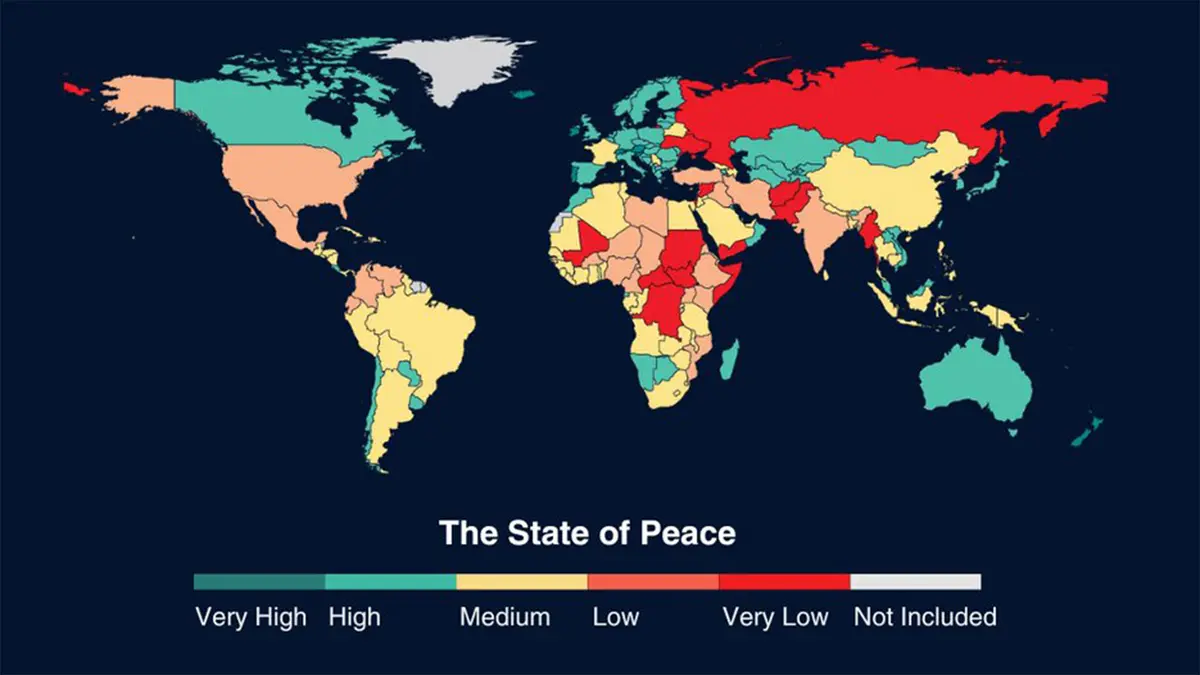
The Institute for Economics & Peace released its Global Peace Index 2026 in June. The report assesses the level of peace in 163 countries and regions based on indicators such as conflicts, crime and militarisation. It shows that the world has become less peaceful for the tenth year in a row.
Background
The Global Peace Index is an annual report that ranks countries according to their peacefulness. Indicators are grouped into three domains: ongoing conflict, societal safety and security, and militarisation. Scores are based on qualitative and quantitative data from international organisations and think tanks. A lower score indicates greater peacefulness.
Major findings
- Overall decline: Global peacefulness fell by 0.7 percent compared with 2025. Fourteen out of 23 indicators deteriorated. There are more active state‑based conflicts now than at any time since the Second World War.
- Top and bottom countries: Iceland remained the most peaceful country for the 19th consecutive year. New Zealand, Switzerland, Slovenia and Ireland made up the rest of the top five. Russia was ranked lowest, followed by Sudan, the Democratic Republic of the Congo, Ukraine and Israel.
- Regional shifts: South Asia experienced the largest regional deterioration and is the second least peaceful region after the Middle East and North Africa. Ninety‑nine countries recorded a deterioration in their scores, while 62 improved.
- India’s performance: India fell to 127th position, dropping four places and recording a 2.9 percent decline in its score. The ongoing conflict domain worsened by 9.2 percent due partly to continued ethnic violence in Manipur that killed more than 260 people since May 2023 and displaced 60,000. Relations with neighbouring countries also deteriorated due to tensions with Pakistan and Myanmar.
- Economic cost: The global economic impact of violence stood at US$21.8 trillion in 2025, equivalent to 10.5 percent of the world’s gross domestic product.
Conclusion
The 2026 Global Peace Index paints a grim picture of rising conflicts and insecurity. India’s decline highlights the need for dialogue and reconciliation in conflict‑affected regions and constructive engagement with neighbours. Policymakers must also address social and economic factors driving unrest while investing in peace‑building initiatives.