

Why in news?
Recent conservation workshops and collaborative projects have brought renewed attention to the plight of the golden langur, an endangered primate found only in western Assam and southern Bhutan. Efforts in 2025 and 2026 aim to prepare a trans‑boundary action plan.
Background
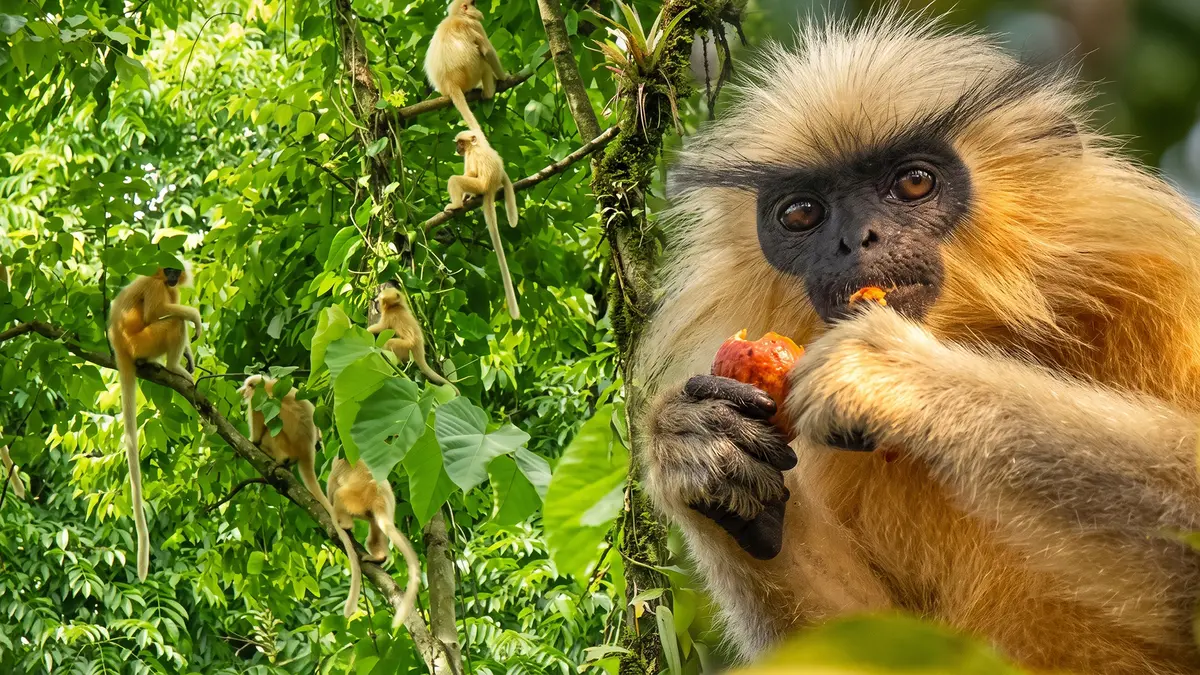
The golden langur (Trachypithecus geei) is a slender monkey with long limbs and a tail often longer than its body. Adults weigh between 9 and 12 kilograms and have a striking golden coat that becomes darker in winter. The species was discovered by zoologist Edward Gee in the 1950s. It lives in small troops in the forests between the Sankosh River in the west and the Manas/Beki rivers in the east, an area known as the Bhutan–Assam foothills. Its habitat includes evergreen, semi‑evergreen and deciduous forests at elevations up to 3,000 metres. The International Union for Conservation of Nature lists the golden langur as Endangered, and the Wildlife Protection Act of India places it in Schedule I.
Threats and conservation measures
- Habitat loss: Logging, agriculture and infrastructure projects fragment the langur’s forest home. Only about 500 square kilometres of suitable habitat remain in India, and the animals cannot easily cross open spaces.
- Population decline: Estimates suggest there are between 6,000 and 7,000 individuals in the wild. Road accidents, electrocution from power lines and conflict with humans further reduce numbers.
- Protected areas: In India the golden langur is protected in several areas, including Manas National Park, Raimona National Park and the Chakrashila Wildlife Sanctuary. Several sanctuaries in Bhutan also shelter populations. The species is listed in Appendix I of CITES, prohibiting international trade.
- Conservation actions: Conservation breeding began at the Assam State Zoo in 2011. An international workshop in 2025 brought Indian and Bhutanese officials and scientists together to draft a recovery plan. Local communities, especially the Bodo people, consider the langur sacred and help protect its habitat.
Conclusion
Saving the golden langur requires habitat connectivity across the Indo‑Bhutan border, stricter protection and community involvement. By protecting this flagship species, authorities will also conserve a biodiverse landscape that benefits many other plants and animals.