

Why in news?
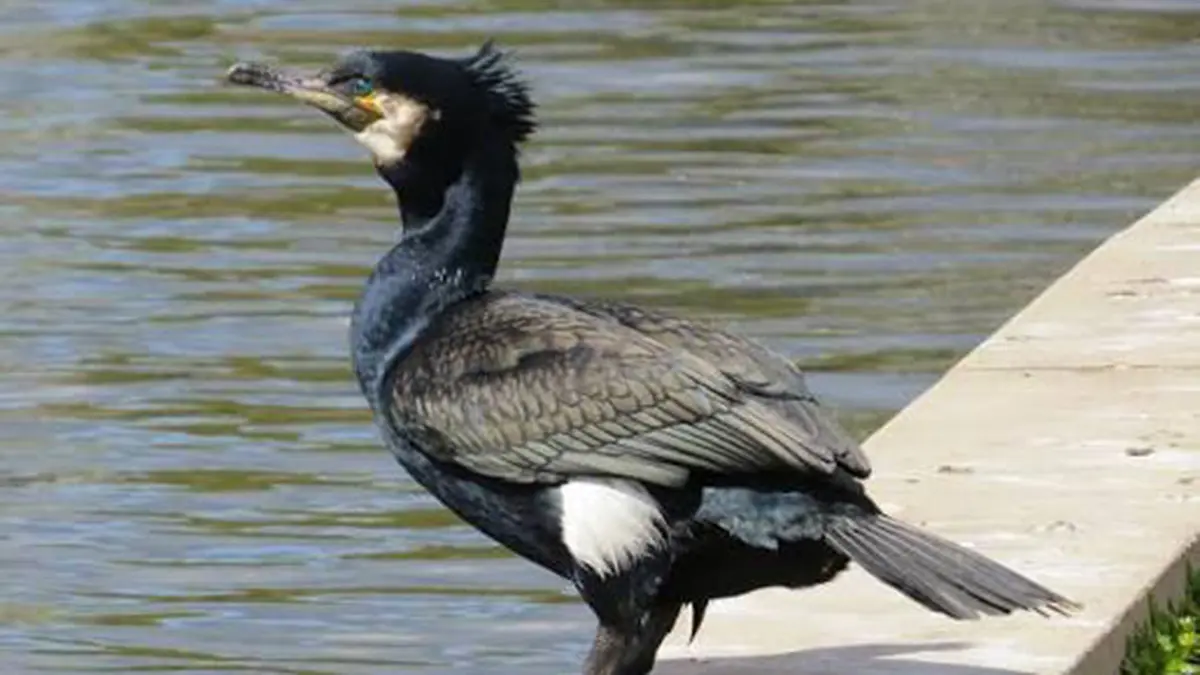
A nearly white great cormorant has been reported at Ameenpur Lake on Hyderabad's outskirts. Telangana Today reported on 22 September that birder Raghuvamsh Chavali photographed the bird and consulted other birdwatchers about its identity. The observation was described as leucism, a condition associated with missing feather pigmentation. Great cormorants are normally predominantly dark waterbirds that dive for fish. The unusual appearance concerns one bird's colouring, not the discovery of a new species. Its precise underlying pigment condition has not been established through laboratory testing. The sighting nevertheless offers a useful opportunity to understand bird identification and the wildlife value of an urban wetland.
Recognising the bird beyond its colour
The great cormorant's scientific name is Phalacrocorax carbo. It is a large, heavy-looking waterbird with a long neck, a substantial hooked bill and a relatively long tail. Adults generally look blackish, sometimes with a metallic sheen. White throat or breeding patches are normal features and should not automatically be called pigment abnormalities. Younger birds can also have pale underparts. Identification therefore combines body structure, age, normal variation and behaviour rather than relying on colour alone.
This becomes especially important when an individual has unusually white feathers. The expected plumage pattern may no longer be available as a guide. A birder instead considers the bill, proportions, posture and the way the animal moves or feeds. Photographs showing several angles can preserve those clues for comparison. They can support an identification without answering every biological question. A field record and a genetic diagnosis represent different levels of evidence.
Leucism is not the same as albinism
Melanin is a pigment responsible for many dark colours in feathers. In leucism, pigment cells are absent from some or all affected areas. Feathers may consequently grow white while the eyes retain their usual colour. Albinism involves a failure to produce melanin and can affect the eyes as well as plumage. These conditions are often confused in casual descriptions, but their underlying mechanisms differ.
The British Trust for Ornithology also warns that several other conditions can produce pale or white feathers. Progressive greying can increase whiteness as a bird ages, while dilution can produce washed-out colouring. Knowing an individual bird's history may help distinguish them. The Ameenpur report should therefore be understood as an attributed field observation of apparent leucism. No evidence presented with it establishes the exact mutation, its inheritance or its effects on this individual's survival.
A bird adapted to underwater feeding
Cormorants pursue prey beneath the surface rather than simply picking food from the water's edge. Their feet provide propulsion, and the bill helps grasp slippery prey. Great cormorants chiefly take fish, although diet varies with place and available food. After feeding, they commonly rest on exposed perches and spread their wings. Their plumage becomes wetter than that of strongly water-repellent birds such as ducks. Drying and warming between feeding periods form part of their familiar behaviour.
The species uses marine coasts as well as inland waters across parts of its range. A North American description focused on rocky Atlantic shorelines should not be mistaken for its entire global habitat. Across Eurasia, lakes, rivers and other productive wetlands also support populations. Some populations migrate, while others remain within a region. A single Hyderabad observation cannot establish where that individual hatched, how far it travelled or whether it remains at the lake throughout the year.
Great cormorants can breed in colonies, with nest placement varying by location. Trees, cliffs and rocky ground may provide suitable sites. Feeding areas and resting or nesting places must be considered together: a waterbody with fish may still lack safe perches. Equally, disturbance at a colony can affect birds even when food remains available. These connections help explain why conserving a wetland involves more than maintaining a visible patch of open water.
Why Ameenpur's setting matters
Ameenpur Lake lies in Telangana's Sangareddy district, within the expanding Hyderabad urban region. The National Biodiversity Authority records it as a biodiversity heritage site. Its description identifies an urban wetland supporting resident and migratory birds alongside fish, reptiles, mammals and plants. The designation recognises a living habitat, not merely a scenic waterbody. Urban growth makes the relationship between the lake, its margins and surrounding land especially important.
Fish-eating birds link the water's food web to the wider landscape. Water quality influences aquatic life, which in turn affects feeding opportunities. Safe banks, trees and undisturbed resting places provide other necessary resources. Observing an unusual bird can attract public interest to these relationships. However, the observation does not measure the lake's water quality or prove that all parts of its ecosystem are healthy. Those questions need repeated ecological monitoring and appropriate water testing.
BirdLife International's 2022 species account lists the great cormorant as globally Least Concern. That category refers to extinction risk across the species, not to the frequency of white individuals at Ameenpur. A globally widespread bird can still face local pressures from pollution, disturbance or entanglement in fishing gear. Conversely, a rare colour form does not make the whole species endangered. Keeping those scales separate allows the unusual sighting and the habitat's everyday conservation needs to receive appropriate attention.
Conclusion
The Ameenpur bird is noteworthy because of its reported pigment variation within a familiar fish-eating species. Its appearance should be documented without converting a field interpretation into a proven genetic result. The broader significance lies in the wetland that supports it and many less conspicuous animals. Continued observation can improve understanding of the individual, while protection of water quality and habitat serves the whole community of species using the lake.