
Why in news?
The Union government approved deoxyribonucleic acid (DNA) indexing for greater one-horned rhinoceroses. The database will identify animals through genetic profiles. It can support conservation and crime investigations after approval by a national wildlife board committee.
Background
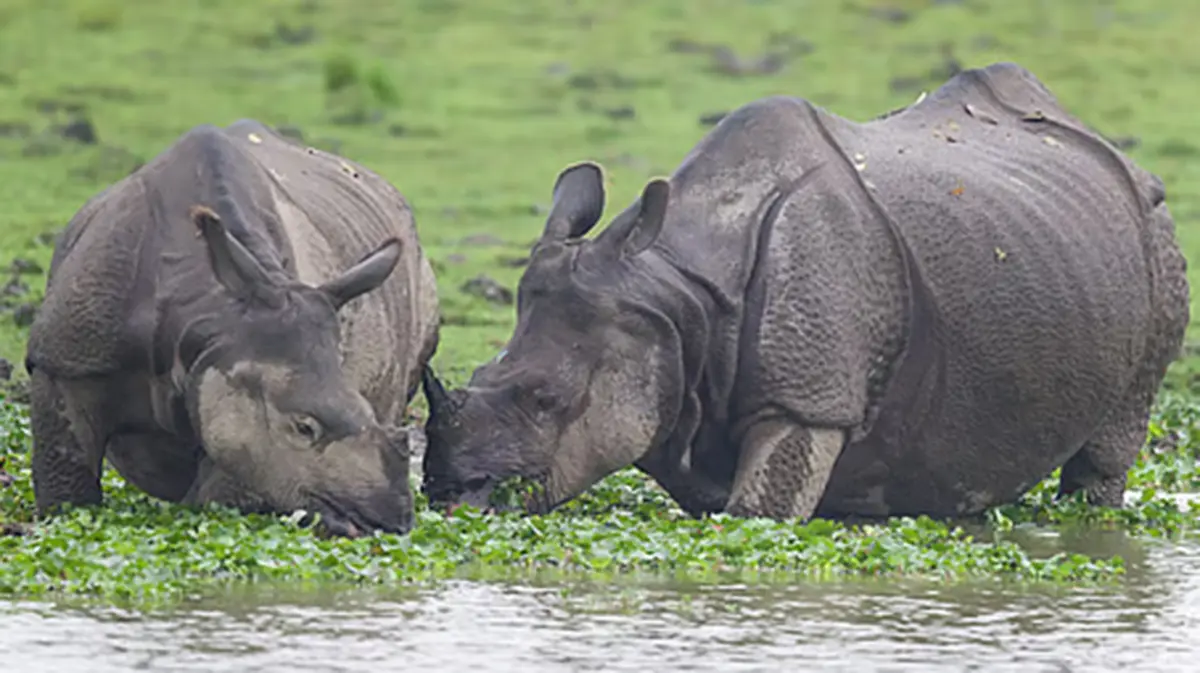
The greater one-horned rhinoceros has the scientific name Rhinoceros unicornis, and it is also called the Indian rhinoceros.
Historically, it lived across the Indus, Ganga and Brahmaputra floodplains, and hunting and habitat conversion reduced this vast range severely.
By the early twentieth century, only small scattered populations survived, and strong protection later produced a major conservation recovery.
Today, wild populations occur mainly in northern India and southern Nepal, and they occupy alluvial grasslands, marshes and riverine forests.
What is DNA indexing?
Deoxyribonucleic acid, or DNA, carries inherited biological information, and most individuals have a distinctive combination of genetic markers.
Scientists can obtain DNA from dung, tissue, blood, hair or horn, and a laboratory then creates a genetic profile.
The proposed Rhino DNA Indexing System will store verified profiles in one database. It is modelled partly upon tiger DNA profiling.
Simple meaning: A DNA profile is a biological identity record. It is not a physical tag, electronic chip or cloning process.
How can the database help conservation?
- It can distinguish individuals without physically capturing every animal.
- It can estimate sex, relatedness and genetic diversity.
- It can reveal movement between protected areas.
- It can guide transfers between isolated populations.
- It can detect inbreeding risks and support breeding plans.
- It can connect seized horn or tissue with a source population.
A database becomes useful only when samples follow common standards, and accurate labels and secure storage are equally important.
Who approved the project?
The approval came at the 91st Standing Committee meeting of the National Board for Wildlife. Environment Minister Bhupender Yadav chaired it.
The national board is a statutory body under the Wildlife (Protection) Act, 1972. The Prime Minister chairs the full board.
Its Standing Committee examines wildlife proposals and conservation matters between full meetings, and the Environment Minister chairs that committee.
How can this rhinoceros be identified?
- It is the largest of the three living Asian rhinoceros species.
- Its grey-brown skin forms heavy folds resembling armour plates.
- Both adult males and females usually carry one horn.
- Newborn calves have no developed horn.
- The horn consists mainly of keratin, not bone.
- The animal eats grasses, leaves, aquatic plants, fruits and twigs.
What is its present population?
The 2025 estimate placed the India–Nepal population at 4,075 animals, and India held 3,323, while Nepal held 752.
Kaziranga National Park contains the world’s largest population. Other Indian populations occur in Assam, West Bengal and Uttar Pradesh.
Important sites include Orang, Manas, Pobitora, Jaldapara, Gorumara and Dudhwa, and some populations remain isolated from one another.
What is its legal status?
- The International Union for Conservation of Nature lists it as Vulnerable.
- It appears in Appendix I of the Convention on International Trade in Endangered Species of Wild Fauna and Flora.
- It receives Schedule I protection under India’s Wildlife (Protection) Act, 1972.
Appendix I generally prohibits commercial international trade in listed wild specimens, and limited non-commercial movement requires strict permits.
What threats remain?
- Poachers kill rhinoceroses for their horns.
- Farms, roads and settlements fragment floodplain habitat.
- Invasive plants replace the grasses needed for food.
- Severe floods can kill calves and displace animals.
- Disease can spread rapidly within concentrated populations.
- Small isolated groups may lose genetic diversity.
Rhino horn has no proven medical benefit, and its keratin is the same structural protein found in human nails.
Conclusion
India’s rhino recovery is a major conservation success, but concentration creates new risks. DNA indexing can improve protection when combined with habitat links and strong field enforcement.