

Why in news?
Prime Minister Narendra Modi congratulated Hakainde Hichilema on his re-election as Zambia’s President. Zambia held its general election on 13 August 2026. The Electoral Commission declared Hichilema the winner on 18 August for a second five-year term. India has longstanding commercial and development interests there.
Modi said India values its wide partnership with Zambia and seeks stronger relations. The election also drew concern after violence, a temporary counting suspension and arrests of opposition officials. The result therefore carries both diplomatic and democratic importance. Zambia’s copper economy gives the outcome wider strategic interest. The new term will also shape debt reform, mining policy and regional cooperation.
Election result and political setting
Hichilema leads the United Party for National Development. Reporting on the final declaration placed his vote share near 60 per cent. Brian Mundubile was the main challenger and received about 38 per cent. Zambia elects its President directly. A winning candidate requires more than half of valid votes, avoiding a second round.
Voters also elected National Assembly members and local representatives. The country returned to multiparty democracy in 1991. Several changes of national leadership have occurred through elections since then. This record distinguishes Zambia within the region. However, peaceful voting alone does not settle concerns about campaign space, policing or the handling of results.
Why the election faced scrutiny
The Electoral Commission temporarily suspended result announcements after reported attacks at polling and counting locations. Officials said ballot materials were stolen in some places. Security forces deployed around parts of Lusaka. Opposition figures disputed government accounts of a raid and gunfire. The United Nations human rights chief later raised concern about arrests linked with the election.
These claims require lawful and transparent investigation. Authorities must distinguish evidence of crime from political association. Detainees need due process and access to legal safeguards. Opposition parties also have a duty to reject violence. Electoral complaints should follow clear judicial or commission procedures. Trust depends on explaining both disputed incidents and any corrective action.
Zambia’s location and borders
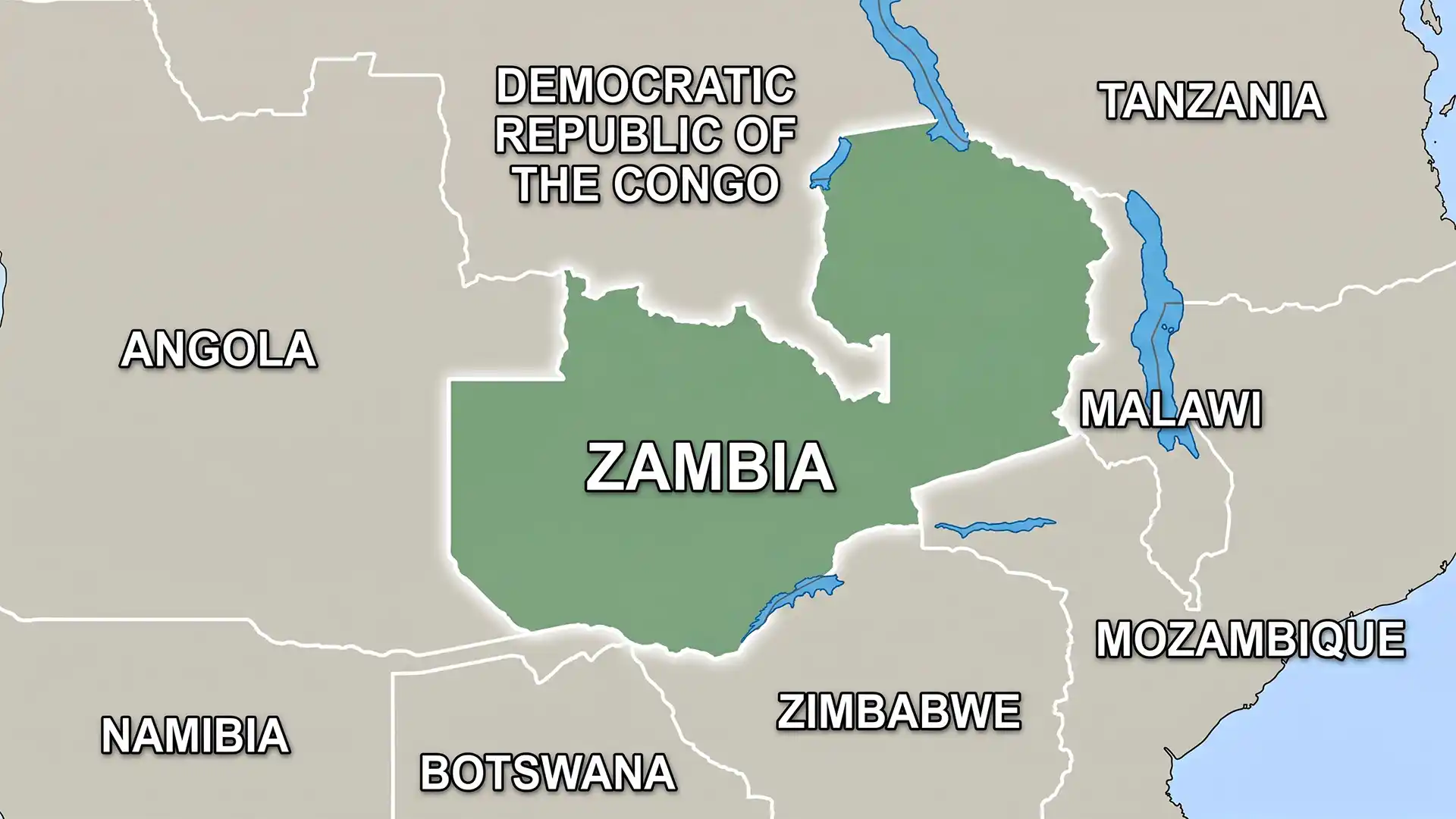
Zambia is a landlocked country in south-central Africa. It shares borders with eight countries. These are Angola, Botswana, the Democratic Republic of the Congo, Malawi, Mozambique, Namibia, Tanzania and Zimbabwe. Lusaka lies in the south-central part of the country. This position connects eastern, central and southern African trade corridors.
Much of Zambia consists of a high plateau, which moderates the tropical climate. The Zambezi drains southern and western areas. It forms the famous Victoria Falls along the Zimbabwe border. The Kafue and Luangwa are major tributaries within Zambia. Lake Tanganyika touches the far north. Lake Kariba lies on the southern border with Zimbabwe.
Transport and strategic geography
Landlocked geography makes dependable regional routes essential. Zambia needs access through neighbouring countries to reach Indian Ocean and Atlantic ports. The Tanzania–Zambia Railway links the Copperbelt towards Dar es Salaam. Southern routes connect through Zimbabwe and South Africa. Disruption at a border or railway can quickly raise export and import costs.
The country’s central position also provides market opportunities. Eight neighbours create links with several regional economic zones. Power pools, roads and river basins cross national boundaries. Zambia therefore benefits from stable relations across a wide neighbourhood. Transport investment has strategic value because copper exports are heavy and global buyers demand timely delivery.
Copper, debt and the economy
Zambia is a major copper producer and also holds cobalt and other mineral resources. Copper supports export earnings, government revenue and employment. It is essential for electricity networks, vehicles and renewable-energy systems. Global demand has increased strategic interest from China, the United States and other partners. Heavy mineral dependence also exposes Zambia to price swings.
The country defaulted on sovereign debt payments in 2020. Hichilema’s first term pursued restructuring with official and private creditors. Agreements now cover much of the external debt, but vulnerability remains high. The World Bank still classifies Zambia at high risk of debt distress. Fiscal recovery must therefore balance investment, social needs and sustainable borrowing.
Drought has also damaged hydropower and agriculture. Electricity shortages can slow mines and small businesses. Climate risk therefore reaches public revenue as well as food security. Economic diversification remains essential. Processing more minerals locally could add value, but needs dependable power, skills and environmental standards. Agricultural productivity and regional trade offer additional routes.
India–Zambia relations
India and Zambia established diplomatic relations soon after Zambian independence in 1964. Political ties have generally remained warm. The partnership covers trade, health, agriculture, education, defence training and capacity building. India has provided lines of credit, railway equipment and emergency assistance. Scholarships and professional training form an important people-centred part of the relationship.
The sixth Joint Permanent Commission met in Lusaka in November 2024. It reviewed cooperation across many sectors. The third Joint Trade Committee met in June 2025. A cooperative-sector agreement followed in July 2025. These institutions provide routes for practical delivery beyond high-level visits. Regular review can identify delayed projects and changing priorities.
Indian businesses operate in pharmaceuticals, mining, agriculture, banking and manufacturing. Zambia’s mineral wealth can support industrial cooperation. Such investment should create local skills and transparent value chains. Environmental and labour standards remain important around mines. A partnership built only around raw material extraction would miss wider development opportunities.
What the second term must address
Hichilema enters the new term with an economic recovery claim and continuing public frustration. Cost-of-living pressure affects households despite stronger macroeconomic indicators. Young people need reliable jobs beyond informal work. Electricity and water systems require climate resilience. Rural services also need sustained attention. Electoral victory does not remove these delivery challenges.
Democratic confidence will depend on treatment of opposition and civil society. Independent institutions must investigate election-related violence fairly. Media and courts need space to operate. The government can strengthen its mandate by publishing evidence and respecting due process. Stable politics would also support investment and regional cooperation. Repression would create the opposite effect.
Strategic interest should not hide democratic concerns
Zambia matters for copper, transport and regional stability. Those interests explain global attention to the election. They should not replace scrutiny of violence and arrests. Durable partnerships benefit from lawful institutions and trusted results.
Conclusion
Hichilema’s re-election gives Zambia continuity during debt recovery and growing mineral demand. The result also opens a demanding second-term agenda. Economic gains must reach households while climate and power risks remain serious. Public confidence requires transparent handling of disputed election incidents. Democratic legitimacy must continue after the declaration of results.
India’s congratulatory message reflects a long and varied partnership. Future cooperation can extend beyond resource trade into health, skills, agriculture and value-added industry. Zambia’s location makes it an important regional link. Responsible investment and accountable institutions can reinforce each other. That balance offers the strongest basis for the next phase of relations.