
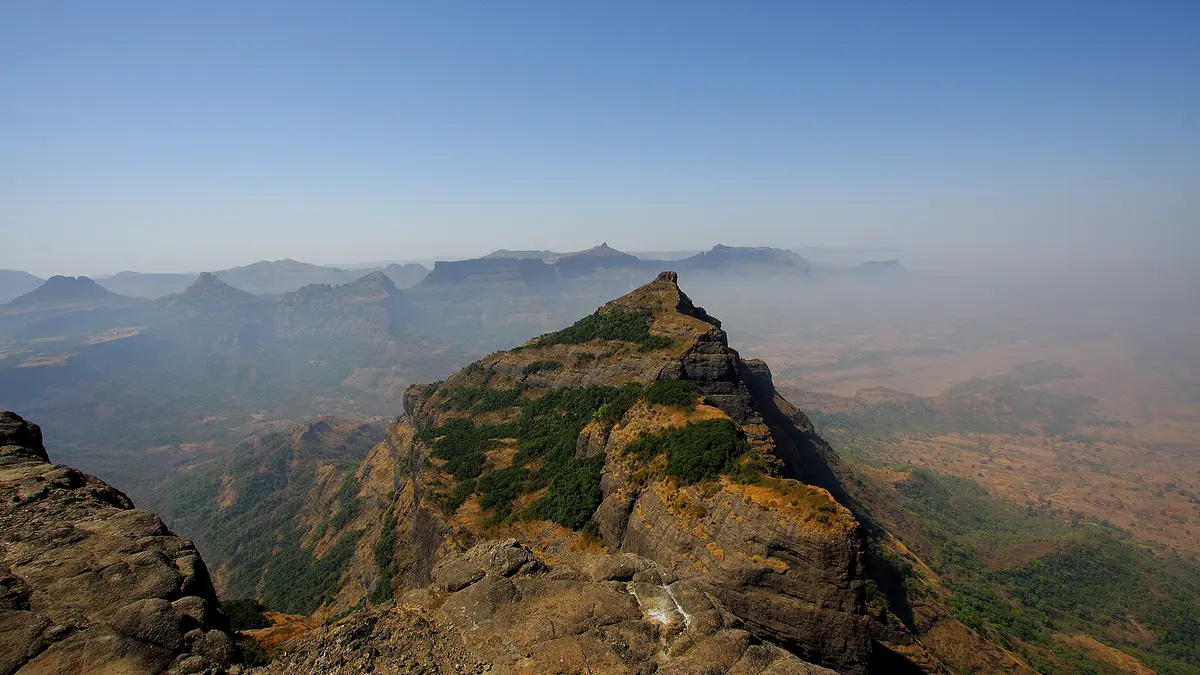
Why in news?
A rockfall struck trekkers descending Harishchandragad during heavy monsoon rain. Four visitors from Mumbai suffered injuries, including two serious cases. Villagers, trekkers and forest personnel helped bring them down safely.
Background
Harishchandragad is an ancient hill fort in Maharashtra’s Ahilyanagar district.
The district was earlier called Ahmednagar, while the fort stands within the Western Ghats’ Sahyadri ranges.
Its official recorded height is about 1,424 metres above sea level.
The difficult hilltop position once helped guard approaches around the Malshej Ghat region.
A short chronological history
- Microlithic remains show that humans used this landscape before recorded dynastic history.
- The fort’s early origin is associated with Kalachuri rule during the sixth century.
- Several rock-cut caves probably developed around the eleventh century.
- Sage Changdev is traditionally linked with meditation here during the fourteenth century.
- The site later came under Mughal control before Maratha forces captured it in 1747.
The Matsya, Agni and Skanda Puranas contain related references showing religious importance, not construction dates.
Important structures and natural features
- Harishchandreshwar is a prominent Shiva temple built in the Hemadpanti style.
- Kedareshwar Cave contains a large Shiva linga surrounded by cold water.
- Saptatirtha Pushkarni is an old stepped water tank near the temple complex.
- Rohidas, Taramati and Harishchandra are the fort’s three principal peaks.
- Taramati is the highest point within the fort complex.
What is Konkan Kada?
Konkan Kada is a huge semicircular cliff on the fort’s western side.
Its rock face curves dramatically outward and gives wide views across the lower Konkan landscape.
Strong winds, mist and exposed edges also make this area dangerous.
What is a Brocken spectre?
Visitors sometimes see a large shadow cast upon clouds or thick mist.
Coloured rings may surround the shadow because water droplets scatter sunlight.
This optical effect is called a Brocken spectre, and the shadow appears large without a clear distance reference.
Prelims point: A Brocken spectre is an atmospheric optical phenomenon. It is not a fort structure or a geological formation.
What happened during the recent accident?
A group of ten trekkers was descending during rain on Sunday.
Loose soil, rocks and boulders fell onto their route near a cliff section.
Two people became trapped beneath debris, while others suffered falling-rock injuries.
A safety railing reportedly prevented a possible fall into the valley.
Local residents and fellow trekkers carried the injured towards medical assistance.
Why does monsoon trekking become risky?
- Rain enters rock cracks and can loosen already weathered material.
- Wet soil loses strength, especially along steep and disturbed slopes.
- Mist reduces visibility near cliff edges and route junctions, while slippery trails slow emergency evacuation.
- Streams can swell quickly and cut off familiar return paths.
Visitors should follow local restrictions, while technical routes require suitable equipment, experience and trained guidance.
Conclusion
Harishchandragad combines archaeology, religious heritage and striking scenery, while the rockfall underlines monsoon risks.