

Why in news?
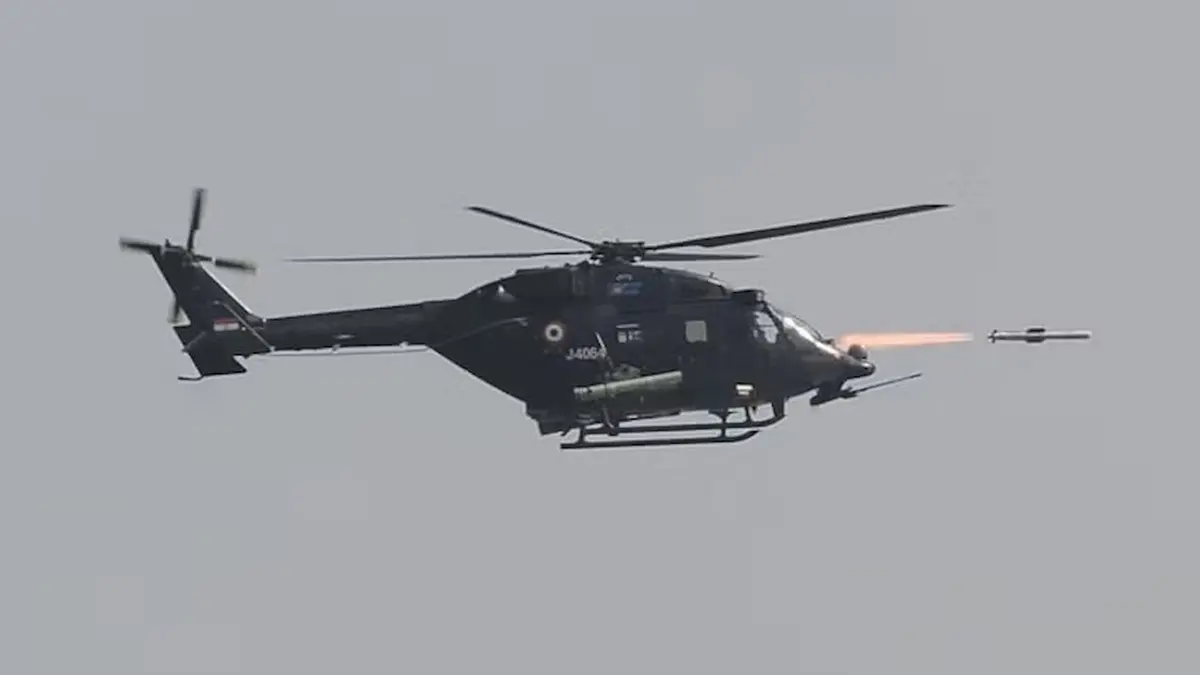
Bharat Dynamics Limited (BDL) received large orders in June 2026 to supply launchers and line‑replaceable units for the HELINA (also called Dhruvastra) missile. These orders will equip the Indian Army’s Dhruv helicopters and the Air Force’s combat fleet.
Background
HELINA is a third‑generation anti‑tank guided missile developed by the DRDO, produced by Bharat Dynamics Limited (BDL), and integrated on Hindustan Aeronautics Limited (HAL) helicopters. The name stands for Helicopter‑launched Nag. The variant used by the Air Force is called Dhruvastra. Tests began in the 2010s, and the missile was cleared for induction after successful trials. It is fired from the ALH Dhruv helicopter via twin launchers that can carry four missiles each.
Specifications and features
- Guidance: An imaging infrared (IIR) seeker provides “lock‑on before launch.” The missile can see and track a target’s heat signature even in bad weather.
- Range: HELINA can strike targets from 500 metres to 7 kilometres away. It climbs after launch and then dives onto the top of a tank where the armour is weakest.
- Warhead: A tandem high‑explosive shaped charge can penetrate up to 800 millimetres of rolled homogenous armour. This allows it to defeat modern battle tanks.
- Dimensions: The missile is about 1.9 metres long and weighs around 44 kilograms. It has fins for stability and can operate in both direct and top‑attack modes.
- Indigenous content: Apart from a few micro‑electronic components, the missile is largely made in India. The unit cost is under ₹1 crore, making it cost‑effective compared with imported systems.
Significance
- Support for mechanised forces: Helicopter‑borne anti‑tank missiles give commanders the ability to destroy armoured vehicles from a safe distance. They enhance battlefield mobility and protection.
- Atmanirbhar Bharat: Mass production of HELINA reduces reliance on foreign weapons. It also supports domestic industries and creates jobs in the defence sector.
- Exports: With orders from the Indian services, India may offer the missile to friendly countries in future. This could strengthen defence diplomacy.
Conclusion
Orders for HELINA launchers show that India’s indigenous anti‑tank capability is reaching maturity. The missile will give the Army and Air Force a potent tool against modern armour.