
Why in news?
The Indian Institute of Astrophysics organised a silver-jubilee meeting for the Himalayan Chandra Telescope. Scientists met in Bengaluru from 29 to 31 July 2026. The telescope obtained its first-light image on 26 September 2000. The meeting reviewed twenty-five years of observations, instruments and researcher training.
Background
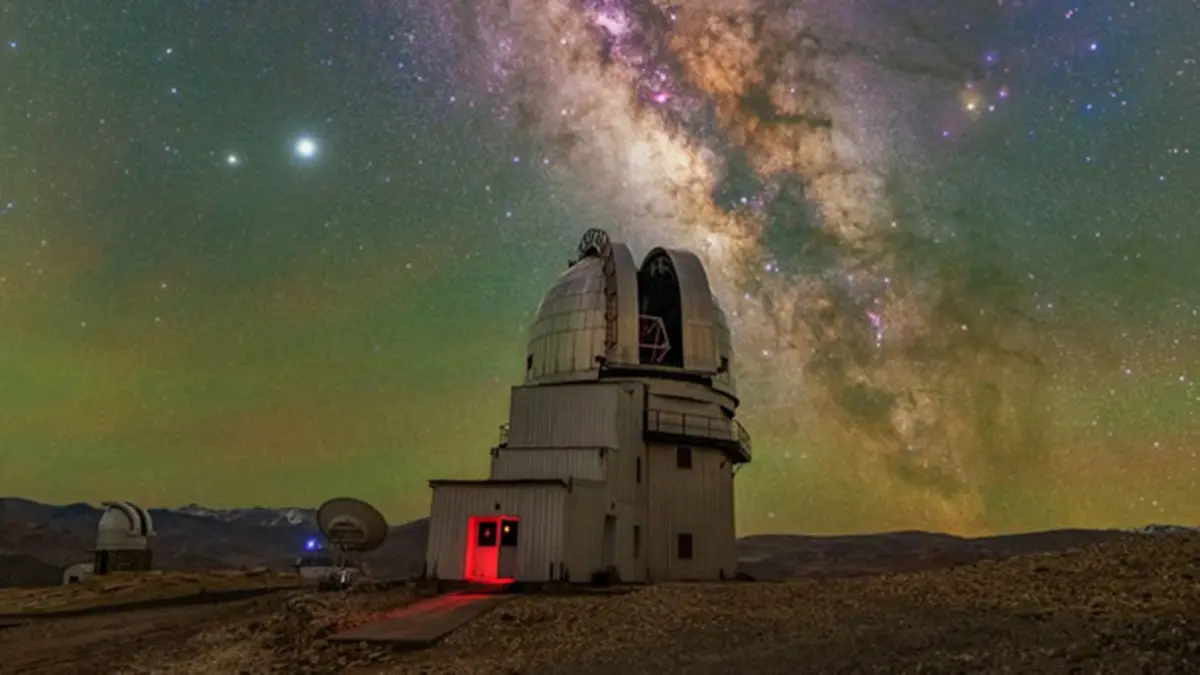
The Himalayan Chandra Telescope is the Institute’s flagship optical and near-infrared observing facility.
Its shortened name is HCT after the full title first appears.
The telescope stands at the Indian Astronomical Observatory near Hanle in Ladakh.
The Indian Institute of Astrophysics operates both the observatory and telescope.
The observatory site lies roughly 4,500 metres above sea level on Mount Saraswati.
Why was Hanle selected?
Hanle lies within a cold, dry and sparsely populated high-altitude desert.
Low atmospheric moisture improves transmission of optical and near-infrared radiation.
Dark skies reduce unwanted artificial light reaching sensitive astronomical instruments.
Many cloud-free nights provide a longer yearly observing window.
Thin air and difficult winters nevertheless create demanding engineering and maintenance conditions.
Telescope design and milestones
HCT has a primary mirror measuring 2.01 metres across.
Its optics gather faint light and focus it towards interchangeable scientific instruments.
The telescope achieved first light on 26 September 2000.
First light means the first successful astronomical image produced by a new telescope.
The facility became available for regular scientific observations during May 2003.
The two-metre telescope was dedicated to the nation on 29 August 2001.
Remote operation
A dedicated satellite link connects Hanle with a control centre near Bengaluru.
The centre is the Centre for Research and Education in Science and Technology.
It is called CREST after the complete institutional title first appears.
Astronomers can control observations remotely without remaining at the high-altitude telescope throughout winter.
Remote operation also improves scheduling, safety and access for research teams across India.
Main scientific instruments
| Instrument | Principal use |
|---|---|
| Himalayan Faint Object Spectrograph Camera | Optical imaging and spectroscopy of faint astronomical sources |
| Tata Institute of Fundamental Research Near Infrared Spectrometer and Imager | Near-infrared imaging and spectral observations |
| Hanle Echelle Spectrograph | High-resolution measurement of stellar spectra and velocities |
Their shortened names are HFOSC, TIRSPEC and HESP respectively.
Spectroscopy separates light by wavelength, revealing composition, temperature, motion and other physical properties.
Scientific contribution
HCT observes stars, galaxies, supernovae, active galactic nuclei and rapidly changing transient events.
Its flexible scheduling supports follow-up work after satellites detect gamma-ray bursts.
Repeated brightness measurements also help researchers examine variable stars and possible exoplanet transits.
The Transiting Planets and Planetesimals Small Telescope gave the TRAPPIST-1 system its name.
HCT contributed follow-up observations but did not single-handedly discover its first reported planet.
Do not confuse nearby facilities
HCT detects ordinary optical and near-infrared light collected by its mirror.
The nearby Major Atmospheric Cherenkov Experiment detects atmospheric flashes created by very-high-energy gamma rays.
These instruments share the Hanle region but use different technologies and scientific methods.
Conclusion
HCT’s longevity demonstrates how location, remote engineering and sustained instrumentation can expand Indian astronomy.