

Why in news?
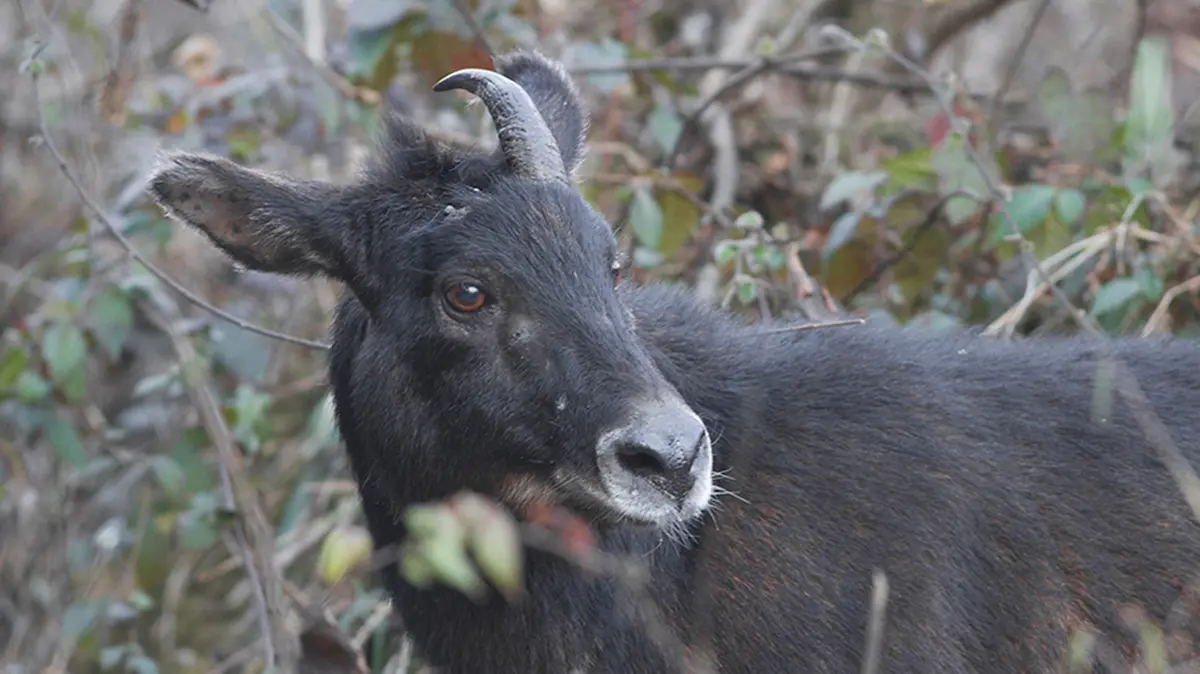
Forest personnel recorded a Himalayan serow during a routine patrol on 2 August 2026. The sighting occurred in Dalhousie’s catchment forests; these forests adjoin Kalatop–Khajjiar Wildlife Sanctuary in Himachal Pradesh’s Chamba district. The divisional forest officer called it an authenticated visual record.
It was reportedly the division’s first such evidence in nearly two decades. Earlier local accounts had produced no documentary proof.
What kind of animal is a serow?
A serow is a stocky, goat-like forest ungulate in the family Bovidae. It is adapted to steep and densely vegetated mountain terrain. Strong limbs and broad hooves help it use difficult rocky slopes; its habits are cautious and largely solitary.
Serows eat leaves, grasses, shoots and other plant matter. They favour forest cover, cliffs and quiet corridors over open alpine ground.
The scientific name requires care because mammal taxonomy has changed. The Mammal Diversity Database follows a broader species treatment.
It places the Himalayan form thar within the mainland or maned serow, Capricornis sumatraensis. This yields the name Capricornis sumatraensis thar; some older and alternative authorities retain Capricornis thar as a separate species. Both names therefore appear in legal and conservation material.
Why the conservation status is often reported differently
The current Mammal Diversity Database links the broader Capricornis sumatraensis to a Vulnerable Red List assessment. Older sources often treat C. thar separately. Those sources commonly quote an older Near Threatened assessment. A careful account states the taxonomic treatment beside the conservation status.
The two labels arise from different treatments; their coexistence is not necessarily a simple factual error.
Trade protection is less ambiguous; the Convention on International Trade in Endangered Species lists both scientific treatments in Appendix I. India’s amended Wild Life (Protection) Act, 1972, lists Himalayan serow in Schedule I; these listings provide strong legal protection.
Legal listing alone cannot preserve habitat. It also reveals nothing about the number of animals remaining in a landscape.
What the Dalhousie record does—and does not—show
The sighting provides valuable evidence of present occurrence. It can guide patrols, sign surveys and camera placement across the Dalhousie–Kalatop landscape. Some usable habitat and connectivity may remain within this heavily visited hill region. A verified image also corrects a long documentary gap.
However, one video cannot establish abundance, range expansion or ecological recovery; it cannot confirm a breeding population.
The animal may be resident, dispersing or using the area seasonally. “After twenty years” does not prove twenty years of absence.
It means authenticated evidence was unavailable during that period; a baseline requires repeated detections and comparable effort across seasons. Researchers can combine camera records with occupancy surveys. Dung or hair may provide genetic evidence, while markings can sometimes distinguish individuals.
Conservation pressures operate across the landscape. Road widening, construction, tourism disturbance, forest fires and hunting can fragment apparently continuous habitat.
Free-ranging dogs create another risk. Serows need escape cover, secure slopes and protected links between habitat patches.
Management should map cliffs and movement corridors. Camera locations should remain confidential, while surveys record both people and dogs. Forest division and sanctuary staff also need a shared monitoring plan; this would connect the new record to repeated evidence.
Local participation is equally important. Shepherds, forest communities, guides and field staff may hold years of observations.
Citizen reports still need verification and a safe reporting channel. Awareness must not turn the animal’s location into a tourism attraction.
The best outcome is better evidence and quieter habitat. A rush to the exact sighting spot would achieve neither.
Conclusion
The Dalhousie footage closes an important documentary gap; it is a starting point, not proof of recovery. Clear taxonomy and repeated monitoring must now guide action. Connected, low-disturbance forests will determine whether a secure serow population persists.