

Why in news?
Indian scientists developed an Internet of Things system for yaks. It monitors health, predicts stress and tracks animal movement, and the system also creates virtual boundaries through geo-fencing. ICAR announced the technology on 7 July 2026.
Background
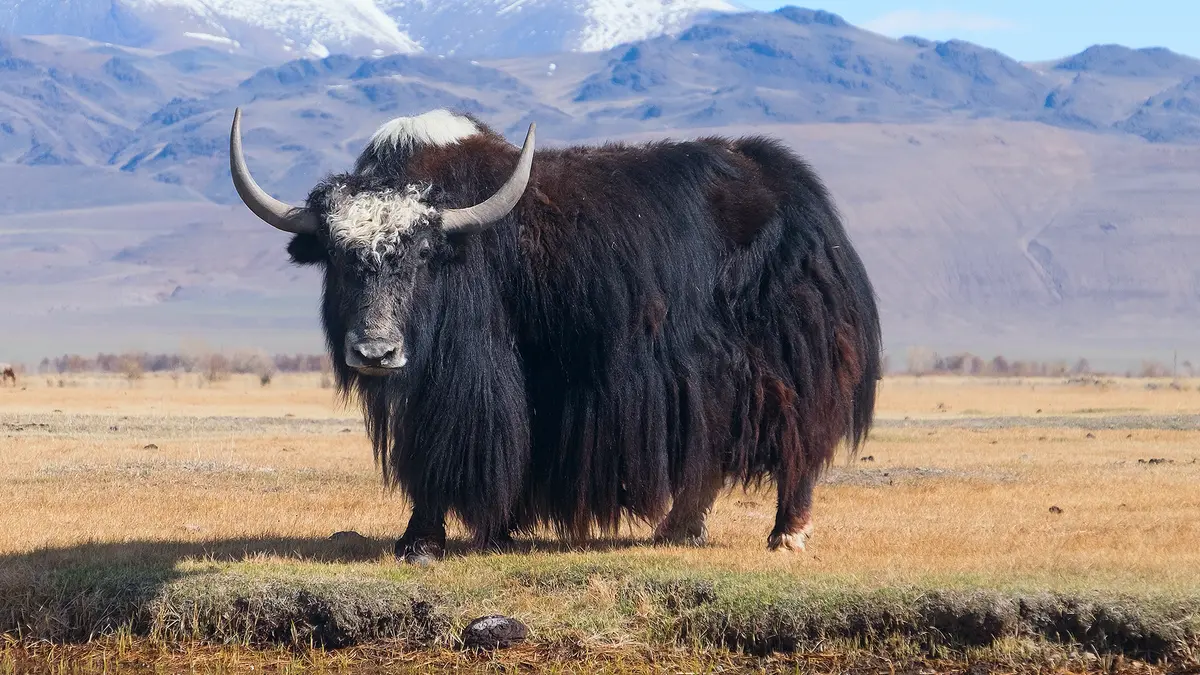
A yak is a long-haired bovine adapted to cold highlands, and domestic yak has the scientific name Bos grunniens. Its wild ancestor is Bos mutus.
Yaks live and graze at very high elevations. Indian yak habitats generally lie between 3,000 and 6,000 metres. Important regions include Ladakh, Himachal Pradesh, Sikkim and Arunachal Pradesh.
High-altitude communities use yaks for milk, meat and fibre, and yaks also carry loads across difficult terrain. Their dung provides fuel where trees are scarce.
Adaptations to high altitude
- Dense coat: Long outer hair and a fine undercoat reduce heat loss.
- Large respiratory capacity: The heart and lungs support life in thin air.
- Cold tolerance: Compact bodies and limited sweating reduce heat loss.
- Grazing ability: Yaks can use sparse alpine grasses and sedges.
- Sure-footed movement: Strong legs and hooves suit steep mountain slopes.
Hypoxia means insufficient oxygen in body tissues, and high mountains have lower atmospheric oxygen. Yak physiology is adapted to this long-term challenge.
Who developed the new system?
The technology came from two institutions, and the first is the ICAR–National Research Centre on Yak at Dirang. The second is Assam Don Bosco University in Guwahati.
ICAR means the Indian Council of Agricultural Research, and it works under the Union agriculture system. The Dirang centre specialises in yak research and husbandry.
The team combined animal science with artificial intelligence and embedded systems, and it also used Internet of Things technology. ICAR has not publicly listed every sensor specification.
How does the system work?
- Connected monitoring: Field devices collect and transmit information about individual animals.
- Health alerts: Farmers can receive early warning about illness or unusual stress.
- Movement tracking: Location information helps find free-ranging animals; Geo-fencing: A virtual boundary marks the safe grazing area.
- Boundary alert: The system can warn when an animal crosses that virtual line.
Internet of Things (IoT) means connected physical devices, and a smart collar is a familiar livestock example. It can link an animal, a network and a monitoring application.
Geo-fencing does not create a physical fence, and software draws a boundary using location coordinates. Crossing the line can trigger an alert.
Why is this useful in the Himalaya?
Traditional herds often graze freely across wide mountain landscapes, and herders cannot watch every animal continuously. Snow, fog and steep terrain make manual tracking difficult.
Early health alerts can support faster veterinary care, and location alerts can reduce animal loss. They may also prevent accidental movement near international boundaries.
The system tracks livestock, not people or the international border itself, and its stated purpose is better herd management. It can reduce repeated travel through dangerous terrain.
Wild yak and domestic yak: do not confuse them
Domestic yak: Bos grunniens is a livestock animal, and ordinary domestic herds are not assessed as “Vulnerable” by IUCN.
Wild yak: Bos mutus is listed as Vulnerable by IUCN, and it is included in CITES Appendix I. The domesticated form is expressly excluded from that CITES listing.
Indian law: Wild yak is listed in Schedule I of the Wild Life (Protection) Act, 1972. This protection does not turn domestic yak husbandry into a wildlife offence.
Broader challenges
Warming conditions can reduce cold alpine pastures, and new diseases may also appear at higher elevations. Younger people are leaving traditional pastoral work in some regions.
Technology cannot solve every problem, and devices need power, network access and maintenance. Alerts must also reach veterinary services in time.
Conclusion
The new system joins traditional yak herding with digital monitoring. It can improve health care and reduce animal loss. The wild–domestic distinction remains the most important Prelims trap.