

Why in news?
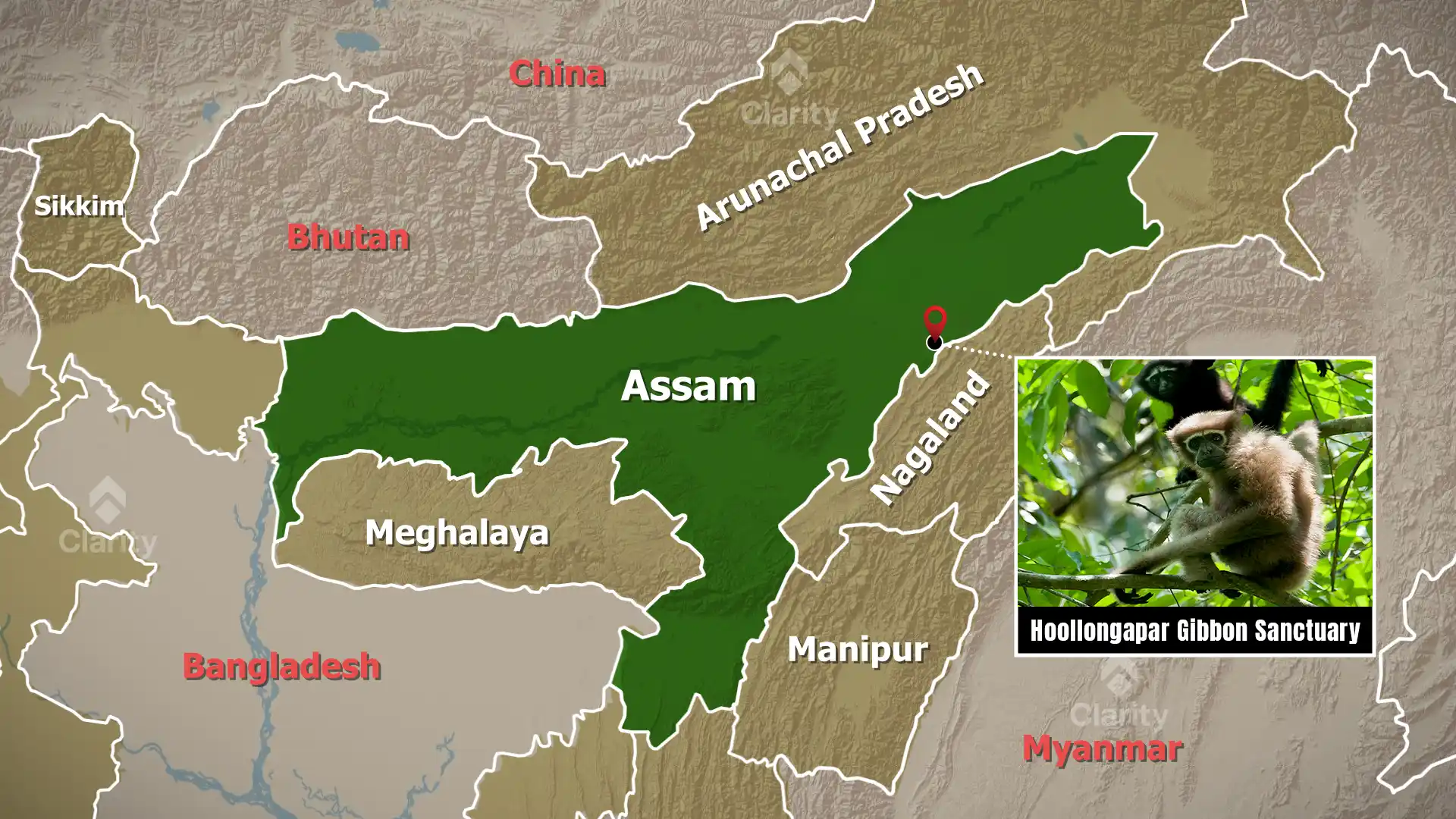
An endangered Western Hoolock Gibbon was electrocuted on 8 February 2026 while attempting to cross an electrified railway line in Assam’s Hollongapar Gibbon Wildlife Sanctuary. The incident drew nationwide attention to the risks posed by railway electrification projects in wildlife habitats and reignited calls to reroute the track away from this unique primate sanctuary.
Background
Hollongapar Gibbon Wildlife Sanctuary is a 20‑square‑kilometre protected area in Jorhat district, Assam. Notified in 1997 and formerly called Gibbon Wildlife Sanctuary, it is the only sanctuary in India dedicated to apes. The forest is home to about 125 Western Hoolock Gibbons and the Bengal Slow Loris, India’s only nocturnal primate. A century‑old metre‑gauge railway line divides the sanctuary into two uneven compartments, fragmenting the canopy. In 2024, the National Board for Wildlife approved electrification of a 1.65‑kilometre stretch of this line, along with diversion of nine hectares of forest land.
What happened?
- Electrocution incident: On 8 February 2026, a male Western Hoolock Gibbon climbed an electricity pole to cross the track and came into contact with a 25 kilovolt wire. The animal died instantly. The tragedy occurred despite the installation of five canopy bridges intended to help arboreal animals cross safely.
- Mitigation measures questioned: Conservationists pointed out that the canopy bridges were not enough. Natural canopy connections had been cut to erect electric poles, forcing animals onto the wires. Local residents reported that the gibbon avoided the bridges and tried to cross where a natural canopy once existed.
- Population fragmentation: Experts note that the railway line separates about four gibbon families in the northern compartment from the larger forest in the south. Gibbons are monogamous and may travel long distances in search of mates. Fragmentation reduces genetic diversity and increases extinction risk.
Response and recommendations
- Immediate steps: Forest officials installed camera traps to monitor gibbons near the electrified line. Safety nets under canopy bridges and intrusion detection devices for elephants were planned, but the incident highlighted the need for stronger measures.
- Long‑term solutions: The Wildlife Institute of India recommended rerouting the railway line outside the sanctuary and its eco‑sensitive zone. Since the electrified stretch is only 1.65 kilometres, conservationists argue that relocating it would balance ecological and economic interests.
- Habitat restoration: Reconnecting canopy gaps through natural regeneration and additional bridges will help gibbons move freely. Protecting the sanctuary is critical for the survival of India’s only ape species.
About the Western Hoolock Gibbon
- India’s only ape: Western Hoolock Gibbons (Hoolock hoolock) are found in northeastern India, Bangladesh and north‑west Myanmar. They are listed as Endangered on the IUCN Red List.
- Arboreal and monogamous: These apes live in the forest canopy and swing from branch to branch using their long arms. They form long‑term pair bonds and live in family groups.
- Threats: Habitat loss, fragmentation and electrocution from infrastructure projects pose major threats. Conservation efforts focus on preserving continuous canopy and preventing hunting.
Source: Down to Earth