

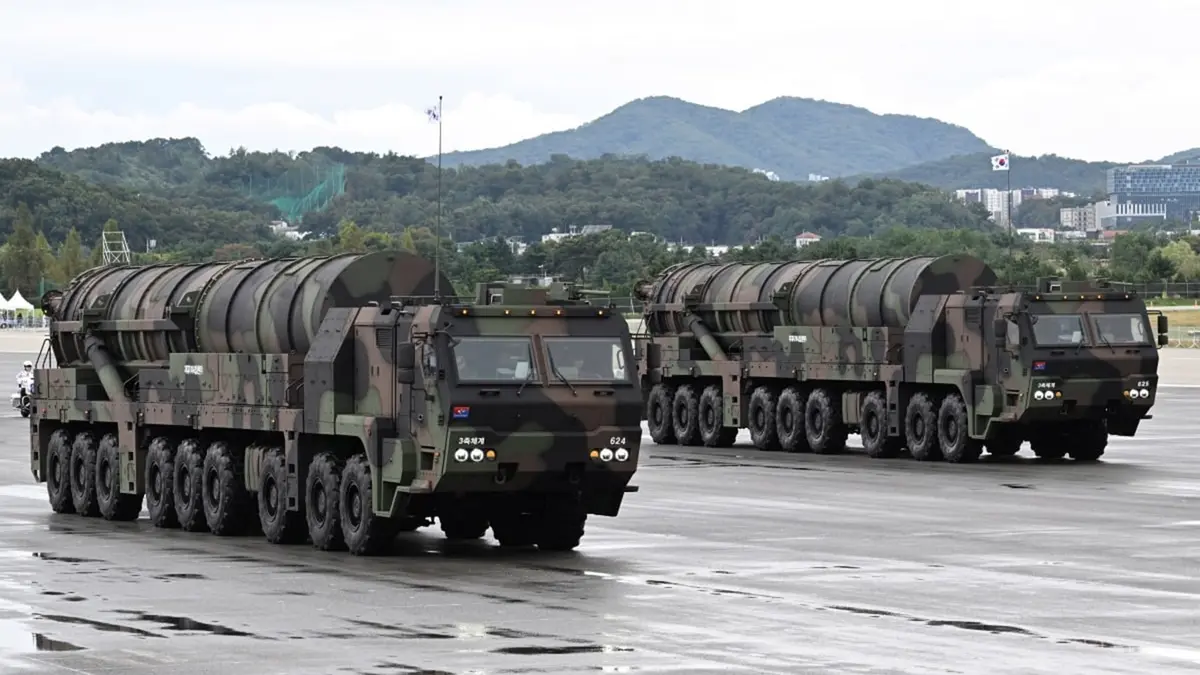
Why in news?
South Korea’s defence minister announced in October 2025 that the country had begun mass‑producing the Hyunmoo‑5 ballistic missile and planned to deploy it by the end of the year. Nicknamed the “monster missile” because of its size, Hyunmoo‑5 is intended to create a “balance of terror” with North Korea’s nuclear arsenal.
Background
The Hyunmoo series (meaning “Guardian of the Northern Sky”) dates back to the 1980s. Earlier versions were limited in range and payload under agreements with the United States, but those restrictions were lifted in 2017. Hyunmoo‑5 is a conventionally armed ballistic missile weighing about 36 tonnes and capable of delivering an 8‑tonne warhead over distances between roughly 300 kilometres and more than 5,000 kilometres, depending on the payload. The missile can penetrate deep underground bunkers, making it a key part of South Korea’s three‑axis defence strategy – a system involving pre‑emptive strikes, missile defence and retaliatory attacks aimed at deterring North Korea.
Key features
- Heavy warhead: The missile carries an 8‑tonne conventional warhead designed to destroy hardened underground targets such as missile silos and command bunkers.
- Range and flexibility: Reports suggest ranges from 186 miles (300 km) to roughly 3,100 miles (5,000 km) depending on how the warhead is configured. This allows South Korea to target facilities deep within North Korea and beyond.
- Mass production: Defence Minister Ahn Gyu‑back said the missile entered mass production in 2025, with the aim of deploying “a considerable amount” by year‑end. An upgraded version with longer range is under consideration.
- Strategic posture: Because South Korea is bound by the Nuclear Non‑Proliferation Treaty, it relies on powerful conventional missiles like Hyunmoo‑5 rather than nuclear weapons. The missile supports the country’s three‑axis system by providing a deterrent and punishment capability.
Significance
- The development reflects escalating tensions on the Korean Peninsula. North Korea continues to test nuclear‑capable intercontinental ballistic missiles, prompting Seoul to bolster its conventional deterrent.
- Hyunmoo‑5 demonstrates South Korea’s growing defence industry and reduces dependence on foreign weapon systems, aligning with its goal of becoming a major arms exporter.
- Mass production of a missile with such a large warhead raises questions about regional arms races and the balance between deterrence and escalation.
- The programme underscores the challenges of maintaining security without nuclear weapons and highlights the importance of diplomacy in preventing conflict.
Conclusion
The Hyunmoo‑5 is central to South Korea’s efforts to deter North Korea without crossing the nuclear threshold. While its deployment may stabilise deterrence in the short term, lasting peace on the peninsula will ultimately depend on dialogue and arms‑control agreements.
Sources: Newsweek; The Guardian