

Why in news?
A Himalayan flowering plant named after Nepalese mountaineer Nirmal “Nimsdai” Purja received renewed public attention. The plant is Impatiens nimspurjae, a balsam known from western Nepal. It grows on moist mountain slopes at high elevation. The name honours Purja’s mountaineering achievements and public work concerning mountains and climate.
The attention does not mark a discovery made in 2026. Botanists collected the type specimen in Myagdi District on 25 August 2011. They formally described the species in a peer-reviewed paper published in October 2022. This timeline matters because collection, scientific description and later publicity are different events. The current news is renewed recognition of an established species.
How scientists establish a new plant species
A scientific description begins with specimens, careful measurement and comparison. Researchers examine flowers, leaves, fruits and other stable characters. They compare these features with related species and herbarium collections. Modern studies may also compare selected genetic sequences. A designated type specimen then provides the permanent reference for the published name.
The researchers combined morphological and molecular evidence for this species. Their analysis separated it from related Himalayan balsams. The formal paper also supplied illustrations, a diagnosis and locality information. That process is more exact than noticing an unusual flower. A species becomes scientifically usable when its defining evidence and name are published under accepted rules.
Appearance and habitat
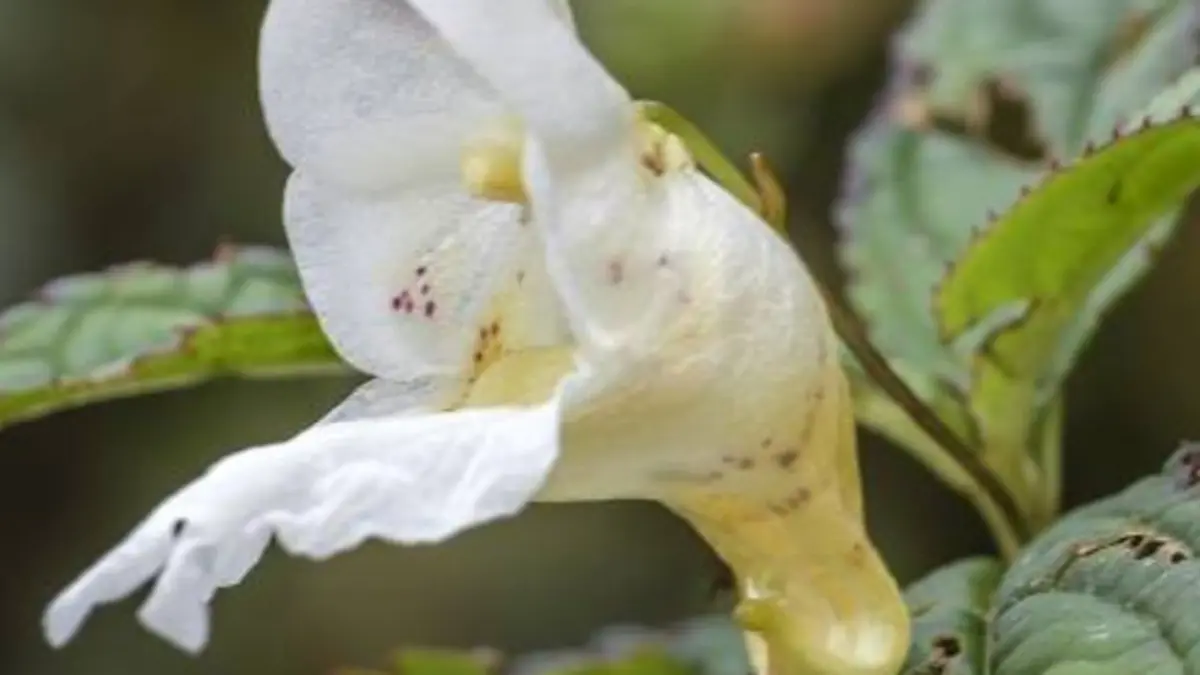
Impatiens nimspurjae belongs to the family Balsaminaceae. It is an annual herb with narrow, mostly stalkless leaves. Its flowers combine yellow and purple colours. A flattened base on the floral spur helps distinguish it. The plant flowers and fruits between July and October, which overlaps with the Himalayan monsoon and early autumn.
The type material came from above Moreni in Myagdi District. The collection site was about 2,800 to 2,900 metres above sea level. Plants grew on moist, humus-rich slopes at forest margins. This is a cool temperate mountain setting with strong seasonal rainfall. The known distribution lies within western Nepal’s complex middle and high mountain terrain.
Nepal stretches along the central Himalaya between India and China. Myagdi lies in Gandaki Province, west of Kathmandu. Deep river valleys rise quickly towards the Dhaulagiri and Annapurna massifs. Such relief creates many local climates and isolated habitats. These conditions can support narrow-range plants, but they can also make those plants vulnerable to local disturbance.
Why endemism matters
An endemic species occurs naturally within a limited geographic area. A small range can reflect long isolation and specialised habitat needs. It also means one road, landslide or land-use change may affect much of the known population. Scientists should not assume extinction risk without a formal assessment. They should still treat limited distribution as a reason for focused surveys.
Himalayan plants face changing temperature, rainfall and snow patterns. Mountain species may shift uphill as conditions warm. Available habitat becomes smaller near high ridges, while valleys and settlements can block movement. Field monitoring should therefore record population size, flowering time and habitat change. Herbarium records can provide an essential historical comparison.
Naming a species after a person
Taxonomists sometimes honour a person through a species name. Such naming does not transfer ownership of the organism. It also does not replace the evidence needed for description. In this case, the authors linked the name to Purja’s achievements and environmental advocacy. The valid spelling is nimspurjae, and consistent spelling matters in scientific databases.
Public interest in an honouree can help unfamiliar biodiversity reach wider audiences. However, the plant’s scientific importance should remain central. Its value comes from being part of Himalayan evolution and ecology. Accurate coverage should identify where it occurs and when it was described. It should not convert later publicity into a false claim of discovery.
Three dates, three different meanings
The specimen was collected in 2011, described in 2022 and highlighted again in 2026. Collection gave researchers the physical evidence. Formal publication established the scientific species. The latest attention introduced that earlier work to a wider audience.
Conclusion
Impatiens nimspurjae shows why plant taxonomy requires time and documentation. A mountain flower becomes a recognised species through evidence, comparison and formal publication. The renewed attention can be useful when it preserves that history. It can also direct interest towards Nepal’s under-recorded plant diversity. Accuracy gives the tribute greater value.
The next need is not another dramatic label. Researchers need repeated surveys across suitable western Himalayan habitats. These surveys can establish range, abundance and threats. Local institutions and communities can then protect important sites without exposing them to harmful collection. A famous name may open the conversation, but long-term botanical work must sustain it.