

Why in news?
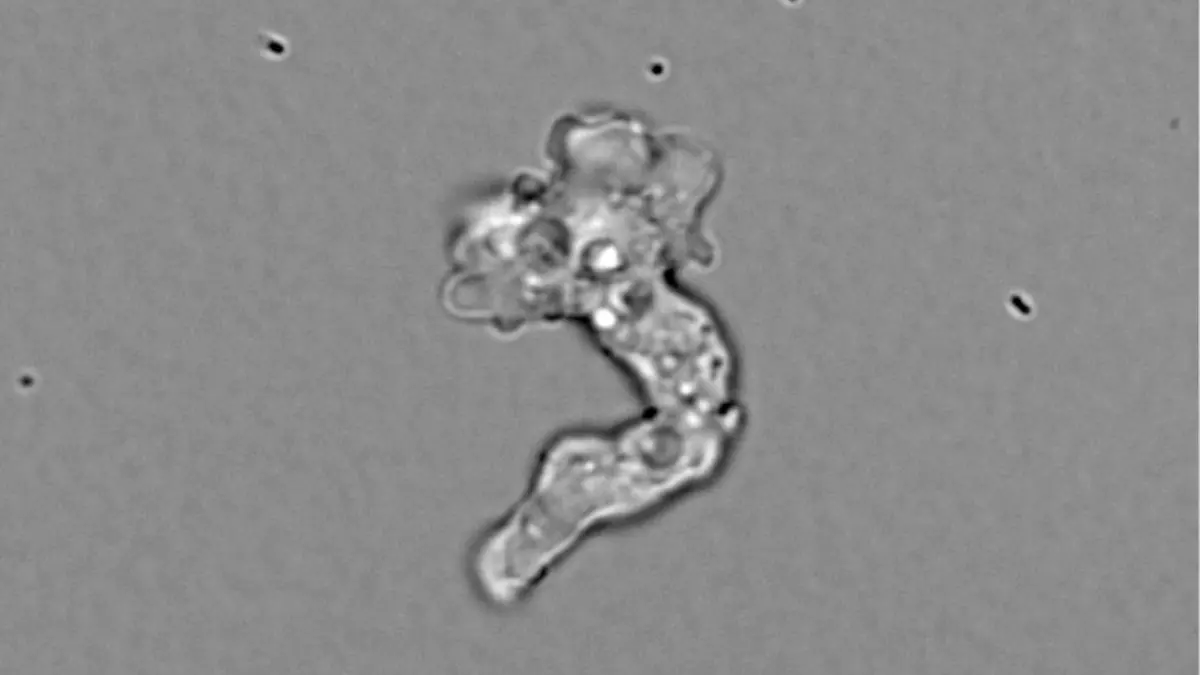
A study published in Cell on 22 September describes an amoeba that divides at 63°C, beyond the previously recognised eukaryotic limit. The organism, Incendiamoeba cascadensis, came from heated waters in California's Lassen Volcanic National Park. Eukaryotes have cells with a nucleus and other internal compartments; they include single-celled organisms as well as plants and animals. Researchers supported by the United States' National Aeronautics and Space Administration (NASA) found that this amoeba remains active under exceptional heat. The result expands what is known about cellular heat tolerance. It does not establish that the organism reproduces at every temperature it briefly survives, or that life exists elsewhere in space.
A volcanic setting with many small environments
Lassen lies in northern California, in the southern part of the Cascade volcanic region of western North America. Its hot-water features are supplied by rain and snowmelt moving underground. Heat from hot or molten rock warms that water before it returns towards the surface. The park contains steam vents, mud pots and hot pools, alongside channels where heated water moves through the landscape.
These environments are not all equally hot or chemically identical. Water can cool as it flows or mixes with other supplies. An organism collected from a geothermal stream therefore occupies a particular set of conditions, not an entire landscape of boiling water. Laboratory measurements are important because they test its capabilities under defined temperatures, rather than inferring them from the site's volcanic appearance.
Why the word “complex” needs explanation
The amoeba is a single-celled organism. Its complexity refers to the organisation within that cell, including a nucleus containing genetic material. Eukaryotic cells also have membrane-bound structures carrying out specialised functions. Bacteria and archaea have a different cellular organisation without a membrane-bound nucleus. Some members of those groups were already known to tolerate temperatures beyond the limits observed in eukaryotes.
The finding consequently concerns a particular category of life. It is not a record for every organism on Earth, nor evidence that a large animal can tolerate similar conditions. The comparison is meaningful because internal membranes and other cellular components were thought to constrain eukaryotic survival. A functioning nucleus-bearing cell at such temperatures provides a new case for studying those constraints.
Four temperatures describe different results
The strongest result concerns reproduction: the amoeba divided at 63°C. NASA's account compares this with an earlier known eukaryotic limit of 60°C in some fungi and red algae. Above the reproductive threshold, other activity persisted. The researchers observed movement at 64°C and partial activity at 66°C. These are distinct observations, not interchangeable definitions of growth.
The organism also recovered after five minutes at 70°C, whereas exposure to 80°C did not produce recovery. Brief survival is different from sustained reproduction. A cell that resumes activity after a short stress has demonstrated resilience, but not an ability to maintain a growing population there. Duration and the measured response are as important as the temperature printed in a headline.
How heat challenges a living cell
Cells depend on proteins with shapes suited to their tasks. Heat can interfere with those shapes and disturb the membranes that separate cellular compartments. Survival therefore requires more than preventing the whole cell from bursting. The organism must preserve enough of its internal organisation to obtain energy, maintain its genetic material and, under suitable conditions, divide.
The team examined the amoeba's genetic material and gene activity at different temperatures. NASA reports signs of mechanisms associated with protecting genetic material and maintaining protein folding. Some proteins also showed high positive surface charge, a feature that may contribute to stability. These results identify promising explanations for investigation; they do not reduce heat tolerance to one fully proven molecular switch.
A finding that changes the search, not just the record
When scientists assume a biological limit is fixed, they may be less likely to sample beyond it. This discovery provides a reason to examine more hot environments for eukaryotes. Comparisons with existing genetic datasets revealed related sequences from geothermal samples elsewhere, including New Zealand and Yellowstone. Such similarities suggest possible relatives, rather than confirming that this exact species occupies every sampled site.
The distinction also matters for naming and distribution. Describing a species from a studied population establishes a documented organism with particular characteristics. Detecting related genetic fragments elsewhere asks a further question about diversity and range. Additional sampling and identification would be needed to connect those records securely. The new work opens that investigation rather than completing a worldwide distribution map.
What this contributes to astrobiology
Astrobiology examines life's origins, conditions and possible distribution in the universe. Organisms from extreme environments help researchers test assumptions about what living systems can endure. Temperature is only one requirement, however. This amoeba also depends on suitable water chemistry, pressure, oxygen and food. A planet with a matching temperature would not automatically provide everything it needs.
The same caution applies to possible technological uses. Heat-stable biological components can be useful research subjects, but the study does not announce a ready industrial product. Before practical use, researchers would need to establish how particular components function and whether they perform reliably outside the organism. The immediate achievement is an expanded biological observation and a new system for studying cellular resilience.
Conclusion
Incendiamoeba cascadensis demonstrates that a nucleus-bearing cell can reproduce at temperatures beyond the previously recognised boundary. Its value lies in the measured distinctions between division, activity and recovery after stress. Those results can guide further sampling and experiments on cellular stability. They broaden scientific expectations without removing the other environmental requirements that make life possible.