

Why in news?
India's Chief Election Commissioner met Kazakhstan's ambassador on 4 August 2026. They discussed cooperation between their election-management institutions. Training and exchanges would operate within India's international democracy initiatives. The meeting also reflected India's 2026 leadership role in International IDEA.
Background
Chief Election Commissioner Gyanesh Kumar met Ambassador Azamat Yeskarayev in New Delhi. Kumar also chairs the Council of Member States during India's current leadership year. Both sides agreed to deepen professional cooperation and training.
The relevant organisation is the International Institute for Democracy and Electoral Assistance, commonly called International IDEA. Fourteen founding members established it at Stockholm in February 1995, and India has remained a member since that year.
Its Council elected India to the rotating chair for 2026 on 3 December 2025. Switzerland held the chair during 2025, while Mauritius and Mexico became vice-chairs. Kumar represents India before the Council's thirty-five member states.
Purpose of the cooperation
Election administrators manage voter registers, polling logistics, staff training and results processes. Exchanges allow officials to compare solutions while respecting different constitutional systems. Useful cooperation does not mean copying one country's law wholesale.
India hosted the International Conference on Democracy and Election Management during January 2026. The Election Commission's India International Institute of Democracy and Election Management organised it with International IDEA. More than one hundred delegates joined from forty-two election-management bodies.
The January conference formed part of wider engagement under India's 2026 chairship. Its training and institutional exchanges include the proposed cooperation with Kazakhstan.
Possible areas include technology, accessible elections, staff development and operational planning. Any technical transfer needs cybersecurity, privacy and independent auditing, because technology cannot replace public trust.
Kazakhstan's geographic setting
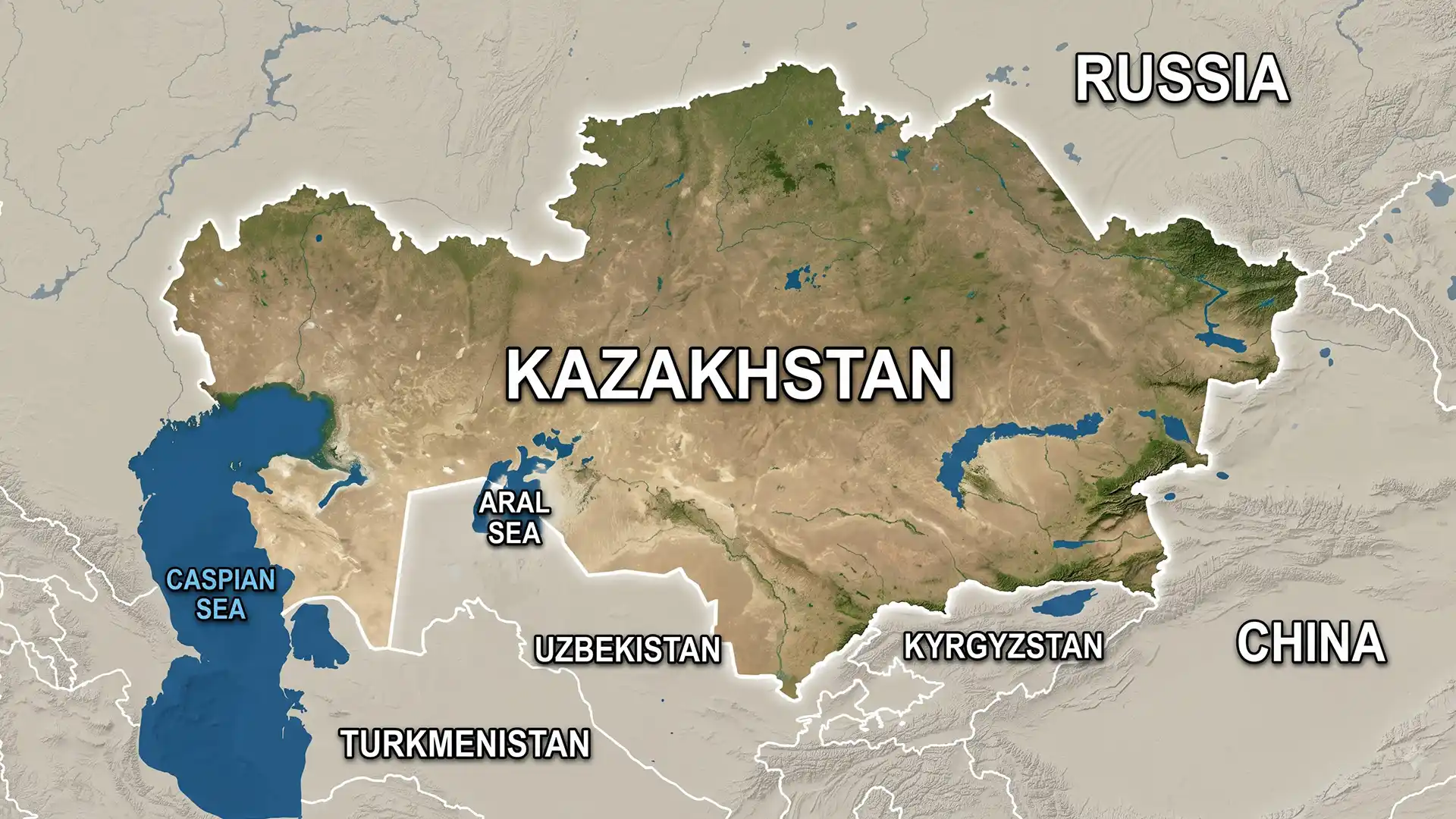
Kazakhstan covers about 2.72 million square kilometres across Central Asia. A small western portion lies beyond the conventional Europe–Asia boundary, making the country transcontinental under that convention.
It borders Russia, China, Kyrgyzstan, Uzbekistan and Turkmenistan, while the Caspian Sea forms part of its western edge. However, that enclosed waterbody provides no navigable connection to the open ocean.
Kazakhstan is consequently the world's largest landlocked country by area and the ninth-largest country overall. These rankings concern land area, not population or economic size.
The landscape includes steppe, semi-desert, desert and high mountains. The Tien Shan rises in the southeast, while the Altai lies towards the east. Severe continental conditions produce hot summers and very cold winters.
Political and economic development
Kazakhstan became independent during December 1991 after the Soviet Union dissolved, with Almaty serving as its early capital. The government transferred the capital northwards to Akmola during 1997.
Akmola became Astana in 1998, Nur-Sultan in 2019 and Astana again during 2022. Almaty remains the largest city and a major commercial centre, while the tenge is the national currency.
Large oil, gas and uranium resources shape Kazakhstan's economy and foreign relations. Its location also connects Chinese, Russian, European and Central Asian transport routes. Diversification remains important because commodity prices can change sharply.
Why institutional engagement matters
Election cooperation can improve professional skills and emergency planning across different environments. Kazakhstan's enormous territory creates logistical challenges for reaching remote voters. India likewise manages elections across great geographic and linguistic diversity.
Credible cooperation must remain transparent and institution-led, with training programmes disclosing objectives, participants and safeguards. Democratic legitimacy ultimately depends upon domestic law, equal participation and effective remedies.
The August meeting was an agreement to deepen cooperation, not a treaty creating shared election rules. It transferred no electoral authority, but created a framework for continued professional engagement.
Conclusion
The India–Kazakhstan meeting combined bilateral training with India's International IDEA chairship. Its value will depend upon practical exchanges, transparent safeguards and respect for constitutional differences.