

Why in news?
India and Lesotho held their sixth Joint Bilateral Commission for Cooperation in New Delhi. Officials reviewed the full range of bilateral relations. They considered deeper cooperation across development and capacity-building fields. The meeting continued an institutional dialogue first convened during 2009.
Background
India and Lesotho maintain diplomatic relations through India's High Commission in Pretoria. That mission is concurrently accredited to Lesotho; Lesotho maintains its own High Commission in New Delhi.
The first Joint Bilateral Commission for Cooperation met in New Delhi during March 2009. Its fourth session occurred in Lesotho on 1 October 2019; the fifth session met in Maseru on 2 August 2023.
The sixth meeting returned the dialogue to New Delhi on 30 July 2026. Such commissions review existing commitments and identify new work; their discussions do not automatically create treaties or funded projects.
India's mission announced Biju Abraham Korah as honorary consul on 22 May 2026. The role supports commercial, cultural and consular links without replacing the accredited High Commission.
Recent cooperation
A December 2020 agreement removed visas for diplomatic and official passport holders. It did not create visa-free travel for every citizen; ordinary travellers still follow applicable entry rules.
The two governments signed a digital public solutions memorandum on 21 July 2025; it covers sharing successful population-scale digital approaches. Implementation must still reflect Lesotho's laws, infrastructure and data safeguards.
India donated 1,000 tonnes each of rice and sorghum during April 2025. The assistance responded to food shortages and climatic pressures; earlier cooperation included agricultural equipment and vocational training credit lines.
India offered seventy Indian Technical and Economic Cooperation training places during 2025–26. Fifty-one were used, according to the Indian mission. Cultural scholarship places have also increased from thirty-five to forty.
Trade and people-to-people links
Bilateral merchandise trade remains modest; India's 2024–25 exports were worth 10.30 million United States dollars. Imports were worth 0.98 million United States dollars during that year.
Indian exports included pharmaceuticals, machinery, rubber and plastics. Imports included metals, seeds, fruits and grains. Annual values should be read with their stated financial year.
About 4,000 Indian expatriates and persons of Indian origin live in Lesotho. Many work in teaching, accounting, business and other professions; their presence supports education and commercial links.
Defence engagement previously included an Indian Army training team from 2001 until 2017. Lesotho personnel continue receiving places at Indian training institutions. Capacity building is broader than equipment sales or military alliances.
Geography of the mountain kingdom
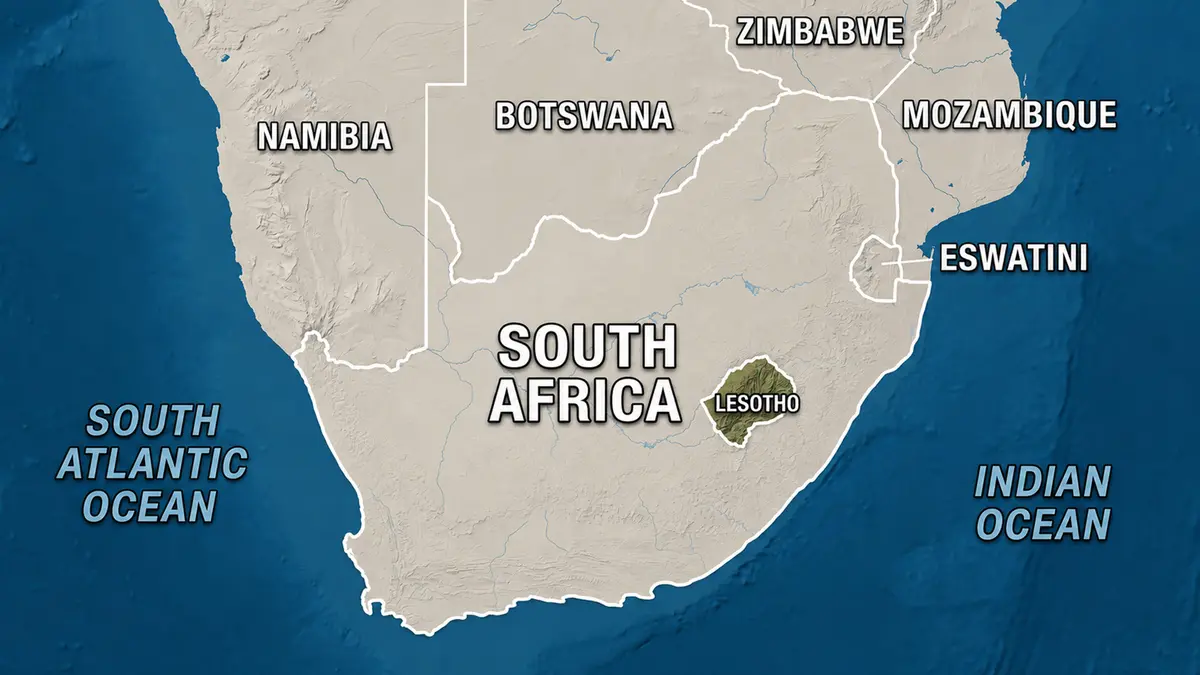
Lesotho is a landlocked constitutional monarchy completely surrounded by South Africa. Maseru is its capital and largest urban centre; the country covers about 30,355 square kilometres.
Its lowest terrain is roughly 1,400 metres above sea level. Lesotho is the only independent state entirely above 1,000 metres. Saying every point lies above 1,400 metres would overstate a rounded minimum.
Thabana Ntlenyana reaches 3,482 metres and forms the national high point. The Maloti and Drakensberg ranges dominate the east; snow can occur during cold highland winters.
The Senqu River rises within these highlands and becomes South Africa's Orange River. Mountain catchments make water a strategic resource; they also expose communities to erosion, drought and changing snowfall.
Water, energy and regional dependence
The 1986 Lesotho–South Africa treaty created the Lesotho Highlands Water Project. Its dams and tunnels transfer water towards South Africa's Gauteng region; the system also generates hydroelectricity for Lesotho.
Phase I was completed during 2003 and inaugurated during 2004. Phase II now includes Polihali Dam and a transfer tunnel; construction brings revenue and infrastructure but also displacement risks.
The project authority must compensate affected households and restore livelihoods. Environmental planning covers river flows, biodiversity and cultural sites; large engineering benefits therefore require continuing social safeguards.
Lesotho participates in the Southern African Customs Union and Common Monetary Area. Its loti is fixed one-to-one with the South African rand. Regional integration supports trade while deepening exposure to South African conditions.
Why the relationship matters
For Lesotho, India offers training, medicines and appropriate digital experience. For India, the partnership strengthens long-term African engagement; small states also hold equal sovereign votes within many international institutions.
Future cooperation could focus on health, agriculture, education and climate-resilient water management; projects need local ownership and maintainable technology. Meeting communiqués should be followed by transparent implementation schedules.
Conclusion
The sixth commission reinforces a steady, development-centred India–Lesotho relationship. Its significance will depend upon completed projects rather than the meeting alone.