
Why in news?
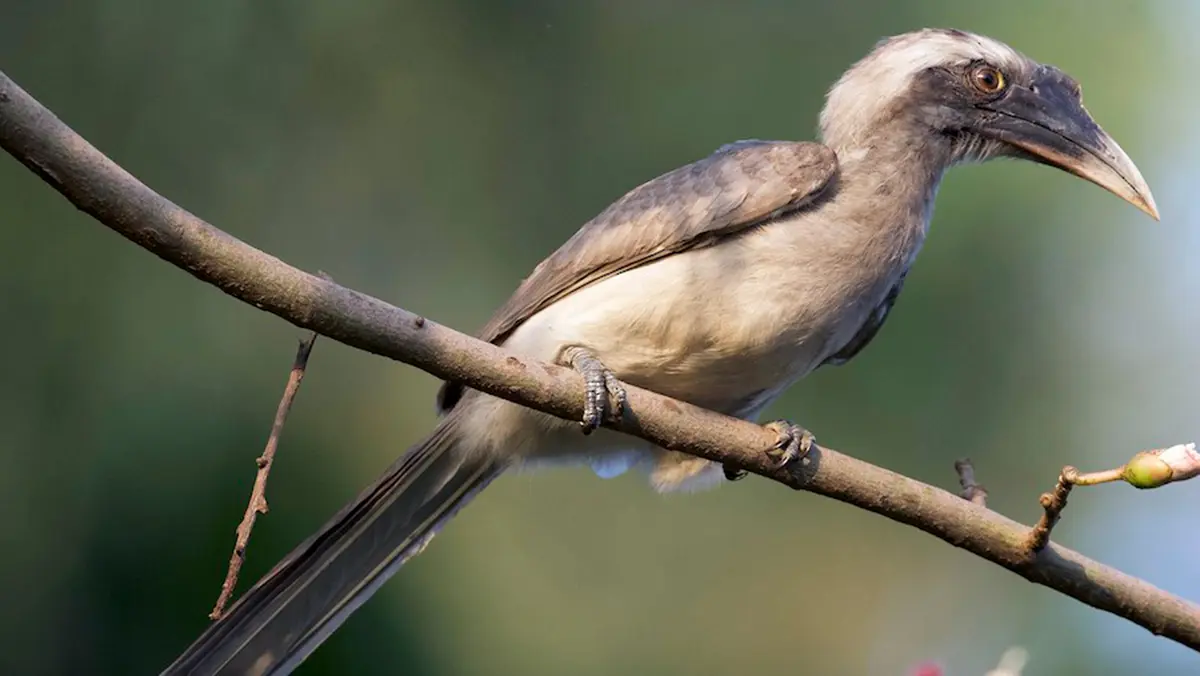
Reintroduced Indian Grey Hornbills bred in Gir for a fourth consecutive year. The bird had disappeared locally more than sixty years earlier. Forty birds were moved into the landscape from 2021 onwards. Repeated breeding suggests promising early establishment.
Background
The Indian Grey Hornbill is scientifically called Ocyceros birostris, and it occurs naturally across much of the Indian subcontinent.
Its range includes India, Pakistan and Nepal, and the peer-reviewed Gir study describes it as Gujarat’s only native hornbill species.
The bird has grey-brown feathers, a long tail and a curved bill. A raised structure above the bill is called a casque.
Males usually have a larger casque and darker bill markings. Females have a smaller casque and more yellow on the bill.
The species is globally listed as Least Concern. This status does not prevent local extinction after habitat loss or hunting.
Prelims fact: The Indian Grey Hornbill is a cavity-nesting fruit eater, and its scientific name is Ocyceros birostris.
How does a hornbill nest?
The species uses a natural cavity inside a mature tree, and it normally cannot excavate a new cavity by itself.
The female enters a suitable hole and seals most of the opening, and a narrow slit remains for receiving food.
The male brings fruits and small animals to the female, and he later feeds the growing chicks through the slit.
This unusual system protects the nest from many predators, and it also makes the family dependent upon one feeding male.
Large old trees are therefore essential for breeding, and young plantations may provide food but lack suitable nesting cavities.
Why are hornbills called forest farmers?
Indian Grey Hornbills mainly eat fruits, and figs form an important part of their diet.
They swallow many fruits and later release viable seeds elsewhere, and this movement helps plants colonise forest gaps.
A mobile bird can carry seeds beyond the parent tree, and such dispersal supports forest renewal and genetic exchange.
The birds also eat insects and other small animals, and parents provide protein-rich prey to growing chicks.
How did the bird disappear from Gir?
- A confirmed direct sighting occurred in the Gir landscape during 1936.
- The last reported local sighting came from around 1950.
- The population disappeared during the following decades.
- Hunting was probably important, but the exact cause remains uncertain.
- Gir Wildlife Sanctuary was established in 1965.
- Gir National Park received protection in 1975.
- An earlier release attempt occurred during the 1970s.
- The present scientific reintroduction began in 2021.
Local extinction means disappearance from one area, and global extinction means no living individual remains anywhere.
The Indian Grey Hornbill survived elsewhere in Gujarat and India, and this surviving population made reintroduction possible.
What is a reintroduction?
A translocation deliberately moves living organisms from one place to another, and it can serve conservation or other management goals.
A reintroduction is a special conservation translocation, and it returns a species to part of its historical natural range.
The receiving habitat must still provide food, shelter and breeding sites. The original causes of disappearance should also be controlled.
Do not confuse: Every reintroduction is a conservation translocation, but not every translocation returns a species to historical range.
How was the Gir programme conducted?
Wildlife teams moved birds from the Aravalli forests of Gujarat, and the source area lies roughly 380 kilometres from Gir.
Teams released twenty-eight birds during 2021–22, and they released another twelve birds during 2023.
The total group contained forty birds, and it included twenty-one males and nineteen females.
Eleven males carried satellite or cellular tracking devices, and five were tagged first, and six joined the later tracked group.
Tracking allowed researchers to study movement and habitat use, and it also helped staff locate nesting pairs and surviving birds.
What did tracking reveal?
Birds initially explored a large landscape, and their average recorded home range was roughly sixty-one square kilometres.
After settling, the average fell to about 5.7 square kilometres. This contraction suggests that birds found dependable local resources.
Dry mixed deciduous forest and teak woodland received strong use, and birds also visited orchards, water bodies and settlements.
Use outside protected areas creates opportunities and risks, and orchards offer food, but roads and electric lines can cause deaths.
What did the breeding records show?
One pair bred during the first monitored breeding year, and three pairs bred during the following year.
The July 2026 report recorded breeding for a fourth consecutive year, and repeated nesting is stronger evidence than survival alone.
The peer-reviewed study was published on 24 October 2025, and it analysed the programme’s earlier tracking and breeding results.
The 2026 news report adds the next breeding season, and the paper itself was not published during July 2026.
Date correction: The scientific paper appeared in October 2025, and the July 2026 update reports continued breeding afterward.
Which trees were important?
Hornbills selected tall trees with large trunks for nesting, and such trees are more likely to contain safe natural cavities.
Sterculia urens and Terminalia bellirica were important nest-tree species, and local protection should retain these mature trees.
Adults fed chicks with banyan and peepal fruits, and Karamda, dhraman and several invertebrates also appeared in their food.
Protecting only one nest tree is insufficient, and breeding birds also need nearby fruiting trees and safe movement routes.
Does repeated breeding prove complete success?
No, because four breeding seasons provide only encouraging early evidence. A self-sustaining population requires survival and reproduction across many years.
Researchers must track chicks after they leave nests, and they must also measure adult survival and genetic diversity.
A population depending permanently upon new releases is not yet self-sustaining. Extreme weather or disease can threaten a small founding group.
What should long-term management include?
- Mature cavity-bearing trees should receive strict protection.
- Native fruiting trees should connect feeding areas.
- Released birds and wild-born chicks need continued monitoring.
- Unsafe power lines should receive bird-friendly treatment.
- Communities should help report nests and prevent hunting.
- Future releases should preserve adequate genetic diversity.
- Success measures should extend beyond annual nest counts.
Conclusion
Four breeding years mark an important recovery step in Gir. Long-term habitat protection must now convert establishment into a self-sustaining population.