
Why in News?
During his official visit to the Netherlands on 17 May 2026, the Prime Minister of India and his Dutch counterpart elevated bilateral ties to a Strategic Partnership and adopted the “Roadmap of India–Netherlands Strategic Partnership 2026–2030.” The roadmap outlines cooperation across sectors such as trade, water management, semiconductors, energy transition, defence and cultural exchanges.
Geographical Overview of the Netherlands
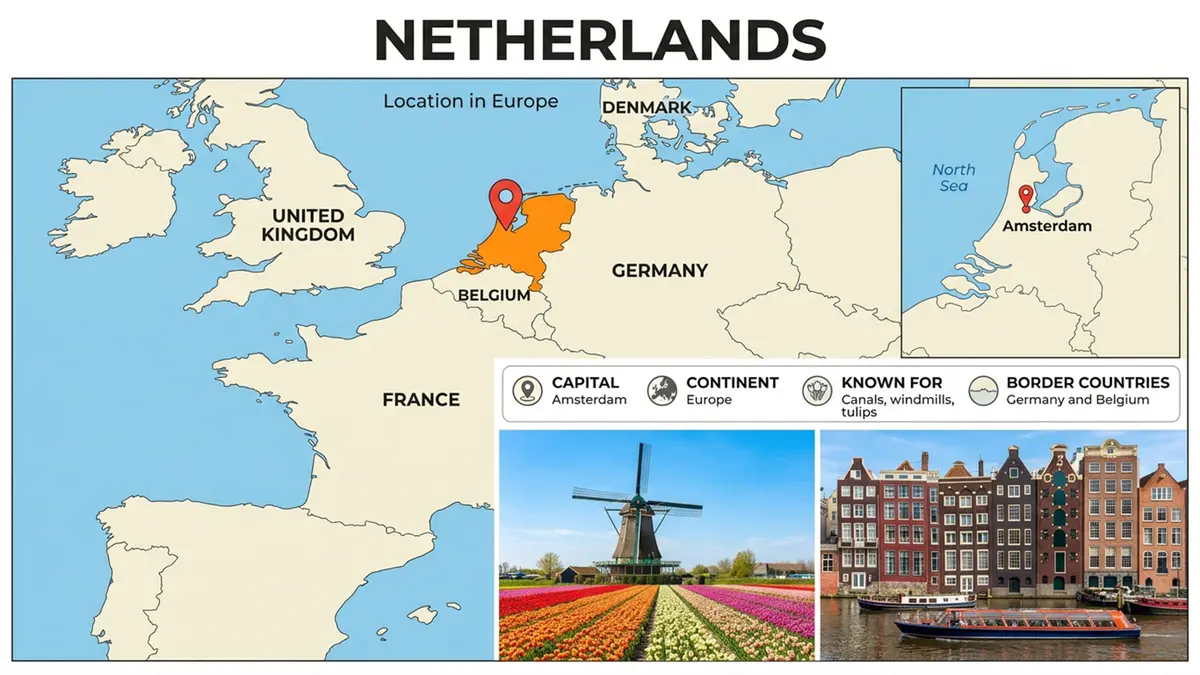
The Netherlands is a north‑western European country bordered by Germany to the east, Belgium to the south and the North Sea to the north and west. Amsterdam is the constitutional capital, while The Hague hosts the government and the International Court of Justice. The country has a temperate maritime climate with gentle winters, cool summers and rainfall spread throughout the year. Low‑lying polders reclaimed from the sea characterise much of the landscape, and an intricate system of dikes, pumps and dunes prevents flooding.
- Geographic regions – According to the World Atlas, the Netherlands comprises three main regions:
- The Lowlands – Flat lands at or below sea level covering most of the country. Extensive dikes and polders protect this area from the North Sea.
- The Veluwe and Utrecht Hill Ridge – Low forested hills in central Netherlands formed by glacial moraines. These ridges are home to heathlands, sand dunes and national parks.
- The Limburg Hills – Rolling hills in the southern province of Limburg. Here lies the Vaalserberg, the highest point in mainland Netherlands at about 322 metres (1,058 ft).
- Water bodies and rivers – The IJsselmeer, a large freshwater lake created after damming the Zuiderzee, serves as a freshwater reservoir. Major rivers include the Rhine, Meuse (Maas) and Scheldt, which branch into numerous channels, forming fertile deltas and facilitating transport.
- Natural resources – The country has significant natural gas reserves, particularly the Groningen gas field, which has historically been one of Europe’s largest. Other minerals include rock salt and small quantities of zinc and magnesium. However, agriculture, services and high‑technology industries drive the modern Dutch economy.
Key Pillars of the Strategic Partnership
1. Political Dialogue & Institutional Mechanisms
- Establish an annual Foreign Ministers’ mechanism to monitor the roadmap’s progress and provide strategic guidance.
- Maintain regular high‑level interactions between heads of government, ministers and senior officials both bilaterally and at multilateral forums.
2. Economic Cooperation and Value‑Chain Resilience
- Leverage the Joint Trade and Investment Committee to expand market access in electronics, telecommunications, infrastructure, pharmaceuticals and metallurgy.
- Review and strengthen the bilateral Fast‑Track Mechanism to resolve investment barriers.
- Launch a critical raw materials partnership to collaborate on exploration, research, sustainable mining practices and supply‑chain diversification.
- Encourage two‑way investments and public‑private partnerships, particularly involving small and medium enterprises.
3. Water, Agriculture and Health
- Renew the Strategic Partnership on Water (signed in 2022) until at least March 2027, focusing on integrated water resources management, flood resilience, coastal zone management and water quality improvement in the Ganga basin. Urban river management plans will use the Dutch “Water as Leverage” approach.
- Collaborate under the Coalition for Disaster‑Resilient Infrastructure to develop climate‑resilient urban water frameworks.
- Strengthen agricultural cooperation by upgrading the Joint Agriculture Working Group and establishing Clean Plant Centres to support sustainable farming.
- Enhance public health cooperation through joint research on cross‑border infectious diseases, antimicrobial resistance and digital health between the Dutch National Institute for Public Health and Environment (RIVM) and India’s ICMR.
4. Emerging Technologies and Education
- Develop a bilateral “Brain Bridge” programme linking India’s Semiconductor Mission and the Netherlands’ Semicon Competence Centre for research, innovation and skills development in semiconductor technologies.
- Sign a memorandum of understanding on higher education and encourage institutional linkages between universities and research institutes.
5. Energy Transition and Maritime Development
- Create a green and digital sea corridor to facilitate sustainable shipping and support India’s green hydrogen exports to Europe.
- Cooperate under global platforms such as the International Solar Alliance, Global Biofuels Alliance and Integrated Biorefineries Mission.
6. Defence and Security Cooperation
- Establish structured tri‑services interactions between the defence ministries to coordinate military cooperation.
- Promote institutional collaboration between the Society of Indian Defence Manufacturers and the Netherlands Industry for Defence and Security for co‑development of platforms and equipment.
- Explore a Mutual Logistics Support Agreement and expand Dutch participation in the Indo‑Pacific Oceans Initiative and the Information Fusion Centre–Indian Ocean Region.
- Deepen cooperation on cyber security, counter‑terrorism and legal assistance, including negotiation of extradition and mutual legal assistance treaties.
7. Culture, Mobility and Heritage
- Implement the Memorandum on Migration and Mobility to encourage legal pathways for students and skilled professionals while combating irregular migration.
- Celebrate cultural cooperation through exhibitions, reciprocal loans of artworks, and joint development of the National Maritime Heritage Complex at Lothal.
- Welcome the restitution of the 24 Chola‑era Leiden copper plates (Anaimangalam plates), taken to the Netherlands in the 18th century. These bronze‑bound plates record the grant of a south‑Indian village to a Buddhist vihara and are of great historical significance.
Conclusion
The India–Netherlands Roadmap 2026–2030 reflects the maturation of a long‑standing friendship. By aligning political, economic, environmental and cultural cooperation, both countries aim to build resilient supply chains, manage water sustainably, harness emerging technologies and strengthen security ties. The roadmap also underscores a shared commitment to open, inclusive and rules‑based international order. Success will depend on diligent implementation and sensitivity to each country’s domestic priorities.

