
Why in news?
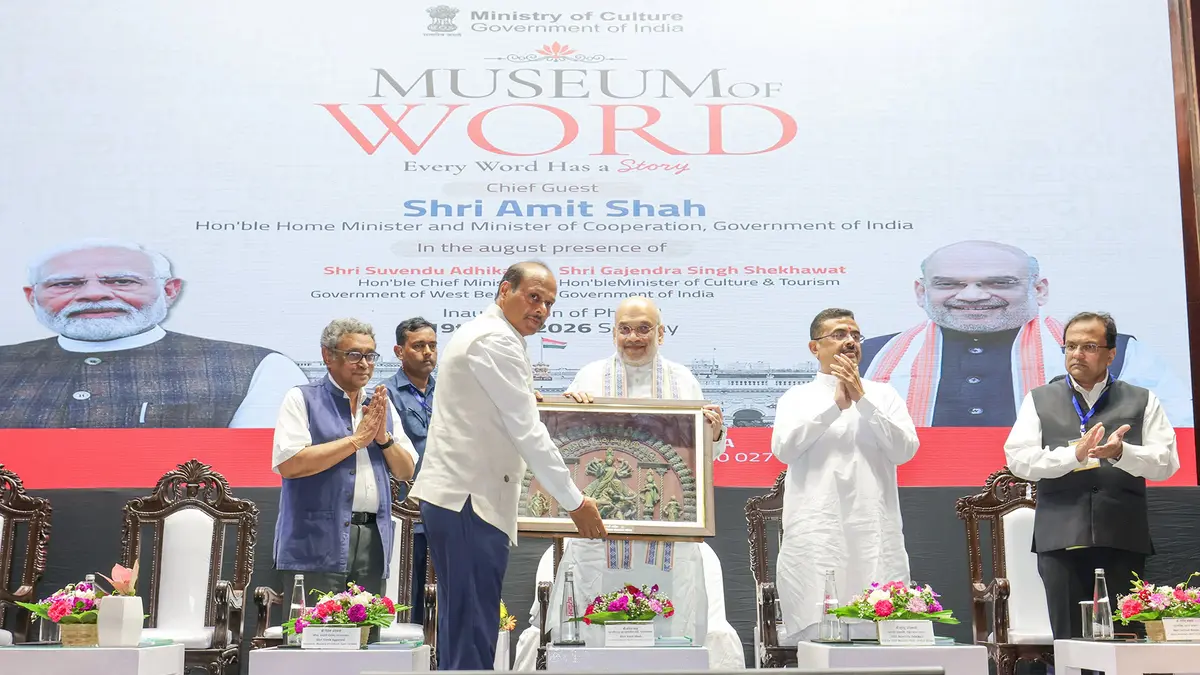
Union Home Minister Amit Shah inaugurated Shabdalok in Kolkata on 19 July 2026. India’s first immersive language museum opened its initial phase inside the National Library. Interactive technology presents India’s words, scripts, sounds and storytelling traditions.
Background
India’s National Library grew through several important historical stages.
The Calcutta Public Library began on 21 March 1836 and served readers through membership and public support.
It merged with the Imperial Library in 1902, and the reorganised institution opened publicly in January 1903.
Maulana Abul Kalam Azad, India’s first Education Minister, opened the renamed Library on 1 February 1953.
The Library functions under the Union Culture Ministry and is India’s largest repository of published material.
The Delivery of Books and Newspapers (Public Libraries) Act, 1954 requires publishers to supply copies to designated libraries.
What is Shabdalok?
Shabdalok means a realm of words, and its first-phase museum covers about 2,282 square metres.
This first phase reportedly cost ₹14 crore within the project’s planned ₹41-crore outlay.
Nine galleries present India’s language story, beginning with mother tongues and the human need to communicate.
Later displays cover scripts and arts while showing how languages change and travel between communities.
Future phases will add ground-floor spaces and other visitor facilities.
Why is it called an immersive museum?
Unlike conventional glass displays, an immersive museum involves sight, sound, touch and visitor movement.
Shabdalok uses projections, directional sound and gesture-based interactions.
Radio-Frequency Identification tags can trigger content, including pronunciations, stories, poems and regional speech patterns.
Interactive maps connect languages with locations and speakers, helping first-time visitors understand difficult ideas.
The National Council of Science Museums provided its experience in building interactive learning spaces.
What is India’s constitutional language position?
India is highly diverse, and the Constitution’s Eighth Schedule presently recognises 22 Scheduled Languages.
Important correction: The Constitution does not collectively call these 22 languages India’s official languages. Hindi in Devanagari is the Union’s official language under Article 343. English continues for Union work under Parliamentary law. India has no constitutionally declared single national language.
States may adopt languages for official purposes, so language arrangements differ across India.
The Eighth Schedule initially contained fourteen languages in 1950.
Sindhi entered in 1967, followed by Konkani, Manipuri and Nepali through a 1992 amendment.
The 2003 amendment added Bodo, Dogri, Maithili and Santhali, taking effect during January 2004.
Does Scheduled status cover every mother tongue?
Scheduled status supports national representation, examinations and language-development work conducted by Union authorities.
It does not prevent governments from supporting languages outside the Eighth Schedule.
India’s Census records mother tongues, which are far more numerous than Scheduled Languages.
A language museum can show relationships without ranking one community’s speech above another.
Digital recordings preserve oral knowledge that printed spelling alone cannot represent completely.
Why does a language museum matter?
- Language carries collective memory, ecological knowledge and social customs.
- Oral traditions preserve knowledge even without a written script.
- Changing livelihoods can weaken language transmission between younger and older generations.
- Recordings preserve voices, pronunciations and performances for future study.
- Translation helps different language communities understand one another.
- An interactive museum can make linguistic diversity interesting to young visitors.
A museum cannot preserve language alone; survival needs continued use by families, schools, writers and communities.
Visitor information at inauguration
The announced hours were 10:00 to 18:00, with the museum closed on Mondays.
Entry was free until 15 August 2026, but operational details can later change.
Conclusion
Shabdalok turns India’s linguistic diversity into an accessible public learning experience.