
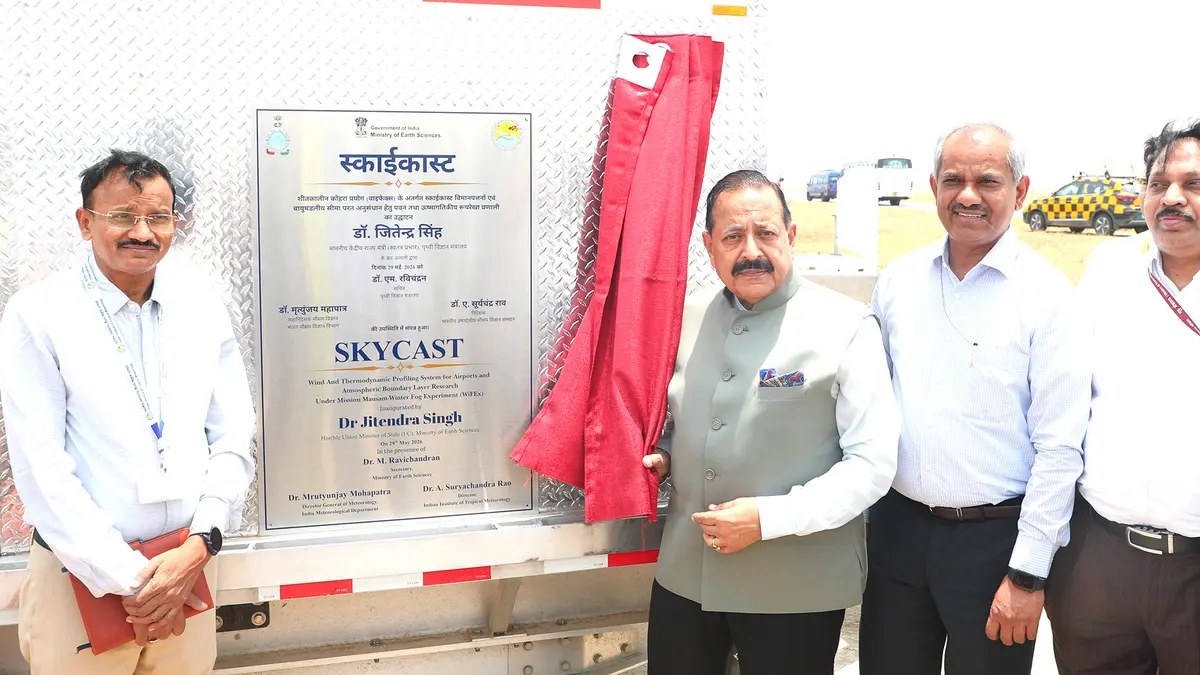
Why in news?
On 29 May 2026 Union Minister Dr Jitendra Singh inaugurated the country’s first SkyCast system at Indira Gandhi International Airport, New Delhi. The integrated weather‑monitoring facility aims to give real‑time information on fog, turbulence and other atmospheric conditions to pilots and air traffic managers. Only 18 such systems exist worldwide; India became the 19th and plans to install similar facilities at Jewar and other airports.
Background
Aviation safety relies on accurate and timely weather data, especially in fog‑prone cities like Delhi. The SkyCast system was developed under “Mission Mausam” by the Ministry of Earth Sciences and builds upon knowledge gained from the Winter Fog Experiment (WiFEX) conducted at IGI Airport since 2015. WiFEX analysed fog formation, aerosol‑cloud interactions and visibility reduction. Lessons from that programme informed the design of SkyCast, enabling continuous monitoring of the boundary layer and fog at airports.
How it works
- Integrated sensors: SkyCast combines several instruments including a boundary‑layer Radar Wind Profiler, a SODAR, a microwave radiometer, a ground‑based fog aerosol spectrometer and a Lidar‑based ceilometer. These instruments measure wind speed, direction, turbulence, humidity, temperature and aerosol properties up to approximately 3 km above the airport.
- Fog and turbulence monitoring: The system continuously analyses fog droplets, aerosols and vertical structure to provide alerts about fog formation and dissipation. It supplies pilots with short‑term forecasts (about three hours) to decide safe landing times and reduce diversions and delays.
- Real‑time data integration: Measurements of wind, turbulence and moisture are integrated into a single platform that supports nowcasting for aviation. Data will also feed into broader weather models, improving forecasts for cities and disaster management.
- Expansion plans: After Delhi, a SkyCast facility is being built at Jewar Airport. The ministry plans to extend the technology to other airports and integrate aircraft‑based observations, making India’s aviation sector more resilient.
Significance
SkyCast marks a major step towards fog‑free and turbulence‑aware flights. Passengers can expect fewer delays during winter, while airlines and pilots will benefit from early warnings and improved decision support. The system also contributes to better urban weather forecasting and supports India’s ambition to democratise weather services for citizens.
Conclusion
By integrating advanced remote‑sensing technologies, SkyCast enhances aviation safety and reliability. Its expansion across airports will strengthen India’s weather infrastructure, support air travel growth and help researchers understand atmospheric processes around major cities.