

Why in news?
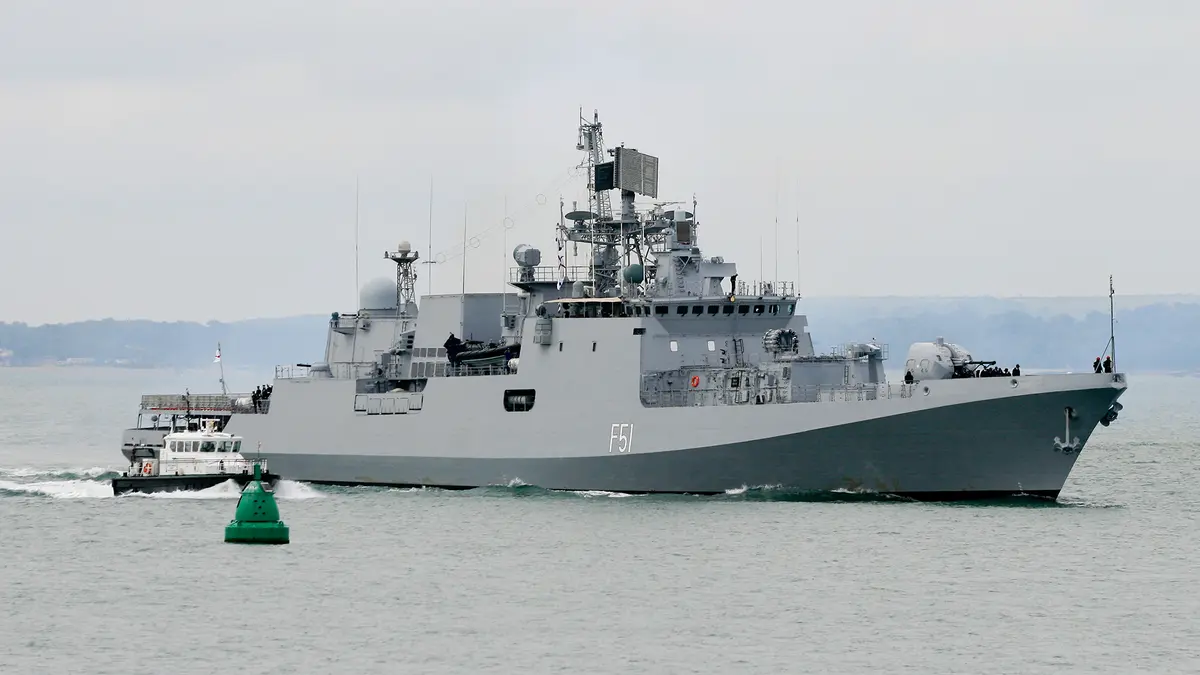
The Indian Navy’s frigate INS Trikand recently took part in a multinational maritime exercise in the Arabian Sea. Its deployment showcased India’s growing blue‑water capabilities and renewed interest in the design and features of this powerful warship.
Background
INS Trikand is the third of three follow‑on Talwar‑class frigates built by the Yantar Shipyard in Russia. The ship was commissioned into the Indian Navy on 29 June 2013. These frigates are derived from Russia’s Krivak III class but are customised for Indian requirements. Designed for stealth and multi‑role operations, they form part of the Western Fleet based in Mumbai.
Key features
- Weapons suite: INS Trikand carries eight BrahMos supersonic cruise missiles for surface targets, a medium‑range 3S 90M Shtil surface‑to‑air missile system, an A190 100 mm naval gun, two AK‑630 30 mm close‑in weapon systems and anti‑submarine torpedoes and rocket launchers.
- Sensors and combat system: Its radar and sonar suite is integrated through the Russian Trebovanie‑M combat management system. This allows the ship to track and engage multiple threats simultaneously.
- Stealth design: The frigate’s hull and superstructure are shaped to reduce radar, magnetic and acoustic signatures, making it harder to detect and target.
- Propulsion and range: Four gas‑turbine engines give the ship a top speed exceeding 30 knots. It has a range of around 4,000 nautical miles at economical speed and can stay at sea for weeks.
- Helicopter capability: Trikand carries a Kamov Ka‑31 airborne early warning helicopter for long‑range surveillance.
Importance
- Sea denial and deterrence: The combination of anti‑ship, anti‑air and anti‑submarine weapons makes INS Trikand capable of neutralising diverse threats, protecting sea lanes and deterring adversaries.
- International cooperation: The ship regularly participates in joint exercises with foreign navies, enhancing interoperability and diplomacy.
- Technology transfer: Integration of Indian weapons like BrahMos on a Russian platform demonstrates indigenous capability and collaborative development.
Conclusion
INS Trikand represents the Indian Navy’s transition to modern, networked surface combatants. Its weapons, sensors and stealth features provide a potent mix for defensive and offensive missions. Continued joint exercises and upgrades will keep the ship relevant in a rapidly changing maritime environment.