
Why in news?
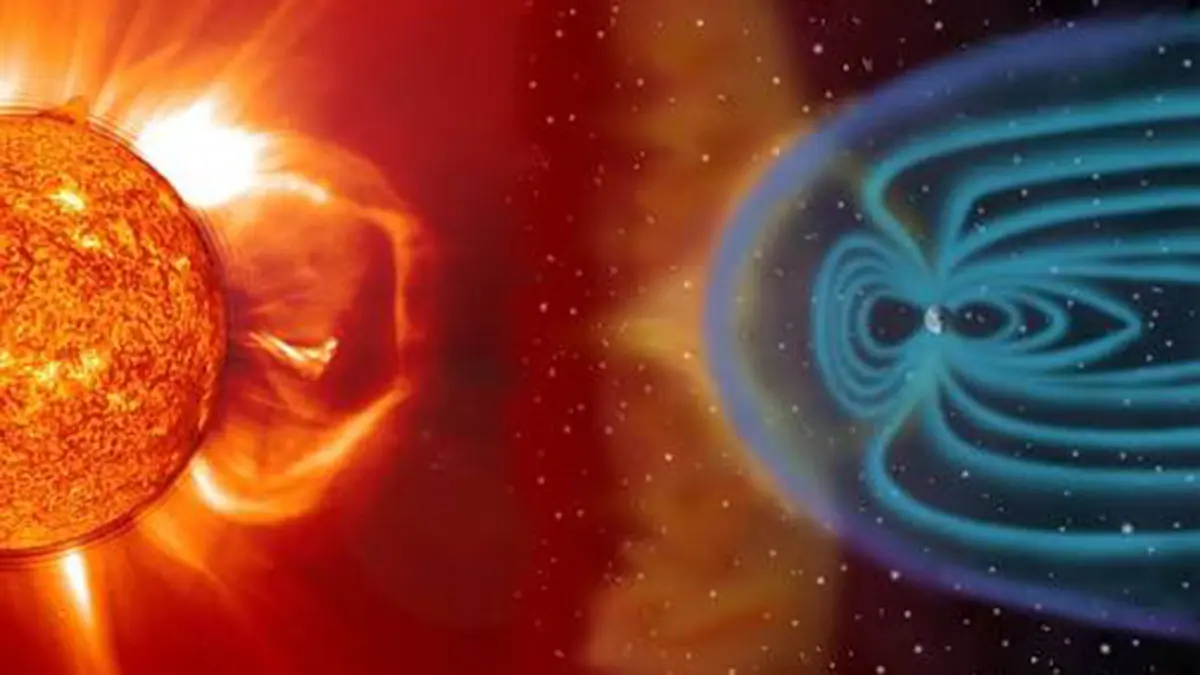
Indian astrophysicists have published new insights into the thermal evolution of interplanetary coronal mass ejections (ICMEs). The research studies the heating and cooling of plasma in these solar eruptions and links their temperature profiles to geomagnetic storms on Earth. Understanding ICMEs helps predict space weather and protect satellites and power grids.
Background
A coronal mass ejection (CME) is a large eruption of charged plasma and magnetic field lines from the Sun’s corona. When such a structure travels through interplanetary space it is called an interplanetary coronal mass ejection. ICMEs can drive shocks and compressed regions ahead of them. If the magnetic field inside an ICME points southward, it can reconnect with Earth’s field and produce geomagnetic storms. The Sun goes through an 11‑year activity cycle, and CMEs are more frequent during solar maxima.
Scientific findings
- Thermal states: The study found that about 45 percent of magnetic ejecta (the core of an ICME) show heating. These heated ejecta are more common during periods of high solar activity and are linked to strong geomagnetic storms.
- Cooling ejecta: The remaining ejecta exhibit cooling or constant temperature profiles with a roughly constant polytropic index across solar cycles.
- Space weather impact: Understanding whether an ICME is heated or cooled helps anticipate the intensity of storms. Accurate forecasts give power grid operators and satellite controllers time to take protective measures.
Conclusion
ICMEs are the main drivers of severe space weather events. By studying their thermal evolution, scientists can refine models of solar eruptions and improve early warnings. Continued research on the Sun–Earth connection is essential as society becomes more dependent on satellites and electronic infrastructure.