

Why in news?
Japan is preparing to conduct a month‑long test to extract rare‑earth‑rich mud from the deep seabed near Minamitorishima Island. The trial, scheduled from 11 January to 14 February 2026, will be the world’s first attempt to continuously lift such mud from around 6,000 m depth to a surface vessel. The project aims to develop a domestic source of rare‑earth elements critical for high‑tech industries.
Background: Minamitorishima Island
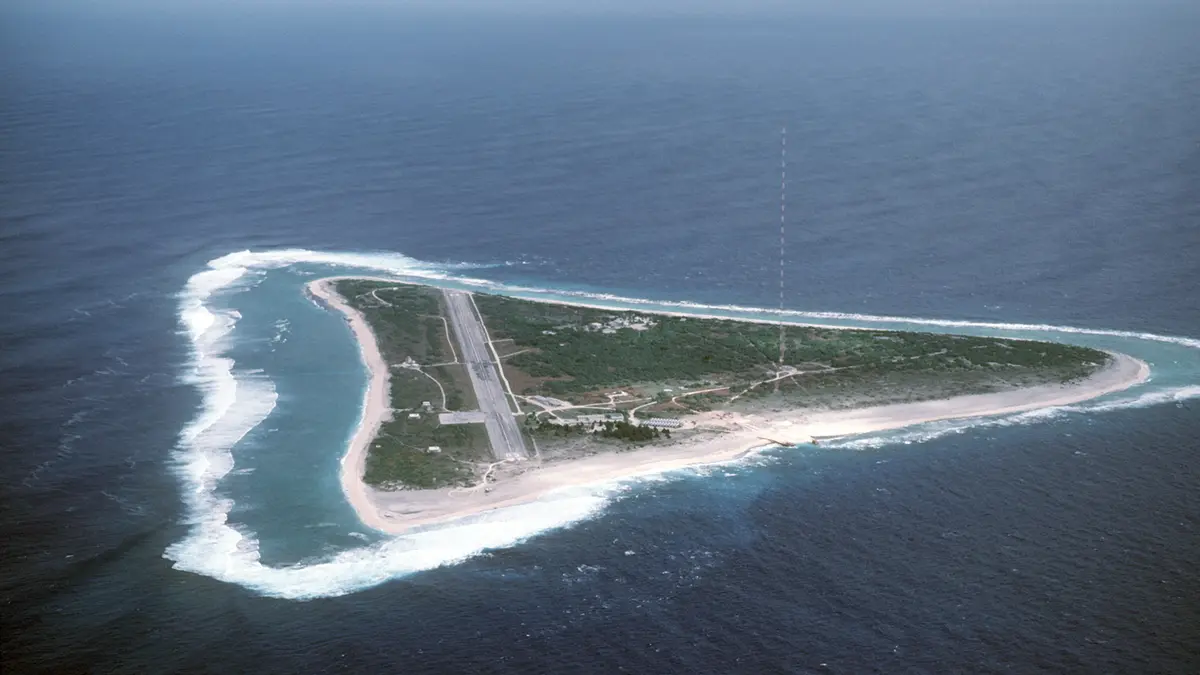
Minamitorishima, also known as Marcus Island, is a remote coral atoll at the easternmost edge of Japan. It lies at 24°17′ N, 153°59′ E, about 1,950 km southeast of Tokyo. Shaped like a rough triangle and covering just 1.5 km2, it sits atop the Marcus–Necker ridge on the Pacific Plate. The island is a raised coral reef with a flat terrain rising only about 9 m above sea level, surrounded by steep oceanic slopes that plunge to depths of 6,000 m. Located in a transitional zone between tropical and subtropical climates, it enjoys an oceanic climate with a small temperature range and an average temperature around 25.6°C. As Japan’s easternmost land, it is the first part of the country to see sunrise. Minamitorishima’s remoteness means human impact is minimal, making it an ideal site for meteorological and oceanographic observations. The surrounding waters form part of a vast exclusive economic zone, rich in marine mineral resources such as rare‑earth muds and cobalt‑rich crusts.
What is rare‑earth mud?
- Definition: Rare‑earth mud consists of pelagic sediments formed from the remains of plankton. These muds contain high + concentrations of rare‑earth elements (REEs) such as neodymium, + dysprosium, cerium, scandium and yttrium, which are essential for + manufacturing magnets, batteries, fuel cells and catalysts.
- Discovery: Japanese researchers discovered these REE‑rich sediments near Minamitorishima around 2010 at depths of about 6,000 m. Unlike some terrestrial deposits, these muds are low in radioactive contaminants and are seen as a cleaner resource.
- Technological challenge: Extracting viscous mud from such depths requires specialised equipment. The test will involve connecting a deep‑sea mining system capable of lifting about 350 tonnes of mud per day. Environmental impacts will be monitored both on board the vessel and on the seabed. If successful, a full‑scale demonstration is planned for 2027.
- Strategic importance: Rare‑earth elements are critical for producing electric vehicles, wind turbines and other clean technologies. China currently dominates global supply, so Japan and its allies are seeking alternative sources to enhance resource security.
Sources: Reuters