
Why in news?
China’s Jiangmen Underground Neutrino Observatory (JUNO) began collecting data in August 2025. The 20‑kiloton detector will help determine the ordering of neutrino masses and measure oscillation parameters with unprecedented precision. The experiment’s progress is of interest to the global physics community and competitive exams.
Background
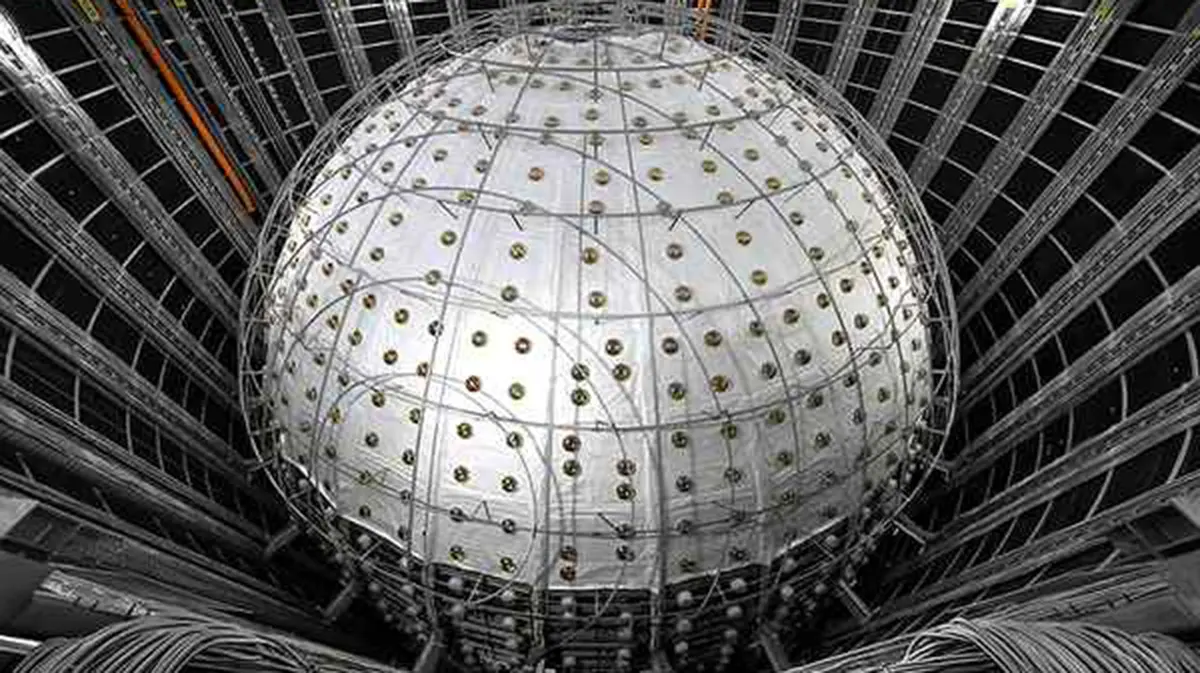
JUNO is located 700 metres underground near Jiangmen city in Guangdong province. It detects antineutrinos from the Taishan and Yangjiang nuclear power plants about 53 kilometres away. Construction started in 2015 and the liquid scintillator sphere was filled by late 2024. The detector uses 20 000 large photomultiplier tubes (PMTs) and 25 600 smaller ones to capture faint flashes of light produced when antineutrinos interact.
Key details
- The aim is to resolve the neutrino mass hierarchy – whether the third neutrino is heavier or lighter than the other two.
- Energy resolution is around 3 per cent at 1 MeV, allowing precise measurements of oscillation parameters.
- The detector also studies solar, supernova and geo‑neutrinos and searches for sterile neutrinos and proton decay.
- A water pool shields the detector from cosmic rays and doubles as a muon veto.
- Scientists plan a 30‑year run and may upgrade JUNO for neutrinoless double‑beta decay experiments.
Conclusion
JUNO’s large size and high precision make it a central player in neutrino physics. Its findings will deepen our understanding of fundamental particles and may reveal new physics beyond the Standard Model.
Source: The Hindu