
Why in news?
The Geographical Indications Registry issued certificate 789 for Jodhpur’s Mojari craft. It sealed the certificate on 28 March 2026. The registration records application 735 from 4 January 2021. It protects the footwear name’s link with Jodhpur district.
Background
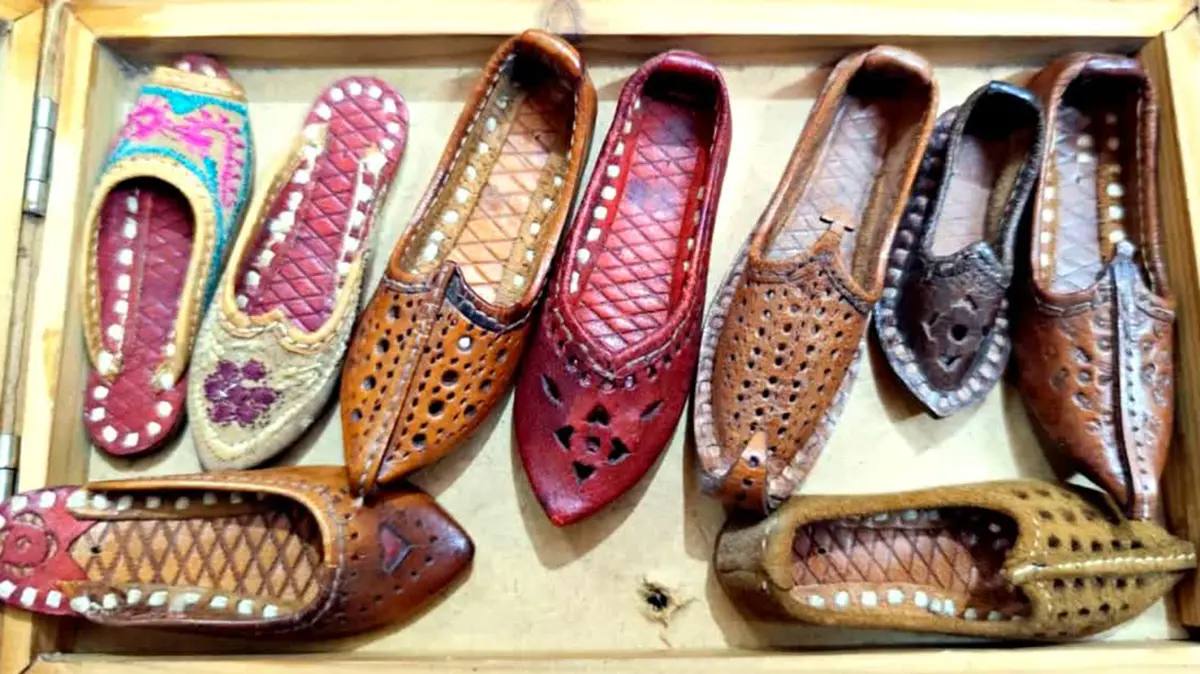
A Jodhpuri Mojari is traditional handmade footwear from Jodhpur. Its closed form often carries a long, curled toe.
The official journal links the craft with Mochi and Regar artisans. These communities have passed the skills across generations.
Earlier artisans also made horse saddles and reins. Historical trade carried some leather goods and footwear as far as Lahore.
Royal patronage later supported decorative footwear, and the craft gradually moved from courtly use into wider social and ceremonial use.
Rural and urban versions developed different features. Rural footwear was thicker, while urban pairs became lighter and richly embroidered.
How is a mojari made?
- An artisan selects vegetable-tanned leather for each footwear part.
- Traditional patterns do not separate the left and right feet.
- A three-piece wooden cobbler’s anvil helps shape the cut leather.
- Thick cotton thread joins the upper firmly with the sole.
- Silk, metallic thread, mirrors or beads can add decoration.
- Final shaping and finishing improve flexibility, comfort and appearance.
The official description mentions buffalo, camel, goat and sheep leather. It assigns harder leather to soles and softer leather inside.
Leather can absorb moisture and keep feet cooler in summer. Its insulating quality can also provide warmth during winter.
Some lightweight pairs can be rolled for carrying. The journal calls these forty-to-fifty-gram versions “pocket mojari”.
Women from artisan families perform much of the embroidery. Handmade production permits variation while preserving shared regional methods.
What is a geographical indication?
A geographical indication identifies goods linked with a particular place. Their quality, reputation or characteristic must relate to that origin.
India protects such names under the Geographical Indications of Goods Act, 1999. The law came into force in September 2003.
The Geographical Indications Registry operates from Chennai, and it examines applications and maintains the official register.
Important distinction: A geographical indication protects a shared place-linked name. A patent protects a qualifying invention for a limited period.
What exactly was registered?
- The official name is “Mojari Craft of Jodhpur (Rajasthan)”.
- Its application number is 735.
- The filing date was 4 January 2021.
- It appears under goods classes eighteen and twenty-five.
- The certificate identifies the registered goods as footwear.
- Its certificate number is 789.
- The certificate was sealed on 28 March 2026.
Classes eighteen and twenty-five cover relevant leather goods and footwear, and these classes help organise registrations by product type.
The applicants were Jodhpur Handicrafts Exporters Association and Gram Vikas Seva Sansthan, and both organisations filed the application together.
The application appeared in Geographical Indications Journal 212 on 27 November 2025. The registry now marks it as registered.
The registry summary displays Rajasthan as the geographical area. However, the official journal defines production across Jodhpur district.
Date distinction: The application date is 4 January 2021. The registry sealed certificate 789 on 28 March 2026.
What rights follow registration?
The registered proprietor can act against misleading use of the name, and eligible producers can seek recognition as authorised users.
Registration does not give one trader ownership over the underlying footwear idea. It protects the recognised name and geographical link.
An Indian geographical indication registration lasts ten years, and it can be renewed for further ten-year periods.
Protection within India is not automatic protection everywhere, and overseas enforcement may require separate registration or legal arrangements.
How can registration help artisans?
- It can separate genuine place-linked products from misleading copies.
- Shared branding can improve buyer recognition.
- Producer groups can develop common quality standards.
- Traceability can connect buyers with actual makers.
- Tourism and exports may support local employment.
However, registration alone cannot guarantee higher artisan income, and producers still need fair contracts, market access and quality control.
Training must preserve hand skills while improving comfort and safety, and sustainable sourcing also matters for long-term production.
Remember: The protected name has application 735 and certificate 789. Its detailed production area is Jodhpur district.
Conclusion
The registration recognises Jodhpur’s place-linked footwear tradition, and its real value depends upon benefits reaching skilled artisans and producer groups.