

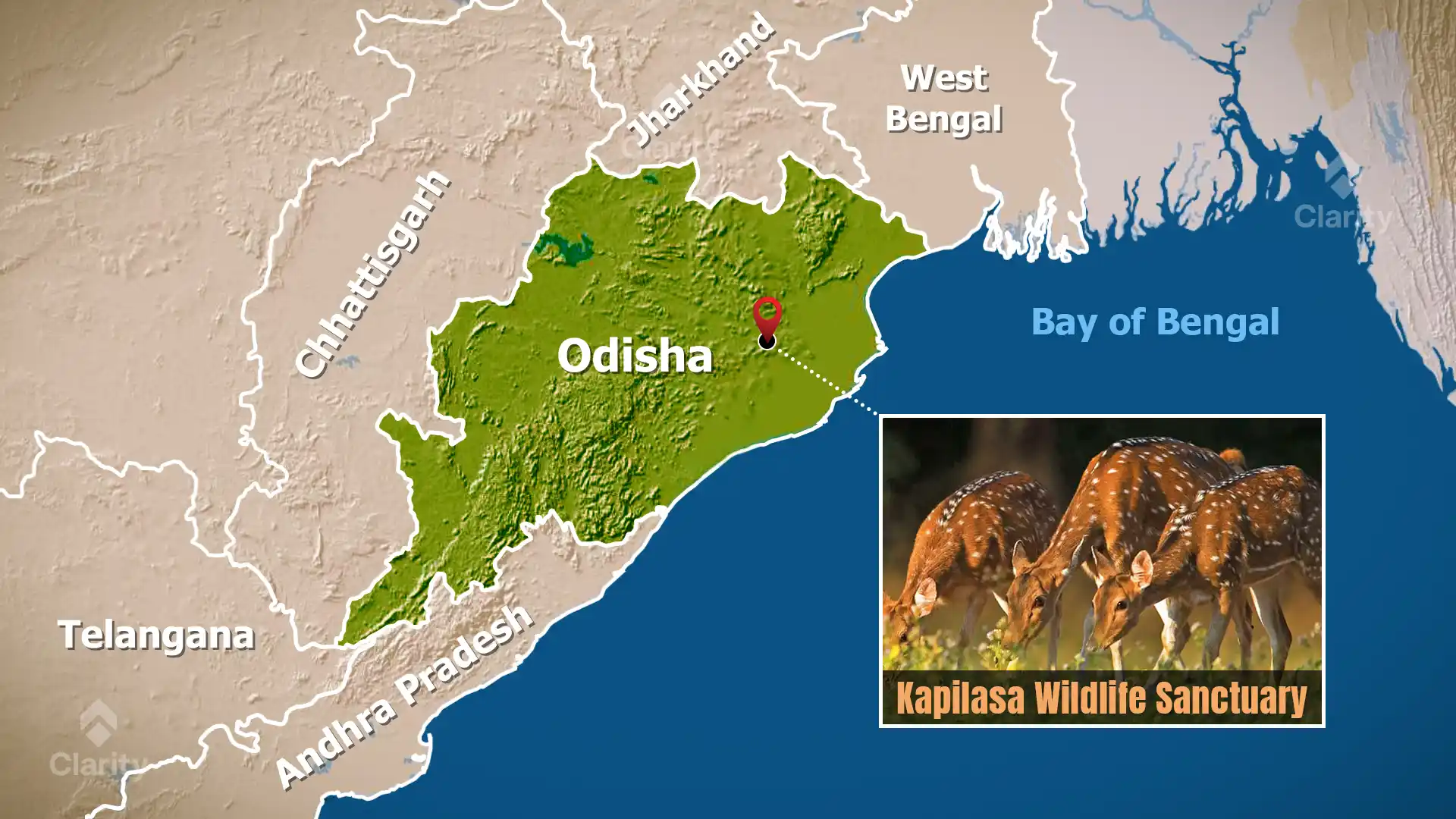
Why in news?
The standing committee of the National Board for Wildlife (NBWL) recently approved the diversion of around 4.68 hectares of forest land within Kapilash Wildlife Sanctuary in Odisha for the construction of a six‑lane Capital Region Ring Road (CRRR). The decision allows the proposed 111 km highway around Bhubaneswar and Cuttack to pass through the sanctuary’s eco‑sensitive zone.
Background
Kapilash Wildlife Sanctuary lies in the Dhenkanal district of Odisha on the slopes of the Chota Nagpur Plateau. Spanning roughly 125.5 sq km, it is known for its rolling hills, dense forests and caves. The 15th‑century Kapilasa Temple sits atop one of the hills. Vegetation here is classified as Eastern Highlands moist deciduous forest, dominated by sal trees and species such as amla, teak and kadamba. The sanctuary hosts elephants, jungle cats, sloth bears, spotted deer, jackals and numerous birds. Pangolins and porcupines also find refuge in its diverse habitats.
Key facts and issues
- Forest diversion: The NBWL approved 13.26 hectares of land (4.68 ha in the sanctuary and 8.59 ha in its eco‑sensitive zone) for the CRRR project. The land lies at the edge of a prime elephant habitat and around 2 978 trees are expected to be affected.
- Wildlife mitigation plan: To reduce disturbance, authorities plan to construct the highway as an elevated corridor through the sanctuary with underpasses, culverts and viaducts fitted with light and sound barriers. A site‑specific wildlife conservation plan prepared with the Wildlife Institute of India sets conditions on construction.
- Concerns: Kapilash is a known corridor for elephant movement. Conservationists fear that building a highway through it could fragment habitat and increase vehicle–animal collisions. The mitigation plan aims to address these risks but its effectiveness will need close monitoring.
Why it matters
Balancing infrastructure development with wildlife protection is a recurrent challenge in India. The CRRR is expected to ease traffic around the capital region and spur economic activity, but the diversion of forest land highlights the need for careful design and strict adherence to environmental safeguards. Successful execution of the mitigation measures could serve as a model for future projects.