
Why in news?
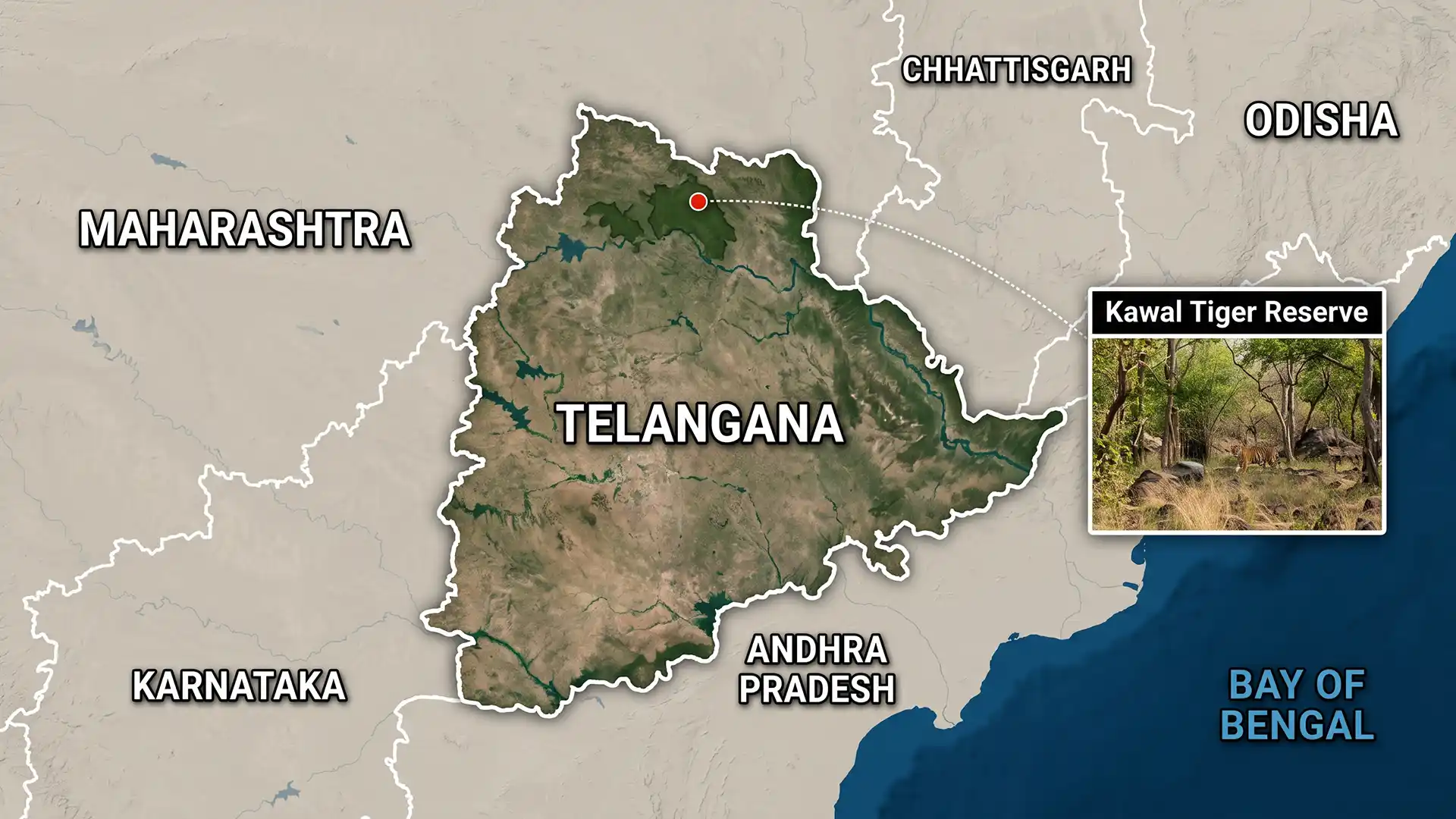
Kawal Tiger Reserve has become a priority site for tiger recovery. A new national roadmap places it in the first recovery stage. The reserve presently has no recorded resident tiger population. Habitat, prey and corridors must improve before any tiger release.
Background
Kawal lies in northern Telangana and was notified as a tiger reserve in 2012.
Its core covers 892.23 square kilometres, while the surrounding buffer covers another 1,123.21 square kilometres.
The current official total is therefore 2,015.44 square kilometres.
Area caution: Some older profiles show a smaller buffer. The current National Tiger Conservation Authority list gives 2,015.44 square kilometres.
The reserve occupies the Godavari catchment within the Deccan Peninsula and Central Indian landscape.
Kawal contains southern tropical dry deciduous forest, including teak woodlands, bamboo patches and riverine habitats.
Its prey animals include chital, sambar, nilgai, chousingha and wild pig.
Leopards and dholes also inhabit this forest, with the dhole being Asia's wild dog.
What is the new recovery roadmap?
The National Tiger Conservation Authority and Wildlife Institute of India released a joint roadmap in June 2026.
It is called the “Roadmap for Active Management of Tigers in India”.
The roadmap identifies places needing habitat recovery, natural recolonisation, reintroduction or population support.
As a priority recipient site, Kawal could receive tigers after scientific and administrative preparation.
The roadmap places Kawal in Stage 1, called Habitat and Prey Recovery.
Current position: Priority listing does not mean immediate tiger release because site preparation must come first.
Why does Kawal lack resident tigers?
The All India Tiger Estimation recorded no resident tiger population in Kawal.
A resident animal regularly occupies an area, while a disperser passes through seeking territory or mates.
Kawal historically supported tigers and receives dispersers, but these visits have not created a breeding population.
Low prey abundance limits food, while fragmented forest corridors make tiger movement dangerous and uncertain.
The 2022 assessment estimated 3.9 chital per square kilometre. It estimated 4.17 nilgai and 3.5 wild pigs.
These estimates show selected prey densities, not the reserve's entire wildlife population.
Why is landscape connectivity important?
A tiger reserve cannot function as an island because tigers need connected forests for dispersal and genetic exchange.
Kawal lies at the southern edge of the Central Indian Tiger Landscape.
Fragmented forest corridors link Kawal towards the Tadoba-Andhari landscape in Maharashtra.
Safe corridors let young tigers leave crowded source populations and establish territories in suitable recipient habitats.
What must happen before reintroduction?
- Scientists must estimate habitat quality and carrying capacity accurately.
- Prey populations need recovery through protection and habitat improvement.
- Corridors require mapping, restoration and protection from further fragmentation.
- Anti-poaching teams must secure the release area and adjoining landscape.
- Communities need consultation, safeguards and effective livestock-loss compensation.
- Health, genetics and source populations must guide selection of any tiger.
Carrying capacity means the population that available habitat and prey can sustain.
Reintroduction restores a vanished population, while augmentation adds animals to a small existing population.
Since Kawal lacks residents, reintroduction is the more relevant present concept.
What pressures require attention?
- Forest fragmentation can block movement between Kawal and neighbouring landscapes.
- Poaching can reduce both tigers and their prey.
- Fire, invasive plants and water scarcity can weaken habitat quality.
- Road traffic and human activity can disturb sensitive forest sections.
- Livestock grazing may increase competition, disease risk and conflict.
How does Amrabad differ?
The roadmap places Amrabad, Telangana's other tiger reserve, in Stage 3.
Amrabad may recover naturally, while Kawal first needs deeper habitat and prey restoration.
The long-term Vision 2047 objective is a self-sustaining tiger population in Kawal.
Conclusion
Kawal can support tigers again only after prey, corridors, protection and community safeguards improve together.