

Why in news?
Lok Sabha Speaker Om Birla welcomed Kenya’s recognition of persons of Indian origin. He described them as an indigenous community.
What was stated
Birla met Kenyan National Assembly Speaker Moses Wetang’ula in New Delhi on 13 August. Akashvani reported the remarks after their meeting.
The phrase “indigenous community” came from Birla’s statement. No new Kenyan law or citizenship order accompanied the report.
Kenya had already recognised Kenyan Asians as its 44th ethnic community. President William Ruto repeated that description during his 2023 India visit.
The development is therefore best read as political recognition and inclusion. It should not be presented as a newly created nationality category.
Historical relationship
Indian Ocean trade linked western India with the Swahili coast for centuries. Larger migration followed colonial railway construction and commercial expansion.
People of Indian origin contributed to trade, professions and Kenya’s anti-colonial movement. Their experience also includes exclusion and the disruptions after independence.
India opened a commissioner’s office in Nairobi in 1948. It became a High Commission after Kenya gained independence in December 1963.
Kenya’s material geography
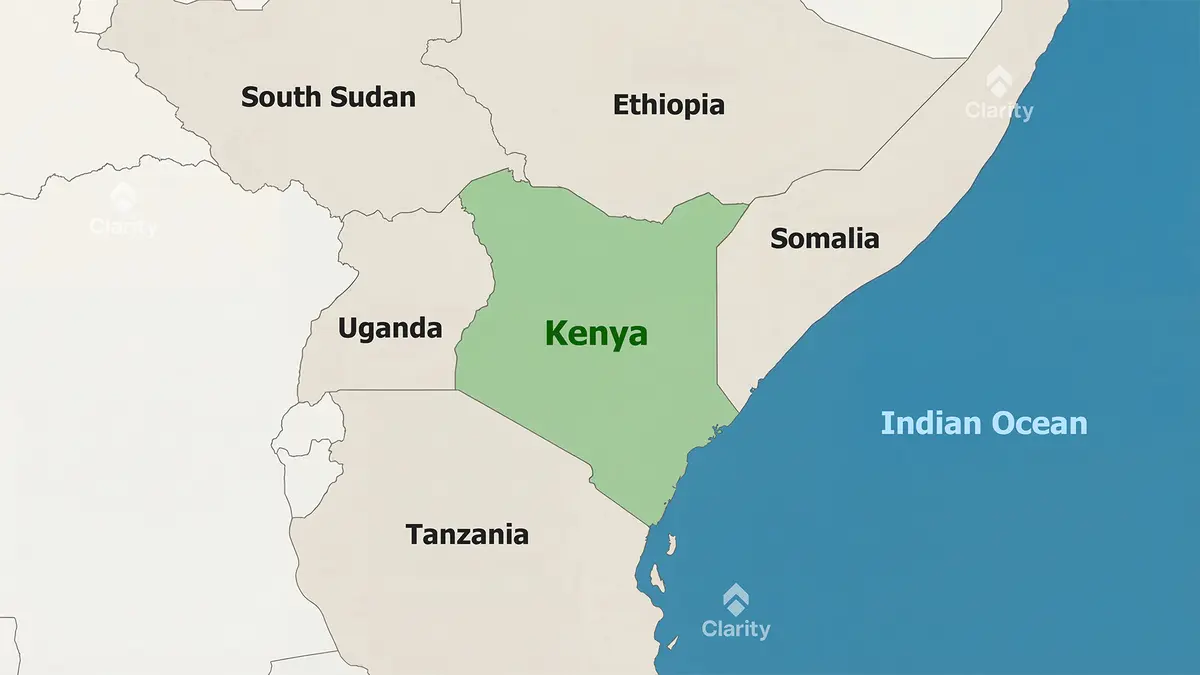
Kenya lies in eastern Africa and crosses the Equator. It borders Ethiopia, Somalia, South Sudan, Uganda and Tanzania.
Its south-eastern coast faces the Indian Ocean. Mombasa is the main seaport and an important gateway for inland East Africa.
Lake Victoria touches western Kenya, while the Rift Valley crosses the interior. Mount Kenya rises in the central highlands.
Nairobi is the capital and a major diplomatic centre. It hosts the United Nations Environment Programme and Human Settlements Programme headquarters.
Why “maritime neighbours” is used
India and Kenya do not share a boundary. Their coastlines face the connected western Indian Ocean trading space.
Strategic and social significance
Recognition can strengthen belonging among Kenyan citizens of Indian ancestry. It also reinforces people-to-people links beyond official diplomacy.
India and Kenya cooperate in health, agriculture, defence, education and trade. Parliamentary exchanges add institutional continuity to those ties.
Mombasa connects Indian Ocean shipping with Uganda and other landlocked neighbours. Stable Kenya ties therefore matter across the wider East African region.
Community recognition should not erase internal diversity. Kenyan Asians include different languages, religions, migration histories and citizenship positions.
Recognition needs precise meaning
The current statement carries political value, but its legal effect should not be overstated without an official Kenyan instrument.
Conclusion
The episode highlights a relationship built through ocean routes and migration. Its strongest outcome is fuller inclusion within Kenya’s national story.