

Why in news?
Brunei Darussalam often appears in discussions on Southeast Asian geopolitics and economic development. Many people know little about this small but wealthy nation. Here we summarise its geography, government and economy to provide context for current affairs.
General overview
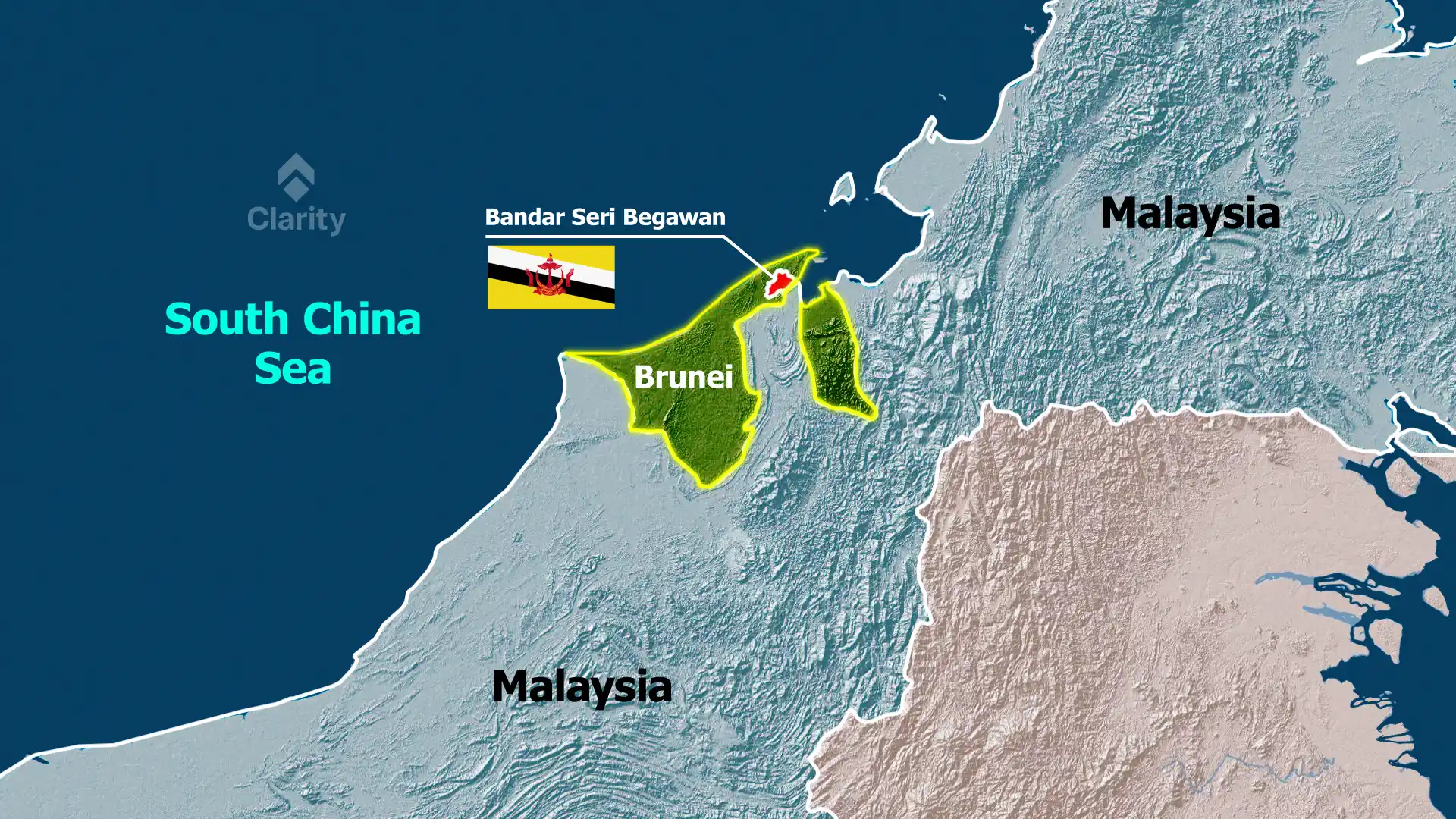
Brunei is a tiny sovereign state on the northern coast of the island of Borneo in Southeast Asia. The country consists of two separate land parcels surrounded by the Malaysian state of Sarawak, with a coastline along the South China Sea. The population is around 460,000 people, with the capital and largest city being Bandar Seri Begawan. Despite its small size (about 5,765 sq km), Brunei enjoys one of the highest standards of living in the world thanks to abundant petroleum and natural‑gas resources.
History and governance
- Brunei was an important trading kingdom from at least the 14th century. It became a British protectorate in 1888 and regained full independence on 1 January 1984.
- The country is an absolute monarchy. Sultan Hassanal Bolkiah has ruled since 1967 and serves as both head of state and head of government. There are no national elections; the Sultan appoints members of the legislative council and cabinet.
- The official religion is Sunni Islam. In 2014 Brunei introduced a Sharia‑based penal code, reflecting its Islamic identity. Malay is the official language, though English is widely used and Chinese and indigenous languages are spoken by minority communities.
Geography and climate
- Brunei’s terrain comprises coastal plains and inland hills. Dense tropical rainforests cover the eastern region, while lowland areas support settlements and oil facilities.
- The climate is equatorial, hot and humid all year. Rainfall is heavy, especially during the northeast monsoon from November to February.
- The Brunei River, the country’s largest, flows through the capital and has historically been a key transport route.
Economy
- Oil and natural gas account for more than half of Brunei’s gross domestic product and about 90 percent of export earnings. Revenues from these resources fund generous welfare benefits such as free healthcare and education.
- The government manages a sovereign wealth fund, the Brunei Investment Agency, which invests petroleum revenues abroad to ensure long‑term financial stability.
- Efforts to diversify include developing finance, tourism and agriculture, but the economy remains heavily dependent on hydrocarbons.
People and culture
- Bruneians are ethnically diverse. The majority are Malay, alongside Chinese and indigenous groups such as the Iban and Dusun.
- Islam shapes cultural life. Mosques dominate skylines, and festivals such as Eid al‑Fitr and Eid al‑Adha are widely celebrated.
- Traditional music and crafts, including songket weaving and woodcarving, are important cultural expressions. Bruneian cuisine features rice, seafood and tropical fruits with influences from Malay, Chinese and Indian cooking.
Source: TH