
Why in news?
President Droupadi Murmu reached Moldova on 20 July 2026. This was the first visit by an Indian President to Moldova. She held talks with Moldovan President Maia Sandu in Chișinău. Both sides discussed technology, agriculture, health and economic cooperation.
Background
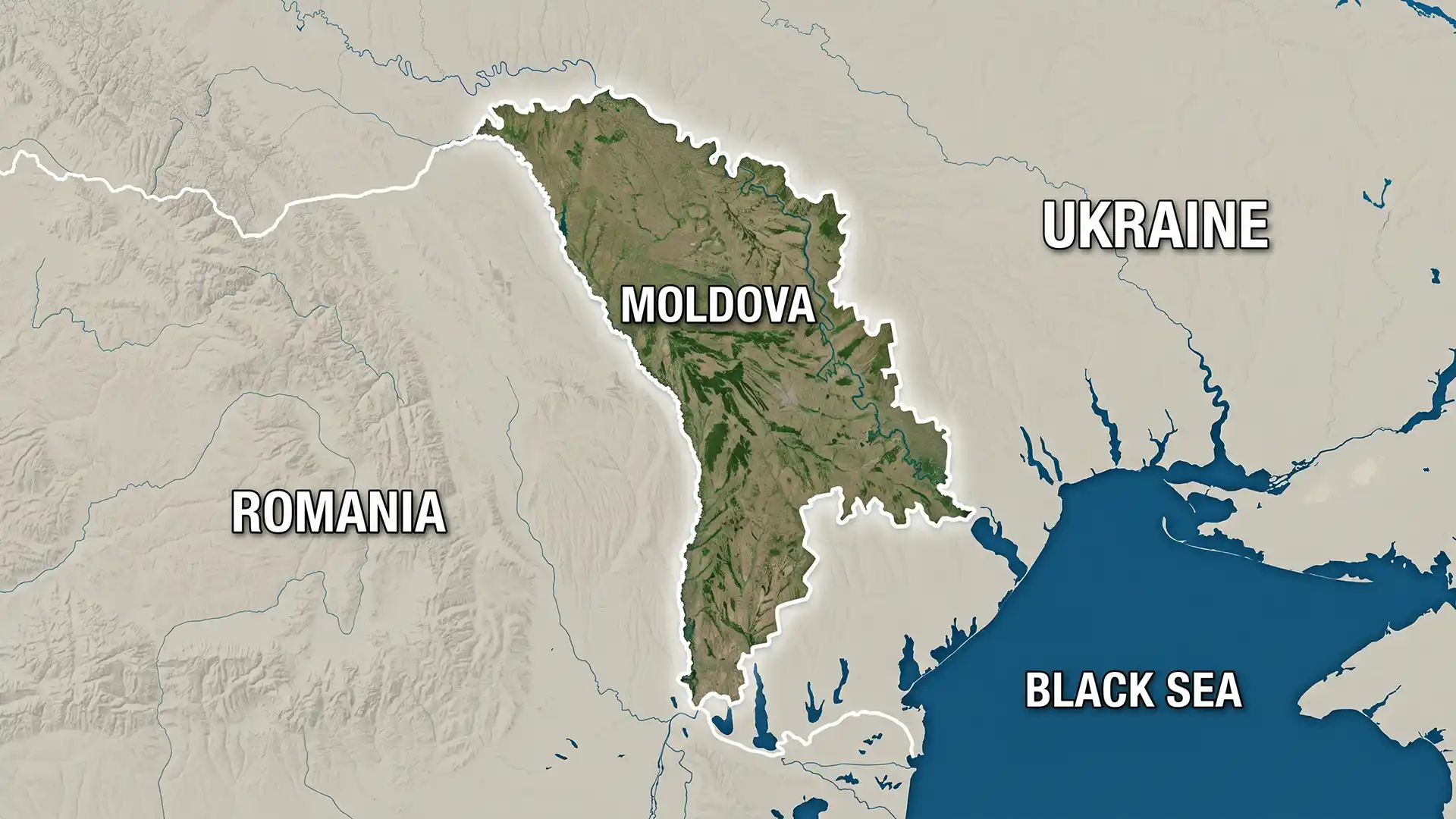
Moldova is a small landlocked Eastern European country between Romania and Ukraine.
Chișinău is the capital, Romanian is official, and the Moldovan leu is the national currency.
Moldova lies east of the Carpathian Mountains and lacks any direct sea coast.
Rivers and physical features
- The Prut River forms most of Moldova’s western boundary with Romania.
- The Dniester River flows mainly through eastern Moldova towards the Black Sea.
- Moldovans also commonly call the Dniester River by its Romanian name, Nistru.
- The country contains fertile rolling plains, low hills and productive black soils.
- The Bugeac region forms a drier steppe landscape across the southern area.
The Dniester reaches the Black Sea through Ukraine, not through a Moldovan coastline.
Map point: Between Romania and Ukraine, Moldova has the Prut westward and Dniester farther east.
How did modern Moldova emerge?
- The medieval Principality of Moldavia once covered lands on both sides of the Prut.
- The Russian Empire annexed its eastern portion in 1812 and called it Bessarabia.
- Bessarabia united with Romania during the political changes of 1918.
- The Soviet Union occupied the territory in 1940 under earlier Soviet-German arrangements.
- Romanian forces recovered it during 1941, but Soviet forces returned during 1944.
- The Soviet Union organised most territory as the Moldavian Soviet Socialist Republic.
- Moldova declared independence from the Soviet Union on 27 August 1991.
Historical clarification: Present Moldova differs from Bessarabia, though most Moldovan land once belonged there. It includes eastern Dniester territory, while Ukraine holds other former Bessarabian areas.
What is Transnistria?
Transnistria is a narrow eastern territory where separatists fought Moldova after the Soviet collapse.
A 1992 ceasefire ended large fighting, but Transnistria still operates separately with its own institutions.
However, international law recognises the entire territory as part of Moldova.
Russian troops have remained in the region, making the dispute strategically sensitive.
What is Gagauzia?
Gagauzia is an autonomous territorial region in southern Moldova.
Its people are mainly Gagauz, a Turkic-speaking community with an Orthodox Christian tradition.
Unlike Transnistria, Gagauzia functions as an autonomous region within Moldova’s constitutional framework.
What happened during the presidential visit?
Deputy Prime Minister and Foreign Minister Mihai Popsoi welcomed President Murmu before the presidential talks.
Both leaders explored cooperation across several practical sectors during their formal discussions.
Moldova was the first leg of her state visit covering North Macedonia and Romania.
- Agriculture and food processing can benefit from technology and business partnerships.
- Healthcare and pharmaceuticals offer opportunities for affordable products and joint activity.
- Renewable energy cooperation can support Moldova’s energy security and green transition.
- Digital public infrastructure can improve reliable delivery of government services.
- Artificial intelligence and innovation can support education, industry and administration.
- Transport, logistics and infrastructure can improve wider European market connections.
Capacity-building cooperation
India doubled Moldova’s places under its 1964 Indian Technical and Economic Cooperation training programme.
It offers training in administration, technology, finance, health and many other fields.
India also offered artificial-intelligence and cyber-diplomacy courses for Moldovan officials.
Why is the visit significant?
The presidential visit raises political visibility for a relatively young bilateral relationship.
It also connects India with a country located between the European Union and Ukraine.
For Moldova, Indian markets, medicines and digital expertise offer useful diversification.
Conclusion
The historic presidential visit created fresh momentum for India–Moldova cooperation.
Moldova’s rivers, Soviet history and unresolved Transnistria question remain important examination areas.