
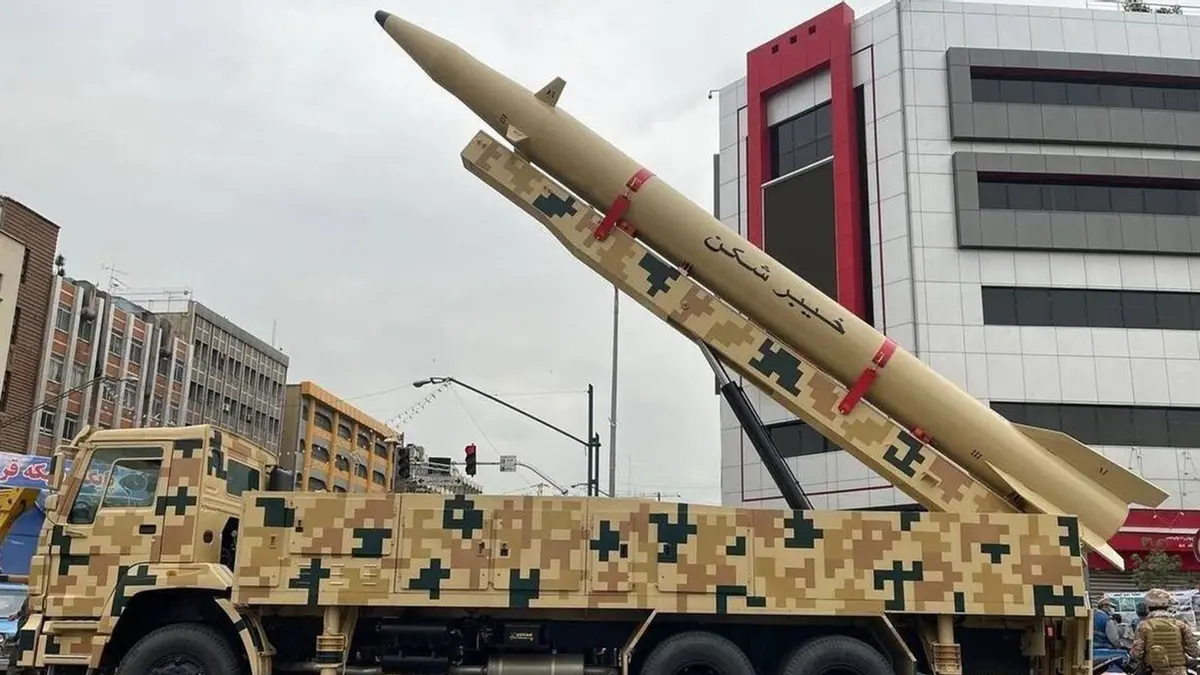
Why in news?
A recent report examined Iran’s use of Kheibar Shekan missiles in complex attacks. Such attacks can combine missiles, drones and carefully chosen launch timings. This makes defensive planning harder for the targeted country. The report therefore renewed attention on the missile’s real capabilities.
Background
Kheibar Shekan, also written as Kheybar Shekan, is an Iranian missile unveiled on 9 February 2022.
The Islamic Revolutionary Guard Corps (IRGC) developed and operates this domestically described long-range missile.
International classifications usually place its claimed range within the medium-range category.
What is a ballistic missile?
A ballistic missile receives strong initial thrust, then follows a high curved path through atmosphere and space.
Gravity returns the vehicle towards its target, though some modern vehicles can manoeuvre during descent.
This differs from a cruise missile, which remains powered for most of its journey.
| Point | Ballistic missile | Cruise missile |
|---|---|---|
| Typical path | It follows a high, curved ballistic path. | It usually flies lower through the atmosphere. |
| Propulsion | Its main engine works mainly during the boost phase. | Its engine normally works throughout most of the flight. |
| Speed pattern | Re-entry can occur at very high speed. | Many cruise missiles travel more slowly. |
| Detection challenge | Height, speed and manoeuvres shape the defence problem. | Low-altitude flight can reduce radar warning time. |
Verified specifications
| Feature | Reliable open-source position |
|---|---|
| Country | Iran |
| Operator | Islamic Revolutionary Guard Corps |
| Type | Medium-range ballistic missile |
| Claimed maximum range | About 1,450 kilometres |
| Propulsion | Single-stage solid propellant |
| Estimated payload | Roughly 450 to 600 kilograms |
| Status | Open-source assessments describe it as deployed. |
| Accuracy | No independently verified public accuracy figure is available. |
Iranian officials claim reduced weight, quicker preparation and manoeuvrability, but independent evidence has not confirmed every measurement.
Why does solid propellant matter?
Solid propellant remains stored inside the missile and therefore requires less visible pre-launch fuelling activity.
Quicker preparation and road-mobile launchers reduce warning while enabling frequent changes of launch position.
However, solid fuel does not make a missile invisible or unstoppable.
What does a manoeuvrable warhead do?
Unlike a traditional warhead, a manoeuvrable re-entry vehicle can make limited changes during its descent.
Those changes complicate interception, although results still depend upon sensors, defensive layers and operational conditions.
Why can a combined attack become difficult?
- Drones and missiles may approach at different speeds and heights.
- Several launch waves can force defenders to ration interceptors.
- Decoys may create additional tracks on defensive radar screens.
- Simultaneous threats can overload command and communication systems.
- Mobile launchers make pre-launch detection more demanding.
This layered or saturation approach creates more defensive problems than one isolated missile can create.
Meaning of the name
The name broadly means “breaker” or “conqueror” of Khaybar, referencing a seventh-century battle in early Islamic history.
Iranian weapon names often use historical, religious or political references.
Do not confuse these two missiles
| Feature | Kheibar Shekan | Kheibar or Khorramshahr-4 |
|---|---|---|
| Unveiled | 2022 | 2023 |
| Missile family | Usually linked visually with Iran’s Fateh lineage | Fourth major Khorramshahr version |
| Fuel | Solid propellant | Liquid propellant |
| Reported range | About 1,450 kilometres | About 2,000 kilometres |
Conclusion
Kheibar Shekan matters because rapid preparation and combined attacks can strain layered missile defences.