

Why in news?
A July report revisited research on the mostly submerged Kikai caldera south of Kyushu. Seismic evidence suggests fresh melt entered a large shallow magma reservoir. The underlying study appeared in March 2026. It does not predict an imminent eruption.
Background
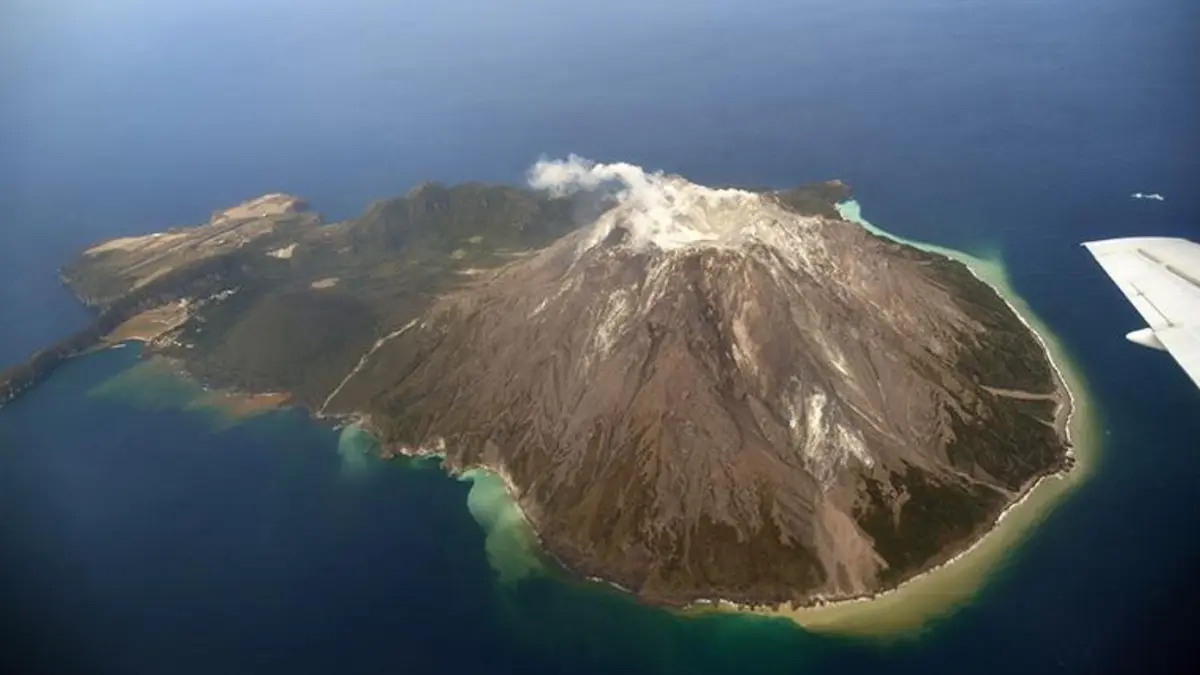
Kikai is a mostly underwater volcanic caldera south of Kyushu in southwestern Japan.
It lies near the northern Ryukyu volcanic arc, where subduction drives repeated volcanic activity.
A caldera is a broad collapse depression created after a volcano rapidly evacuates substantial magma.
It is generally much wider than an ordinary summit crater.
The Kikai-Akahoya eruption
Kikai produced the enormous Kikai-Akahoya eruption about 7,300 years ago.
The event expelled roughly 133 to 183 cubic kilometres of dense-rock-equivalent magma.
Researchers consider it probably the largest known eruption during the Holocene epoch.
The Holocene began about 11,700 years ago and continues today.
Widespread ash and pyroclastic material affected southern Japan and surrounding seas.
How did researchers look underground?
Kobe University and Japan’s marine-earth science agency conducted a seismic refraction survey.
The research ship released controlled acoustic pulses along a 175-kilometre survey line.
Thirty-nine ocean-bottom seismometers recorded how the waves travelled through crustal materials.
Wave speeds change with rock type, temperature, fractures and the presence of partial melt.
Researchers used these travel times to build a two-dimensional subsurface velocity model.
Main findings
| Feature | Study estimate |
|---|---|
| Reservoir depth | Approximately 2.5 to 6 kilometres below the caldera. |
| Reservoir width | At least as wide as the inner caldera. |
| Estimated melt fraction | Usually 3 to 6 per cent, with 10 per cent as an upper limit. |
| Interpretation | New melt entered the reservoir used by earlier Kikai volcanism. |
What does partial melt mean?
A magma reservoir is not necessarily a vast underground lake of completely liquid rock.
Many reservoirs resemble a hot crystalline mush containing connected pockets of melt.
The reported melt fraction describes the liquid proportion within the interpreted reservoir volume.
Its low seismic velocity provides indirect evidence rather than a direct underground sample.
Re-injection after the giant eruption
Petrological work indicates later Kikai magma differed from the 7,300-year-old eruptive material.
A central lava dome developed from different magma during later activity around 3,900 years ago.
The team therefore proposed that fresh melt entered the same broad storage region.
At least 32 cubic kilometres may have entered during the last 3,900 years.
This represents an average exceeding 8.2 cubic kilometres per thousand years.
Actual injection may have occurred episodically rather than at a constant rate.
Does this forecast another giant eruption?
No study can infer an eruption date from the reservoir image alone.
Partial melt may remain stored, cool, crystallise or move without reaching the surface.
Forecasting requires changing evidence from earthquakes, deformation, gases and other continuous observations.
Why is the result important?
Giant caldera eruptions are rare, making their complete preparation cycles difficult to observe.
Kikai provides a natural laboratory because its large underwater setting permits systematic marine surveys.
The proposed model may help researchers compare Yellowstone, Toba and other large caldera systems.
However, every volcano has a different magma supply, crustal structure and monitoring record.
Key volcanic terms
- Magma is molten or partly molten rocky material stored beneath Earth’s surface.
- Lava is erupting magma that has reached the planetary surface.
- Tephra includes fragmented volcanic material thrown through the air during explosive eruptions.
- Pyroclastic flow is a fast, extremely hot mixture of gas and volcanic debris.
- Caldera is a large volcanic depression formed mainly through surface collapse.
Conclusion
Kikai reveals how a giant volcanic reservoir can rebuild slowly after a catastrophic eruption.