

Why in news?
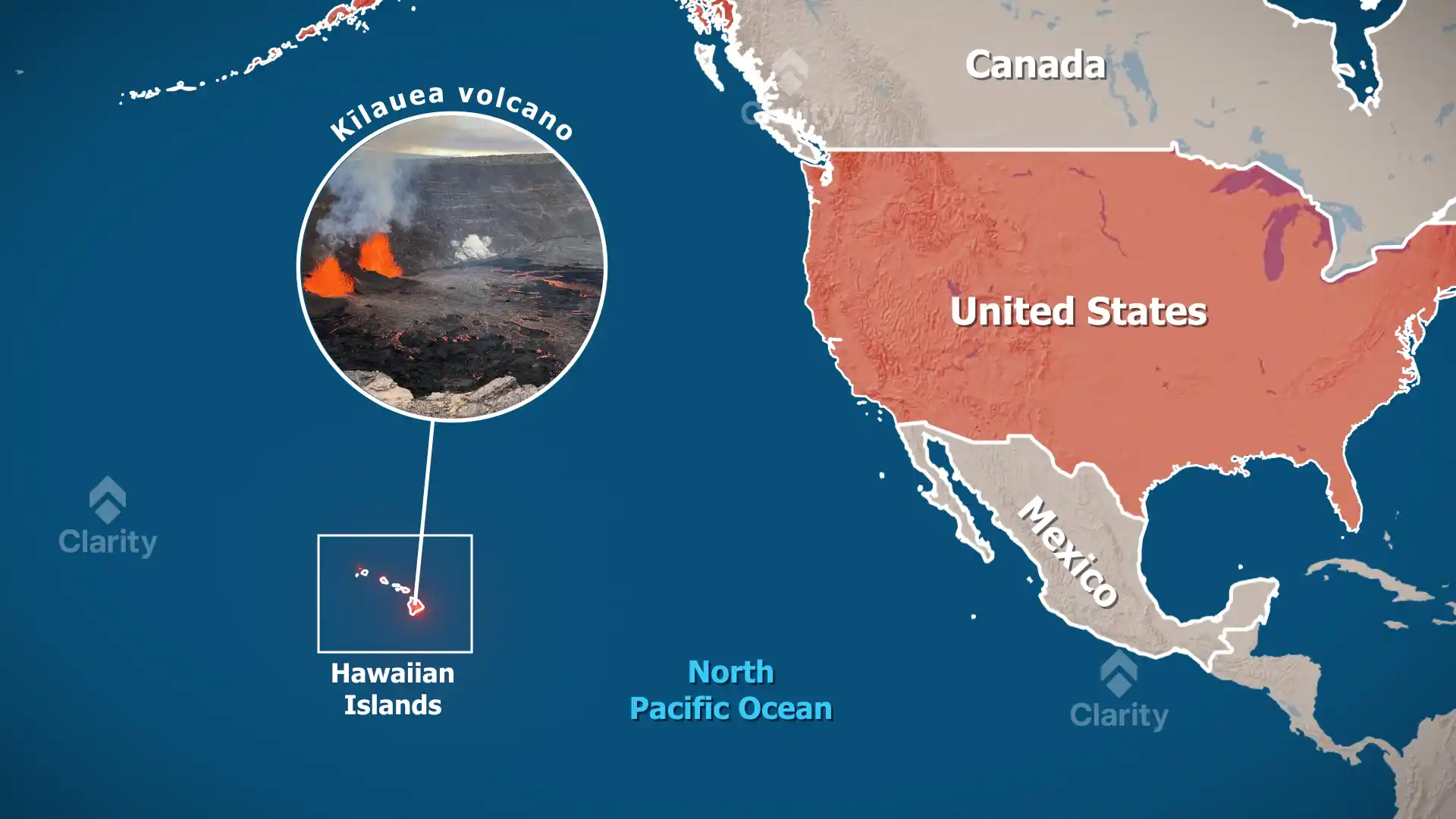
Fresh lava fountains erupted from Hawaii’s Kīlauea volcano on 6 December 2025. The US Geological Survey’s webcams showed fountains shooting fifteen to thirty metres into the air from a vent on the north side of the Halema‘uma‘u crater. The eruption is part of an ongoing eruptive phase that began in December 2024 and remains confined within Hawaii Volcanoes National Park. Authorities said there was no tsunami risk or impact on local airports but warned of volcanic gases and glass fibres known as “Pele’s hair.”
Background
Kīlauea is a shield‑type volcano on the southeastern side of the island of Hawaii. It stands about 1,250 metres above sea level. The summit collapsed thousands of years ago, forming a broad caldera roughly five kilometres long and three kilometres wide. Within this depression lies a persistent lava lake, Halema‘uma‘u, associated in Hawaiian tradition with the volcano goddess Pele.
Geological features
- Kīlauea is one of the world’s most active volcanoes; it has erupted nearly continuously since 1983, mostly producing fluid basaltic lava flows rather than explosive eruptions.
- The volcano’s slopes merge with those of neighbouring Mauna Loa to the west and north. Both volcanoes owe their existence to the Hawaiian hotspot—a plume of hot rock rising from deep within the Earth’s mantle.
- The ongoing eruption episodes occur within the Halema‘uma‘u crater and typically last a day or less. Lava fountains build spatter cones and lava lakes but generally do not threaten populated areas.
- Hazards include volcanic gas emissions (mainly sulphur dioxide) that can irritate eyes and lungs, and fine threads of volcanic glass (“Pele’s hair”) that can travel many kilometres downwind.
Despite its relative safety, Kīlauea’s activity is closely monitored by the Hawaiian Volcano Observatory. Tourists flock to the park to view glowing lava, but authorities urge visitors to follow park rules and stay informed about air quality advisories.
Source: Hindustan Times