
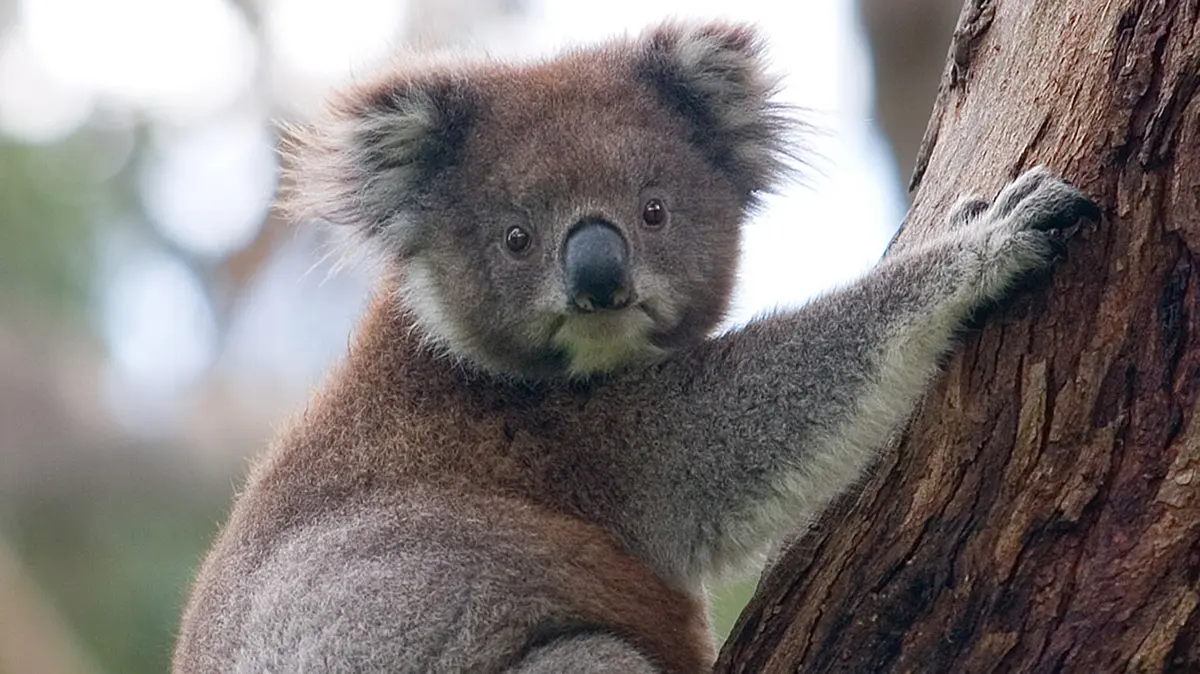
Why in news?
The University of Queensland has created Queensland’s first coordinated koala reproductive bank. It will preserve sperm and egg cells in liquid nitrogen. These cells may support future breeding and genetic rescue. The project responds to habitat loss, disease and declining genetic diversity.
Background
The koala is a tree-dwelling marsupial found naturally only in Australia.
Its scientific name is Phascolarctos cinereus; it is the only living member of the family Phascolarctidae.
A marsupial gives birth to a very undeveloped young; the young usually completes early development inside its mother’s pouch.
A young koala is called a joey; it remains dependent on its mother for many months.
Koalas mainly inhabit forests across eastern and south-eastern Australia.
Their range includes Queensland, New South Wales, the Australian Capital Territory, Victoria and South Australia.
They eat leaves from selected eucalypt species; their specialised digestive system helps process this fibrous and chemically defended food.
Common confusion: A koala is not a bear; it is a marsupial and is more closely related to wombats.
What is a reproductive bank?
A reproductive bank stores cells needed for producing future offspring.
The Queensland project will preserve koala sperm and egg cells. Storage takes place in liquid nitrogen at about −196 degrees Celsius.
This very low temperature stops almost all biological activity; properly frozen cells may remain useful for many years.
The facility is located at the University of Queensland’s Gatton campus, west of Brisbane.
It is a coordinated bank for Queensland koalas; it is not claimed as the world’s first koala cell collection.
How will the process work?
- Wildlife hospitals may recover cells from koalas that cannot breed naturally.
- Suitable cells may also come from recently dead animals.
- Teams will transport samples in temperature-monitored containers.
- Scientists will examine sample quality, disease status and genetic value.
- Selected cells will be frozen and entered in the central bank.
- Future conservation programmes may use them for assisted reproduction.
Partner hospitals already receive injured, sick and orphaned koalas; this creates an ethical source of otherwise lost genetic material.
Who supports the project?
Australian partners include Currumbin Wildlife Hospital and Endeavour Veterinary Ecology.
The Royal Society for the Prevention of Cruelty to Animals Queensland is also involved.
The Smithsonian’s National Zoo and Conservation Biology Institute provides international scientific support.
The Queensland government funds the project.
Why is genetic diversity important?
Genetic diversity means having many useful gene variants within a population.
A diverse population can respond better to disease, climate stress and changing habitats.
Habitat fragmentation separates koala groups; small isolated groups then breed within a limited gene pool.
Over time, harmful inherited traits may become more common; fertility and disease resistance may also fall.
A frozen bank can retain genes that might disappear from living populations.
How may the stored cells be used?
Researchers may later use sperm for artificial insemination; this places sperm inside a female without natural mating.
Egg cells could support in vitro fertilisation after further technical development; fertilisation then occurs outside the animal’s body.
The University of Queensland produced the first koala born through artificial insemination in 1998.
The new bank builds upon that reproductive research; however, each future use will require scientific and animal-welfare approval.
How does the project address chlamydial disease?
The bacterium Chlamydia pecorum causes serious disease in many koala populations.
Infection can damage the eyes, bladder and reproductive organs; it may cause blindness, infertility or death.
Scientists will screen samples before storage; researchers also report methods for removing infection from reproductive samples.
This cleaning concerns stored cells; it does not cure an infected koala living in the wild.
What is the koala’s conservation status?
The International Union for Conservation of Nature lists the koala as Vulnerable globally.
Australia uses a separate legal assessment for particular populations.
On 12 February 2022, Australia listed combined populations in three regions as Endangered.
These regions are Queensland, New South Wales and the Australian Capital Territory.
Koalas in Victoria and South Australia are not included in that federal Endangered listing.
Population conditions therefore differ across Australia; a national description can hide severe regional decline.
Prelims point: “Vulnerable” is the global assessment; “Endangered” is Australia’s legal status for specified eastern populations.
What are the major threats?
- Forest clearing removes food trees and resting places.
- Roads and buildings divide connected habitat into smaller patches.
- Bushfires, drought and extreme heat can cause sudden deaths.
- Chlamydial disease reduces health and reproductive success.
- Vehicle collisions and dog attacks kill moving koalas.
- Climate change can reduce leaf moisture and food quality.
Can a genetic bank save koalas by itself?
No. Frozen cells preserve options, but they do not preserve living forests.
Conservation still requires habitat protection, wildlife corridors, disease control and safer roads.
Population monitoring must guide where stored genes can provide genuine benefit.
Important distinction: Genetic banking is not cloning; it stores reproductive material for possible future breeding.
Conclusion
The bank protects valuable koala genes for future use; its success still depends upon strong protection for wild populations.