
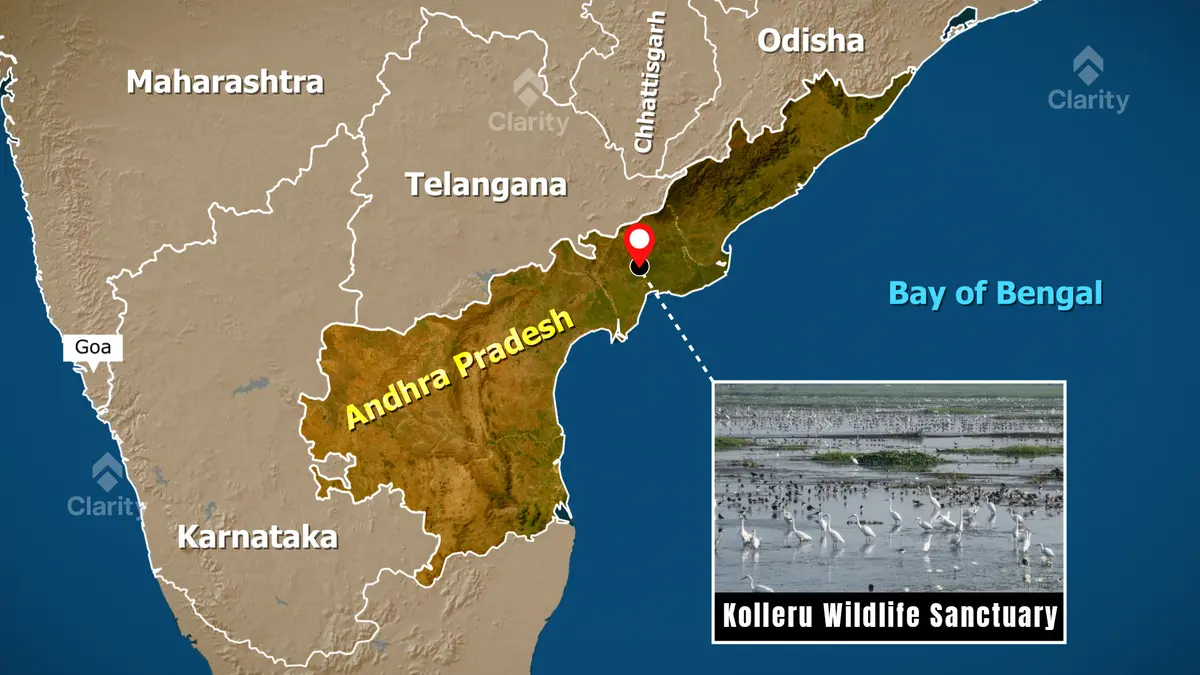
Why in news?
A Supreme Court-appointed panel sought Andhra Pradesh’s response on Kolleru Lake. Petitioners alleged fresh encroachments, illegal fish ponds and growing pollution. The panel requested removal support, although state authorities disputed parts of the fresh allegations.
Background
Kolleru is a large, shallow Andhra Pradesh freshwater lake between the Krishna and Godavari deltas.
The lake spreads across parts of Eluru and Krishna districts.
Its surface area changes greatly between dry and wet seasons.
Numerous catchment drains feed it, including the important Tammileru, Budameru and Ramileru channels.
The Upputeru channel carries lake water towards the Bay of Bengal.
Kolleru stores delta floodwater, thereby reducing flooding across nearby settlements and agricultural land.
How did legal protection develop?
- Andhra Pradesh issued a preliminary sanctuary notification during 1995.
- The final notification followed under Section 26A of the Wildlife (Protection) Act, 1972 on 4 October 1999.
- It protected the lake up to the five-foot contour.
- India designated the wider lake as a Ramsar Site in 2002.
- The Supreme Court addressed illegal fish tanks during 2006.
- Encroachment and restoration disputes continued in later years.
Contours join equal elevations; Kolleru spreads farther as its water rises above the five-foot mean-sea-level contour.
Do not mix the areas: The wildlife sanctuary covers about 308.55 square kilometres. The Ramsar Site covers about 901 square kilometres. The Ramsar boundary follows the wider ten-foot contour.
Why do both boundaries matter?
The sanctuary protects core habitat, while the wider Ramsar area recognises the connected hydrological system.
Activities outside the sanctuary can still change inflow, pollution loads and flood storage within protected waters.
Management therefore cannot stop at forest boundary pillars or district administrative limits.
| Protection | Date | Approximate area |
|---|---|---|
| Kolleru Wildlife Sanctuary | 4 October 1999 | 308.55 square kilometres |
| Kolleru Ramsar Site | 19 August 2002 | 901 square kilometres |
A Ramsar Site is a wetland of international importance under the Ramsar Convention.
India must maintain the site’s ecological character through wise use.
Why is Kolleru ecologically important?
The lake’s open water, reed beds and mudflats support resident and migratory waterbirds.
Many arrive through the Central Asian Flyway, including pelicans, painted storks and Asian openbills.
Fish, plants and smaller organisms support a food web and long-standing village livelihoods.
Flood storage, fisheries, village livelihoods and bird habitats therefore depend on one connected water system.
What is the present dispute?
The Central Empowered Committee, called CEC, assists the Supreme Court in environmental matters.
The CEC sought Andhra Pradesh’s report after allegations of new fish ponds and bunds inside protected areas.
The petition also raised pollution, habitat degradation and low water at the Atapaka bird centre.
Officials were asked to remove illegal structures, although the Forest Department reported local resistance.
State officials denied some fresh encroachment claims and described certain reported work as desilting.
Legal reading: These are claims before an oversight process. They should not be presented as final judicial findings. The Government’s response and later court orders remain important.
How can intensive aquaculture damage the lake?
- Earthen bunds divide a connected lake into enclosed ponds.
- They obstruct natural inflow, drainage and seasonal water movement.
- Reduced storage can increase flood risks outside the lake.
- Feed and fish waste add excessive nutrients to water.
- Nutrient enrichment can cause algal growth and oxygen loss.
- Chemicals may harm birds, fish and other aquatic life.
- Commercial ponds replace shallow feeding spaces used by waterbirds.
Excessive nutrient enrichment, called eutrophication, can produce dense algae and lower dissolved oxygen.
Traditional fishing differs from intensive aquaculture in its methods, scale, inputs and permanent structures.
What did the Supreme Court address in 2006?
The Court considered removing illegal fish tanks while protecting the notified boundary and its ecological purpose.
Authorities later conducted Operation Kolleru, but removed bunds can return when monitoring weakens.
Restoration needs open channels and natural levels, while demolition cannot stop pollution entering from the catchment.
Restoration should remove flow barriers, reconnect channels and allow the lake’s seasonal spread.
Continuous water-quality data can identify drains carrying sewage, farm chemicals or industrial waste.
How should conservation and livelihoods be balanced?
- Authorities must clearly map legal and illegal activities.
- Traditional users need fair consultation and lawful livelihood support.
- Commercial polluters should face consistent legal and financial enforcement.
- Restoration plans must follow the lake’s natural hydrology.
- Water quality needs monitoring across all major inflowing drains.
- Bird, fish and flood data should guide annual management.
Protection becomes durable only when local communities also benefit from a healthy lake.
Conclusion
Kolleru needs lawful restoration that protects hydrology, biodiversity and legitimate local livelihoods together.