

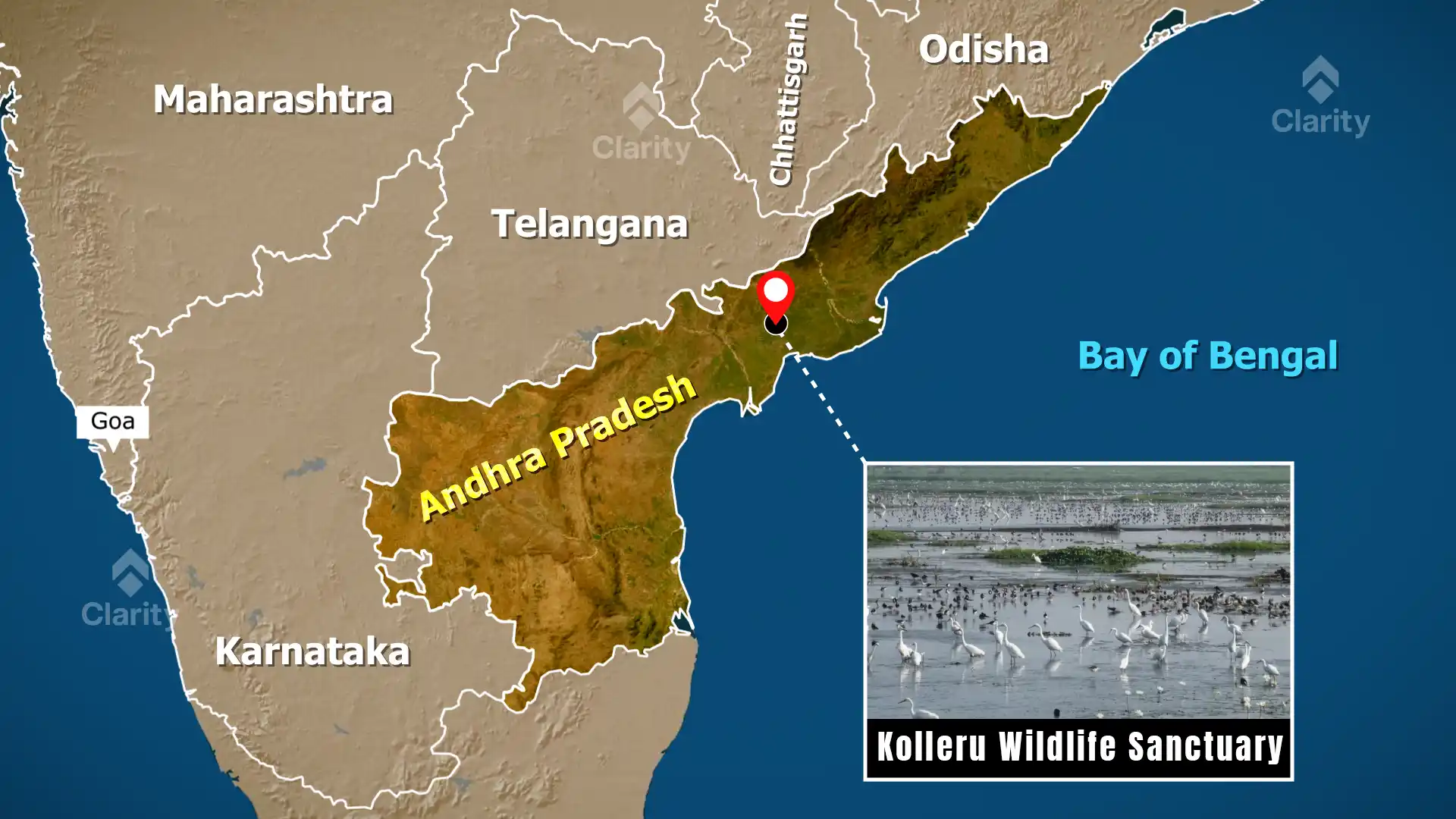
Why in news?
Just months after an anti‑encroachment drive removed illegal fish ponds in Andhra Pradesh’s Kolleru Wildlife Sanctuary, reports on 20 February 2026 indicate that aquaculture tanks have resurfaced across roughly 5,000 acres. Locals have even obstructed forest officials from demolishing these shallow “zero‑point” tanks, raising concerns about renewed ecological violations in this Ramsar‑designated wetland.
Background
Kolleru Lake, situated between the Krishna and West Godavari districts of Andhra Pradesh, is one of India’s largest freshwater lakes. A core area of about 308 sq km was declared a wildlife sanctuary in November 1999 under the Wildlife Protection Act (1972), and the wetland was recognised as a Ramsar site of international importance in 2002. Fed by seasonal rivers like Budameru and Tammileru, the lake drains into the Bay of Bengal via the Upputeru channel. Its mosaic of shallow wetlands, marshes and reed beds supports more than 200 bird species, including grey pelicans, painted storks and spoon‑billed sandpipers, and hosts migratory birds in winter. The lake also acts as a carbon sink and filters pollutants, making it vital for regional climate moderation and local livelihoods.
Ecological importance
- Bird haven: Kolleru provides nesting and feeding grounds for resident and migratory waterfowl. Large colonies of spot‑billed pelicans, painted storks and open‑billed storks rely on its wetlands.
- Carbon sink: The lake absorbs carbon dioxide and helps mitigate climate change. Its marsh vegetation also filters pollutants from surrounding agriculture and industry.
- Livelihoods: Communities around Kolleru depend on traditional fishing, duck rearing and paddy cultivation. Sustainable management of the lake supports both biodiversity and local economies.
Threats and recent developments
- Illegal fish tanks: Over the past decades, large parts of the sanctuary have been converted into deep fish ponds to farm carp. These tanks block water flow, destroy bird habitat and introduce pollutants.
- Encroachment drive: In 2025, authorities demolished thousands of acres of illegal tanks following Supreme Court orders. However, villagers have now dug shallow tanks only 4–5 feet deep, hoping to evade regulation.
- Resistance: Local residents have resisted forest officials attempting to remove these new tanks. Sources say operations have restarted in villages across Eluru, Kaikaluru and Unguturu mandals.
- Other pressures: Industrial effluents, sewage, road construction and proposals to reduce the sanctuary’s boundary continue to threaten the lake’s health.
Way forward
Protecting Kolleru requires consistent enforcement against encroachment, compensation and livelihood alternatives for local communities, and restoration of natural hydrology. Without sustained vigilance, the sanctuary’s unique biodiversity and wetland functions could be lost.
Source: The Hindu