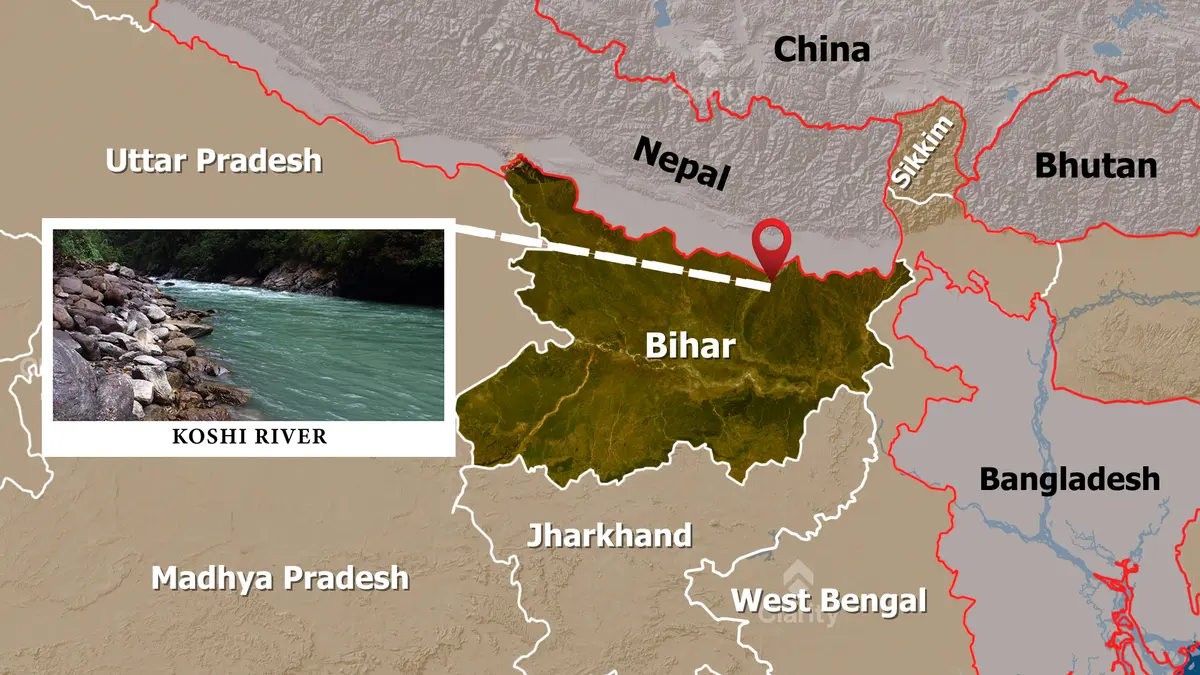
Why in news?
A recent feature on the Kosi River highlighted how this Himalayan river has shifted its course westward by more than 100 kilometres over the past two centuries. Its unpredictable shifting and heavy sediment load make it prone to sudden flooding, earning it the nickname “Sorrow of Bihar”. These floods impact millions of people each year, causing destruction yet also depositing fertile alluvial soil across the plains.
Background
The Kosi originates in the Himalayas of Tibet and Nepal. It is formed by the confluence of three main streams – the Sun Kosi, Arun and Tamur – collectively known as the Sapta Kosi system. The river flows south‑east through Nepal before entering Bihar, eventually joining the Ganga in Katihar district. Over centuries it has wandered across its broad alluvial fan, creating a maze of old channels. Heavy monsoon rains and landslides upstream carry enormous amounts of silt, which raise the riverbed and push the stream into new paths. When embankments fail or the river breaks through them, the resulting floods inundate vast areas.
Why the Kosi is called the ‘Sorrow of Bihar’
- Course shifting: The river has migrated westward by over 100 km in the past 200 years. Sudden shifts force floodwaters into populated areas, washing away villages, crops and infrastructure.
- Frequent floods: The heavy sediment load raises the riverbed, reducing its carrying capacity. When embankments breach – as in the severe 2008 flood – millions of people are displaced. The destruction, loss of life and disruption to livelihoods have led locals to describe it as Bihar’s sorrow.
- Dual nature: Despite its destructive floods, the Kosi also brings fertile alluvium that sustains agriculture in north Bihar. Farmers rely on the nutrient‑rich soil to grow maize, wheat and pulses, making the river both a threat and a lifeline.
Significance and challenges
- Transboundary management: Since the Kosi flows through China (Tibet), Nepal and India, effective flood control requires cooperation on embankment maintenance, sediment management and early warning systems across borders.
- Infrastructure and livelihoods: Embankments and barrages such as the Kosi Barrage seek to control the river, but they can also trap sediment and increase flood risk. Balanced approaches that include floodplains for natural dispersion may reduce damage while sustaining agriculture and fisheries.
- Climate change: Changing rainfall patterns and glacial melt in the Himalayas could further alter the river’s behaviour. Strengthening disaster preparedness and developing resilient farming practices are essential for communities in the Kosi basin.
Conclusion
The Kosi River is a powerful force shaping the landscape and livelihoods of north Bihar. Its frequent floods have earned it a fearful reputation, yet its sediments nourish one of India’s most productive agricultural regions. Understanding the river’s dynamics and implementing cooperative, adaptive flood management will help turn the Sorrow of Bihar into a more sustainable lifeline.
Source: India Today