
Why in news?
A 26-year-old farmer suffered critical injuries inside Odisha’s Kuldiha Wildlife Sanctuary. He had entered the forest after two cattle strayed inside. Preliminary field reports and photographs indicated a leopard attack. The incident highlights difficult human–wildlife interactions near forest boundaries.
Background
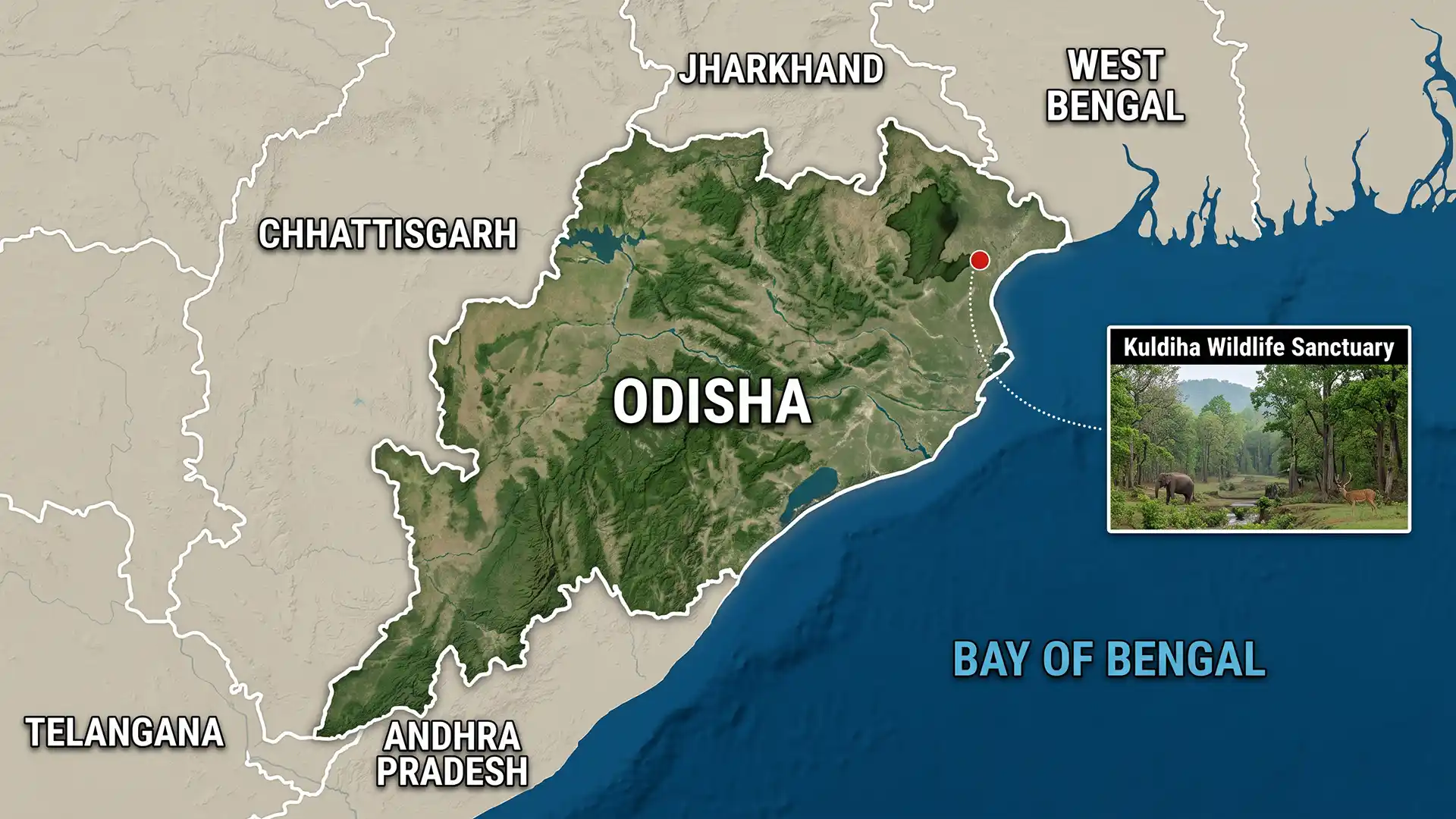
Kuldiha Wildlife Sanctuary lies in Balasore district, where Odisha notified it on 4 January 1984.
Its officially recorded 272.75 square kilometres occupy forested hills within the Nilagiri range.
Landscape setting
Kuldiha belongs to the Eastern Highlands, although some descriptions associate these hills with the wider Chota Nagpur region.
Rolling hills, valleys, streams and small plateaus create both moist and dry local habitats within short distances.
Kuldiha connects towards Similipal through Sukhupada, Nato and the adjoining Hadgarh Wildlife Sanctuary landscape.
Chronology of protection
- Odisha declared Kuldiha a wildlife sanctuary during January 1984.
- The sanctuary became part of the Mayurbhanj Elephant Reserve landscape.
- Conservation planning increasingly focused on connections with Hadgarh and Similipal.
- Odisha notified the Similipal–Hadgarh–Kuldiha Conservation Reserve during 2023.
A conservation reserve protects important ecological links adjoining national parks, wildlife sanctuaries and other government-owned forests.
It does not replace the separate legal identity of Kuldiha Wildlife Sanctuary.
Why does connectivity matter?
Elephants and other large animals need space beyond one protected boundary.
Continuous forest corridors permit seasonal movement, feeding, breeding and genetic exchange between otherwise separated wildlife populations.
Broken or obstructed corridors can force animals through busy roads, cultivated farms and densely occupied settlements.
Connectivity therefore supports biodiversity while also reducing dangerous encounters.
Vegetation
Mixed deciduous forest covers much of the sanctuary, where many trees shed leaves during the dry season.
Sal is a dominant tree species, together with locally important bija, asan and several bamboo species.
Perennial streams and shaded valleys support relatively moist plant communities within this mainly deciduous forest.
Important fauna
| Group | Examples |
|---|---|
| Large mammals | Asian elephants, gaur and leopards use this forest landscape. |
| Herbivores | Sambar and other deer provide important prey and grazing functions. |
| Smaller mammals | Indian giant squirrels and several forest mammals occur here. |
| Birds | Hornbills, hill mynas, peafowl and other forest birds occur. |
| Reptiles | Monitor lizards, cobras, vipers and pythons are reported. |
Understanding the leopard
The Indian leopard, Panthera pardus, is an adaptable big cat using forests, scrublands and rocky hills.
Leopards usually avoid people and remain most active between evening and the following early morning hours.
Natural prey includes deer, wild pigs, monkeys and smaller mammals.
They may approach forest-edge settlements when unguarded livestock or numerous stray dogs provide relatively easy prey.
Conservation status of the leopard
| Framework | Status |
|---|---|
| International Union for Conservation of Nature Red List | The leopard is globally listed as Vulnerable. |
| Convention on International Trade in Endangered Species | The leopard is included in Appendix I. |
| Wild Life (Protection) Act, 1972 | The species receives protection under Schedule I. |
What happened in the reported incident?
The farmer followed two bullocks that had strayed into the adjoining forest.
An animal reportedly attacked him during Friday afternoon.
Nearby villagers responded after hearing his cries, rescued him and arranged urgent movement to a local hospital.
Forest officials later recorded his statement, visited the hospital and examined the available photographs from local residents.
Officials said this preliminary field material indicated a leopard, while further verification remained appropriate.
Why do such encounters occur?
- Livestock may enter forests while grazing or after becoming separated.
- People enter forests for fuelwood, fodder or livestock retrieval.
- Dense vegetation can cause sudden close-range encounters.
- Habitat fragmentation may increase movement near farms and roads.
- Unsecured livestock can attract predators towards forest-edge settlements.
Reducing conflict
- Villages need quick communication channels with trained forest teams.
- Livestock should use secure night shelters near forest boundaries.
- People should avoid entering dense forest alone, especially during low light.
- Compensation must remain timely, transparent and easy to access.
- Corridors should remain free from disruptive construction and fencing.
- Monitoring should identify repeated animal routes near settlements.
Conclusion
Kuldiha’s connected forests protect wide-ranging wildlife, while safer boundaries require cooperation between residents and forest authorities.