

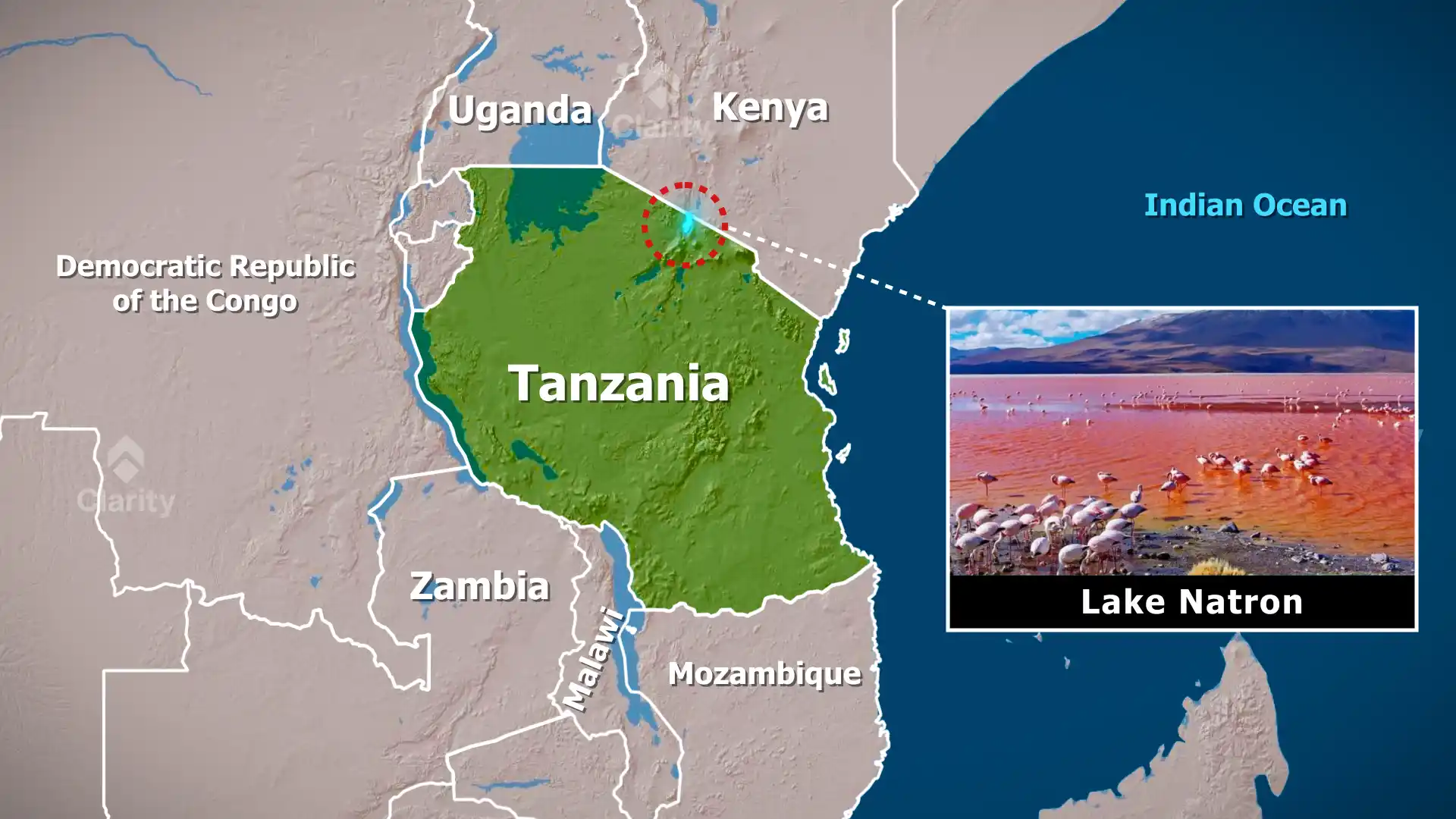
Why in news?
Photos of Tanzania’s Lake Natron appearing blood‑red and “turning animals to stone” resurfaced online, prompting curiosity about the lake’s extreme environment and its role as a critical breeding ground for lesser flamingos.
Background
Lake Natron lies in northern Tanzania near the Kenyan border, along the East African Rift. It is a soda lake, meaning it contains high concentrations of dissolved sodium carbonate and other alkaline salts. Water flows into the lake from seasonal rivers and hot springs but has no outlet, so salts accumulate as water evaporates. The surrounding geology, including volcanic ash deposits, continually feeds minerals into the basin.
Extreme conditions
- High alkalinity: The lake’s pH ranges between 9.5 and 12, approaching the causticity of household ammonia. This makes the water corrosive to the skin and eyes of most animals.
- Heat and shallowness: Lake Natron is shallow, averaging about 0.5 metres deep and roughly 15 kilometres wide. During the dry season, temperatures can reach 60 °C (140 °F), concentrating salts further.
- Red coloration: Salt‑loving microorganisms such as haloarchaea and cyanobacteria thrive in the alkaline water. They contain pigments that turn the lake shades of red and orange, especially when the water level recedes.
- Calcified carcasses: Animals not adapted to the lake may die and become coated in salt and minerals. Photographer Nick Brandt’s images of desiccated birds gave rise to the notion that the lake “turns animals to stone,” although the carcasses were positioned for artistic effect.
Life and ecology
- Lesser flamingos: Lake Natron is the world’s most important breeding site for lesser flamingos (Phoeniconaias minor). About 75 percent of the global population nests on islands that form during the dry season. The birds feed on cyanobacteria and their legs have tough skin and scales that protect them from burns.
- Endemic fish: A hardy species of tilapia (Alcolapia latilabris) lives in the warmer, less alkaline springs around the lake’s edge.
- Ramsar site: Recognising its ecological importance, Tanzania designated Lake Natron and its wetlands as a Ramsar site (wetland of international importance) on 4 July 2001.
Why it matters
- Conservation of flamingos: Protecting the lake’s water levels and quality is vital for the survival of East Africa’s lesser flamingos. Proposed developments, such as soda ash mining and hydroelectric dams, have raised concerns among conservationists.
- Unique landscape: The striking red waters and calcified shoreline attract photographers and tourists, but human activity must be managed to avoid disturbing wildlife.
- Climate indicator: Changes in rainfall and temperature can alter the lake’s size and chemistry. Monitoring Lake Natron offers insights into how climate change affects fragile soda lake ecosystems.