
Why in news?
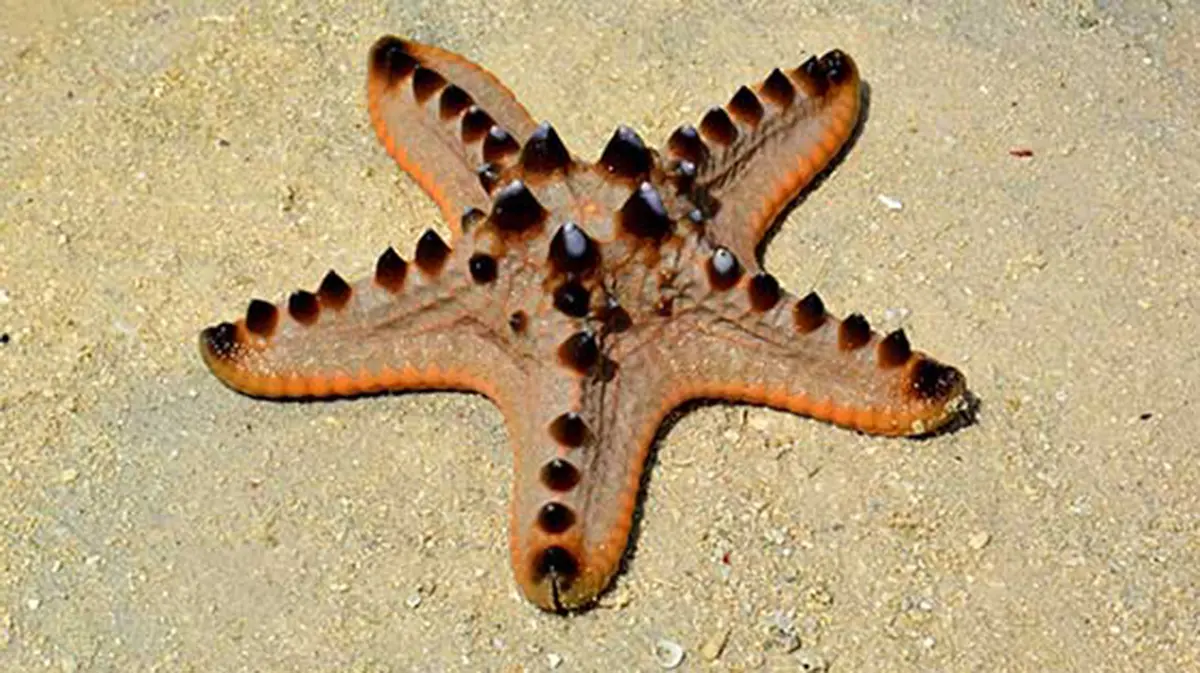
Scientists studying the chocolate chip sea star (Protoreaster nodosus) discovered a unique light‑guiding structure in its skeletal plate. The finding, published in an open research journal, shows that the sea star can transmit and focus light inside its body. This capability may inspire bio‑engineered materials and sheds light on how simple animals perceive their surroundings.
Background
The chocolate chip sea star lives in shallow warm waters of the Indo‑Pacific. It has a central disk with five thick arms and dark conical projections that look like chocolate chips. The species is carnivorous, feeding on clams, corals and other invertebrates. Inside the tip of each arm is a terminal plate made of calcite. Researchers found that this plate contains an array of cone‑shaped light‑guiding structures (LGSs) embedded in a porous matrix.
Key details
- Each light‑guiding cone transmits about 70 per cent of incoming light at normal incidence.
- The cones concentrate light up to 2.8 times as it exits into an internal cavity.
- The array covers a field of view of about 120 degrees and enhances transmitted light intensity six‑ to eight‑fold.
- The structure also increases the mechanical stiffness of the plate by three times compared with random bone.
- Scientists are still unsure if the sea star uses the structures for vision, sensory cues or thermoregulation.
Conclusion
The light‑guiding ossicles of Protoreaster nodosus show how evolution can combine optical and mechanical functions in one structure. Such discoveries may inspire engineers to design lightweight materials that channel light while bearing loads.
Source: The Hindu