
Why in news?
Scientists described a new African monkey species named Likweli. Its scientific name is Colobus congoensis. The study appeared on 15 July 2026. The monkey has a very small known range in the Democratic Republic of the Congo.
Background
Likweli is a black-and-white colobus monkey, and Colobus monkeys belong to the Old World monkey family Cercopithecidae.
Within that family, they form part of the subfamily Colobinae, and these leaf-eating monkeys occur naturally in tropical Africa.
The genus Colobus contained six widely recognised species before this description. Likweli becomes another scientifically recognised member.
Meaning of “new species”: Likweli is newly described by science. It did not suddenly evolve during 2026.
Where was it found?
The species lives in east-central Democratic Republic of the Congo. Its known range covers only about 1,700 square kilometres.
This area lies between the Lomami and Lualaba river systems, and scientists call such land between rivers an interfluve.
Confirmed records extend eastward from the Lomami River towards the Lilo River, and they fall within Tshopo and Maniema provinces.
Most confirmed sites lie inside Lomami National Park, and the surrounding forest remains important because animals cross administrative boundaries.
How was the species discovered?
- Ashley Vosper and Bernard Ikembelo photographed an unusual monkey during 2008.
- The animal’s appearance did not match any known local colobus species.
- No further confirmed report emerged for roughly ten years.
- Jean Pierre Kapale photographed a diagnostic individual during November 2018.
- Researchers then reviewed another photograph taken during August 2018.
- That earlier image had originally received an incorrect species identification.
- Field teams recorded 114 observations between 2018 and 2022.
- Researchers combined body features, genetics and calls before naming the species.
The Public Library of Science publishes PLOS ONE, which carried the description. Its authors recommended “Likweli” as the common name.
Balanga-speaking communities use that name, and Mituku speakers call it “kasaba nkoni,” meaning branch shaker.
Local knowledge guided scientific fieldwork, and only eight of fifty-two surveyed villages could accurately describe the animal.
What does Likweli look like?
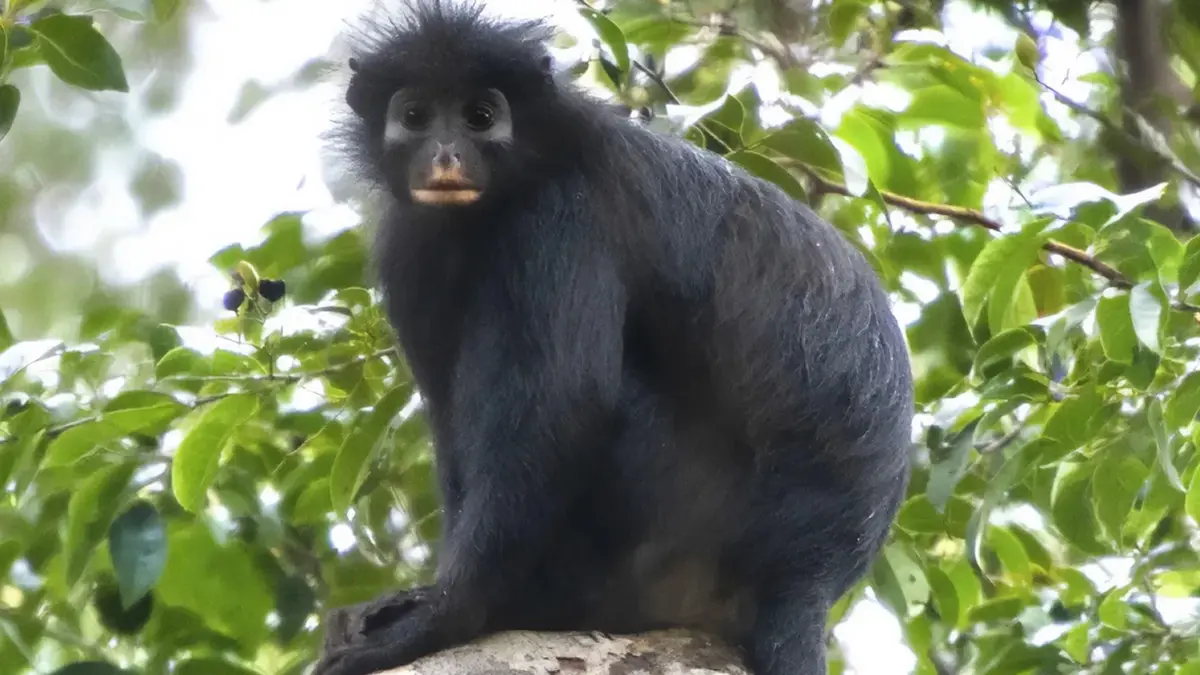
Likweli has a largely glossy black coat, and long hair forms a cape around its shoulders and back.
An orange-cream patch surrounds its mouth and nose, and this facial colour provides a particularly noticeable identifying feature.
Its tail is long, and its body is relatively small. The skull is smaller than those of several related colobus monkeys.
Both sexes have a white patch around the rear, and the patch differs slightly between males and females.
How did scientists establish a separate species?
Taxonomy requires evidence that a population is consistently distinct, and researchers used three independent forms of evidence.
- Body structure: Facial colour, hair patterns and skull measurements differed from related species.
- Genetic evidence: Researchers compared 4,090 base pairs of mitochondrial deoxyribonucleic acid.
- Sound evidence: Recorded male roars were compared with calls from other colobus monkeys.
Deoxyribonucleic acid carries inherited biological information, and mitochondrial material passes mainly through the maternal line in mammals.
The genetic results placed Likweli nearest to the black colobus, Colobus satanas. Their present ranges lie over 1,200 kilometres apart.
Different dating methods suggested separation around four to five million years ago, and such estimates always contain statistical uncertainty.
How does it live?
Likweli favours tall, closed-canopy forest on firm ground, and it also uses forest islands surrounded by different vegetation.
Researchers found relatively small groups, averaging about six animals, and the monkey often joins groups of other primate species.
It associates with Lomami red colobus and Angolan colobus monkeys, and mixed groups may improve feeding or predator detection.
Males produce loud morning roars and snorts, and their calls resemble those of the black colobus.
Why is the discovery exceptional?
The researchers call it only the fifth newly discovered African monkey species in seventy-five years.
This statement concerns field discoveries of previously unknown monkeys. It does not include every later taxonomic division of known populations.
The finding also reveals major scientific gaps in Central African forests. Large mammals can remain poorly documented in remote landscapes.
What is its conservation position?
The authors recommend a preliminary Endangered classification because the species has a tiny range and specialised habitat.
Hunting, population growth and forest conversion may increase future pressure, and dependence on mature forest makes rapid adaptation difficult.
Status correction: Endangered is the researchers’ proposal. It is not yet a completed International Union for Conservation of Nature assessment.
Protection should focus on Lomami National Park and nearby forests, and cooperation with resident communities remains essential for preventing hunting.
Conclusion
Likweli shows that major species can remain scientifically unknown. Its discovery must now support careful research and local forest protection.