
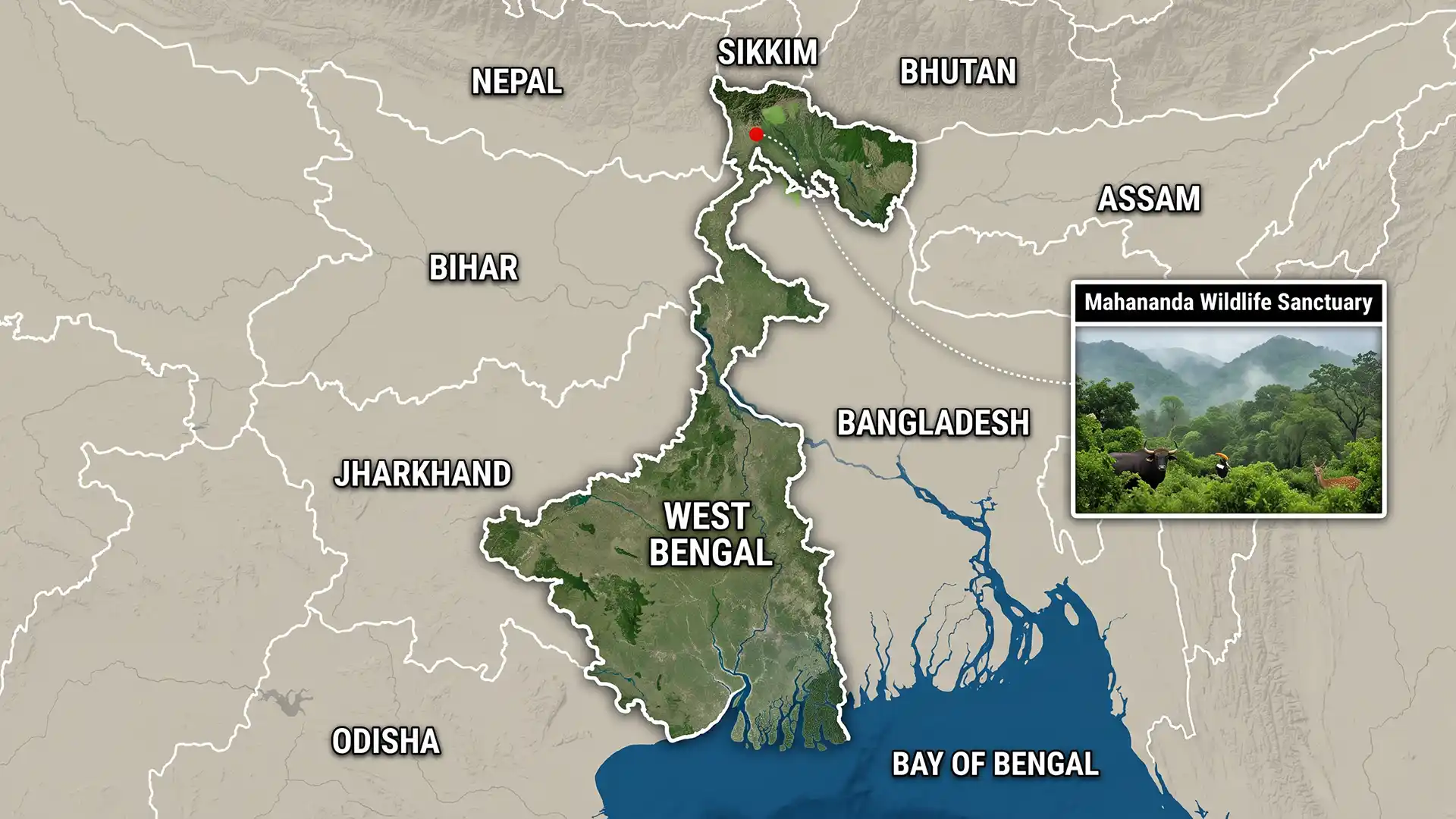
Why in news?
West Bengal announced plans to reduce a proposed regulatory zone. The change concerns areas around Mahananda Wildlife Sanctuary. The state prefers one kilometre instead of five kilometres. A final legal change requires the prescribed central notification process.
Background
Mahananda Wildlife Sanctuary lies in the Himalayan foothills of northern West Bengal, and it covers about 158.04 square kilometres.
The sanctuary is located mainly in Darjeeling district, and Siliguri, Sukna and surrounding settlements lie close to its boundaries.
The Teesta River lies towards its east, and the Mahananda River and its tributaries drain the western landscape.
Its altitude rises from roughly 166 metres near Sukna, and higher areas around Latpanchar reach about 1,500 metres.
This sharp rise creates several habitat types, and riverine forests gradually change into moist foothill and hill forests.
How did the protected area develop?
- The area received protection as a game sanctuary during 1955.
- Further sanctuary protection followed during 1959 under the existing framework.
- India enacted the Wildlife (Protection) Act during 1972.
- A 1976 notification aligned the sanctuary with the newer national law.
- Later conservation planning recognised its role in a wider elephant landscape.
Historical correction: The area began as a game sanctuary. Claims describing it as a “game sanctuary for children” are incorrect.
Which plants and animals occur there?
Lower forests contain sal, khair and sissoo, and higher slopes support moist mixed forests and broad-leaved trees.
Asian elephants move through the landscape, and gaur, leopard, barking deer, serow and Himalayan black bear also occur.
Gaur is sometimes called Indian bison. However, Bos gaurus is not a true bison species.
Clouded leopards have also been recorded, and hornbills and many Himalayan foothill birds make the sanctuary important for birdwatching.
The forest connects lowland Terai habitats with Himalayan slopes, and roads, railways and settlements can interrupt animal movement.
What is an eco-sensitive zone?
An eco-sensitive zone is a regulated transition area around a protected area, and it is often called an ESZ.
The Union Environment Ministry notifies such zones under the Environment (Protection) Act, 1986, and state governments submit and discuss proposals.
An eco-sensitive zone does not become part of the sanctuary, and it provides graded regulation outside the protected boundary.
The aim is to reduce sudden ecological pressure. Activities nearest wildlife habitat may affect water, noise, air or movement routes.
Are all activities prohibited?
No, because notifications usually divide activities into prohibited, regulated and permitted groups. The exact list depends upon each final notification.
- Commercial mining and highly polluting industries are generally prohibited.
- Large construction, tourism facilities and roads may require regulation.
- Traditional farming and existing household activities usually continue.
- Rainwater harvesting and organic farming are generally encouraged.
- Residents are not automatically evicted merely because an ESZ exists.
Prelims point: An eco-sensitive zone is not a complete no-activity belt, and its width can vary locally.
How did the one-kilometre rule develop?
On 3 June 2022, the Supreme Court directed a default one-kilometre zone around protected areas.
The direction addressed places lacking a final or proposed notification. It was never a universal ecological measurement for every landscape.
On 26 April 2023, the Court modified its earlier direction. Properly notified or officially proposed site-specific zones could continue to govern.
Therefore, a zone may be smaller or larger than one kilometre. Ecological needs, settlements and geography shape the final boundary.
What has West Bengal announced?
The state government said it wanted to reduce the proposed Mahananda zone. Its preferred outer distance is now one kilometre.
State officials said a five-kilometre belt created legal obstacles, and they cited infrastructure around Siliguri, Dabgram, Salugara and Sukna.
Environmental groups warned that a smaller zone could expose corridors and catchments, and they requested decisions based upon ecological mapping.
The forest minister said the final framework would consider ecology, and details about a uniform boundary remained unclear.
Legal status: A state announcement cannot by itself amend a central ESZ notification. The prescribed expert and Gazette process must finish.
What factors should determine the boundary?
- Elephant corridors should remain free from new movement barriers.
- River catchments and steep slopes require erosion protection.
- Rail and road collision locations need targeted safeguards.
- Existing settlements require clear and fair activity rules.
- Industrial pollution risks need scientific measurement.
- The boundary can vary instead of following one perfect circle.
Why does the decision matter?
Siliguri is a major transport and commercial centre. It also lies beside a narrow ecological connection to the eastern Himalaya.
Unplanned growth can isolate wildlife and increase conflict, and excessive restrictions can also burden residents and essential public services.
A sound zone must therefore protect ecological functions without ignoring local needs, and transparent maps can reduce uncertainty for everyone.
Conclusion
The debate is not simply five kilometres against one kilometre. Scientific mapping and lawful notification should decide protection for each location.