
Why in news?
India and Maldives completed their first free-trade negotiation round. Both sides reported progress across several areas. Bilateral trade exceeded 771 million dollars during 2025–26. No free trade agreement has been signed yet.
Background
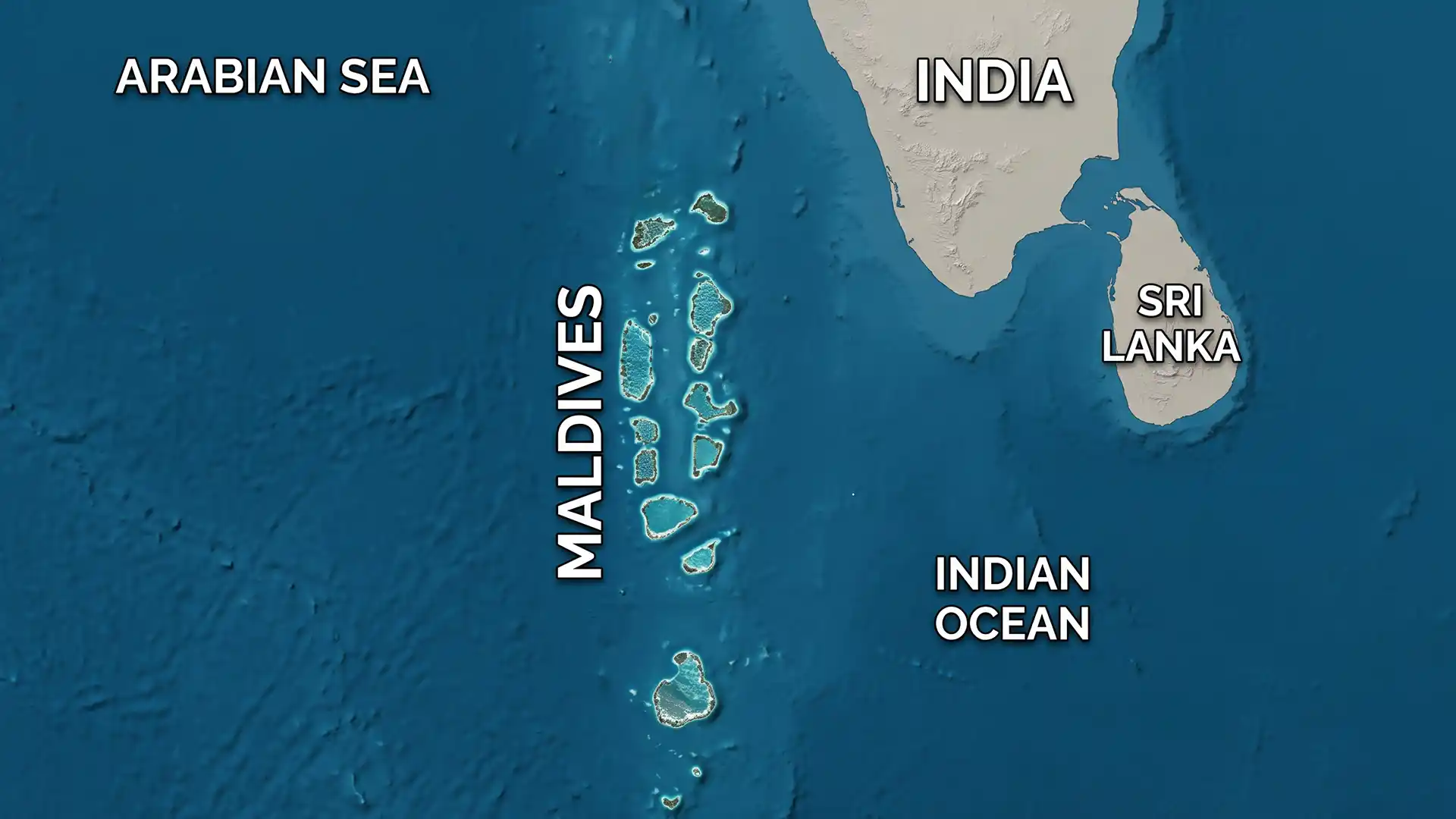
Maldives is a small South Asian island country in the Indian Ocean. It lies southwest of India and Sri Lanka.
The country consists of about 1,192 coral islands, and they form a double chain of twenty-six natural atolls.
An atoll is a ring-shaped coral reef around a lagoon, and many Maldivian islands rise only slightly above sea level.
Malé is the national capital. The country has about 298 square kilometres of land across roughly 90,000 square kilometres of sea.
Counting caution: Island and atoll totals vary by survey and definition, and natural atolls differ from administrative units.
How did the islands form?
- Volcanic islands once rose from the Indian Ocean floor.
- Coral reefs developed around their warm, shallow shores.
- The volcanic foundations slowly sank and eroded.
- Corals continued growing upward towards sunlight.
- Reef rings and lagoons remained above submerged foundations.
- Sand and broken coral accumulated into low islands.
This process explains the country’s low elevation, and Maldives is widely recognised as the world’s lowest-lying country.
Average ground height is about 1.5 metres, and the highest natural point is only about 2.4 metres.
Sea-level rise therefore threatens coasts, homes and freshwater, and salt water can also enter thin underground freshwater lenses.
Which channels are important?
The Eight Degree Channel lies between Minicoy and northern Maldives, and Minicoy forms part of India’s Lakshadweep islands.
The channel takes its name from the nearby latitude. The India–Maldives maritime boundary also passes through this wider area.
The One and a Half Degree Channel crosses the Maldivian island chain, and it lies between Haddhunmathi and Huvadhu atolls.
These deep channels support navigation through the archipelago, and their names are useful map-based facts for preliminary examinations.
Map fact: The Eight Degree Channel separates Minicoy from northern Maldives. The One and a Half Degree Channel lies farther south.
How did India–Maldives relations develop?
- Maldives became independent from Britain in July 1965.
- India established diplomatic relations during that year.
- India launched Operation Cactus after a requested intervention in 1988.
- Indian forces helped defeat an attempted coup.
- India provided help after the 2004 Indian Ocean tsunami.
- India supplied drinking water during Malé’s 2014 water crisis.
- Medical and economic support continued during the coronavirus period.
- Both sides launched formal trade-agreement talks in July 2025.
India is the closest large economy to Maldives, and geography therefore shapes supplies, tourism, security and disaster response.
Maldives also lies near important Indian Ocean shipping routes, and its location gives the relationship wider strategic importance.
What is a free trade agreement?
A free trade agreement reduces selected barriers between participating economies, and these barriers can include customs duties and restrictive rules.
Such an agreement does not make every product duty-free immediately, and countries negotiate exclusions, timelines and origin requirements.
Rules of origin identify where a product was substantially made. They stop outsiders from misusing lower tariffs through simple re-routing.
Modern agreements can also cover services, investment and digital trade. Domestic laws continue to apply after an agreement enters force.
What happened in the first round?
Officials held the first negotiation round virtually, and they discussed market access, investment and wider economic cooperation.
Both sides reported broad convergence and substantive progress, but agreed wording still requires further negotiation and legal review.
India described the proposed agreement as broad, balanced and comprehensive, and fairness and reciprocity remain stated guiding principles.
Current status: The first round has concluded, and the agreement is neither signed nor in force.
What do the trade figures show?
Bilateral goods trade exceeded 771 million dollars during 2025–26, and it stood near 679 million dollars during 2024–25.
This represents reported growth of 13.54 per cent, and India was Maldives’ second-largest trading partner during the latest period.
Annual totals can vary with fuel, construction demand and tourism activity. Exchange rates and reporting revisions can also affect comparisons.
What could each side gain?
- Maldives could gain easier access to food and medicines.
- Construction materials may become cheaper and more predictable.
- Indian businesses could gain clearer investment rules.
- Service providers may receive better market access.
- Smaller firms could benefit from simpler customs procedures.
- Reliable supply chains can improve emergency resilience.
Maldives imports most essential goods because its land and manufacturing base are small. Nearby Indian suppliers can reduce delivery time.
Which concerns require attention?
- Maldivian producers may face competition from larger Indian firms.
- Tariff cuts can reduce government customs revenue.
- Unequal economic size requires careful transition periods.
- Rules should protect food, labour and environmental standards.
- Debt-creating projects need transparent financial assessment.
- Climate-resilient infrastructure should guide future investment.
A durable agreement needs political trust and practical enforcement, and it should also recognise Maldives’ small-island vulnerabilities.
Conclusion
The first round marks progress, not completion, and a balanced agreement could deepen trade while protecting smaller and vulnerable sectors.