
Why in news?
Migratory birds have returned to Manasbal Lake in notable numbers. Authorities linked the return with ongoing restoration work. Dredging and weed removal improved parts of the wetland habitat. However, the lake still faces serious pollution pressures.
Background
Manasbal is a freshwater lake in Jammu and Kashmir, located near Safapora in Ganderbal district.
The lake is roughly 30 kilometres northwest of Srinagar; it stands about 1,583 metres above mean sea level.
Its surface area is approximately 2.81 square kilometres.
Published studies generally place its maximum depth near 12 or 13 metres.
Local tradition connects the name Manasbal with Lake Manasarovar.
This name link is a traditional explanation, not a proven geological relationship.
How does the lake receive and release water?
Natural springs and groundwater feed the lake; rainfall and surface runoff also enter it.
Many accounts refer to numerous springs beneath or around its basin.
Its outlet, Nunnyar Nallah, connects the lake with the wider Jhelum river system.
Manasbal is not completely closed; surrounding land-use changes can therefore affect its water quality quickly.
What does “warm monomictic” mean?
Scientists describe Manasbal as warm monomictic; during warmer months, upper water remains warmer than deeper water.
This temperature difference creates separate layers, which mix completely during one cooler period each year.
“Monomictic” means full mixing occurs once annually; this cycle influences oxygen, nutrients, plankton and fish habitat.
Why is Manasbal ecologically important?
- The lake supports fish, aquatic plants and microscopic plankton.
- Its open water and reed areas provide feeding places for birds.
- Migratory waterbirds use Kashmir’s wetlands during colder months.
- Lotus growth supports local livelihoods and traditional food use.
- The wider landscape connects the lake with nearby wetland habitats.
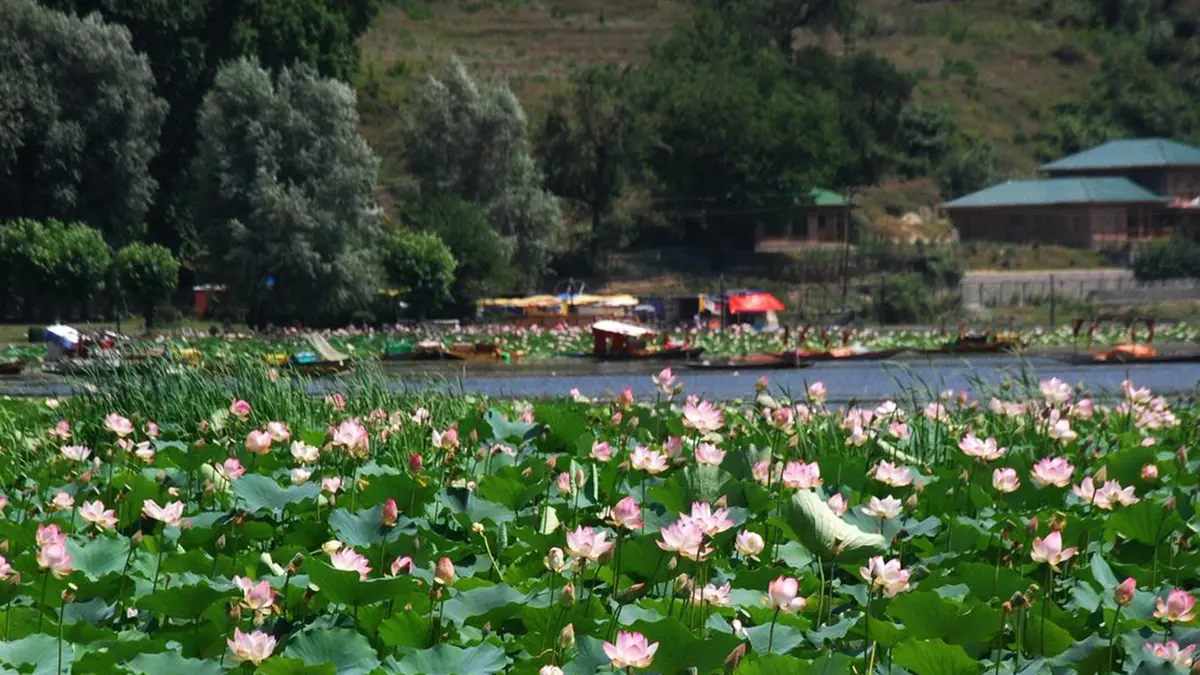
Lotus plants usually bloom during July and August; local communities harvest several parts, including the edible stem.
The lake also supports fishing, tourism and small local businesses.
What is its cultural importance?
A Mughal garden called Jaroka Bagh, also Jharokha Bagh, overlooks the lake; Nur Jahan built it during the seventeenth century.
The structure reflects the Mughal practice of combining gardens with scenic water bodies.
Manasbal therefore carries ecological, livelihood and heritage value together.
Why did the lake deteriorate?
- Catchment runoff brought silt, while untreated sewage increased the lake’s pollution burden.
- Agricultural runoff carried nutrients and chemicals into the water.
- Solid waste affected the shoreline and nearby settlements.
- Excessive aquatic weeds reduced open water, while encroachment damaged the lake’s natural margins.
- Recent research has also detected microplastics in the lake system.
Extra nutrients can cause excessive growth, called eutrophication; later decomposition consumes oxygen and harms aquatic organisms.
What restoration work was undertaken?
The Wular-Manasbal Development Authority, shortened to WMDA, manages major restoration work around the lake.
The authority intensified dredging and deweeding during late 2025 and 2026.
Dredging removes accumulated sediment from selected parts of the lake.
Deweeding removes excessive vegetation that blocks open water and water movement.
The authority reported dredging about 1.3 square kilometres by March 2026.
It also reported removing nearly 7,000 cubic metres of weeds.
These figures describe reported work completed by that stage, not the entire lake’s recovery.
Why did migratory birds return?
Removal of dense weeds created more open water and accessible feeding areas.
Improved circulation may also have supported better habitat conditions.
Authorities reported large bird numbers after limited visits for decades; the return is an encouraging biological signal.
One successful season cannot prove complete recovery; birds, water quality and habitat condition require continued monitoring.
Is Manasbal India’s deepest freshwater lake?
Several government pages and research papers repeat that national superlative.
They usually connect it with Manasbal’s maximum depth of about 13 metres.
Published measurements for several other freshwater lakes exceed that depth; therefore, the nationwide claim is difficult to defend.
A safer description is “the deepest freshwater lake in the Kashmir Valley”.
Accuracy correction: Use the Kashmir Valley description; treat the broader “deepest in India” claim as disputed.
What does the bird return not prove?
- It does not prove that sewage inflow has ended.
- It does not remove the need for catchment protection.
- It does not show that every part has recovered.
- It does not settle the lake’s long-term nutrient problem.
- It does not guarantee similar bird numbers every year.
In February 2026, the National Green Tribunal issued notices over allegations that untreated sewage entered the lake.
These notices showed that restoration must address pollution sources beyond the water itself.
What should long-term conservation include?
- Conservation requires sewage treatment and catchment measures that reduce soil and nutrient runoff.
- Solid waste collection should cover settlements and tourist areas.
- Dredging should follow scientific assessment and ecological safeguards.
- Birds, fish, plants and water chemistry require regular monitoring.
- Local residents should share in planning and livelihood benefits.
Conclusion
The birds’ return offers hope for Manasbal Lake; lasting recovery requires pollution control, habitat protection and continuous scientific monitoring.