

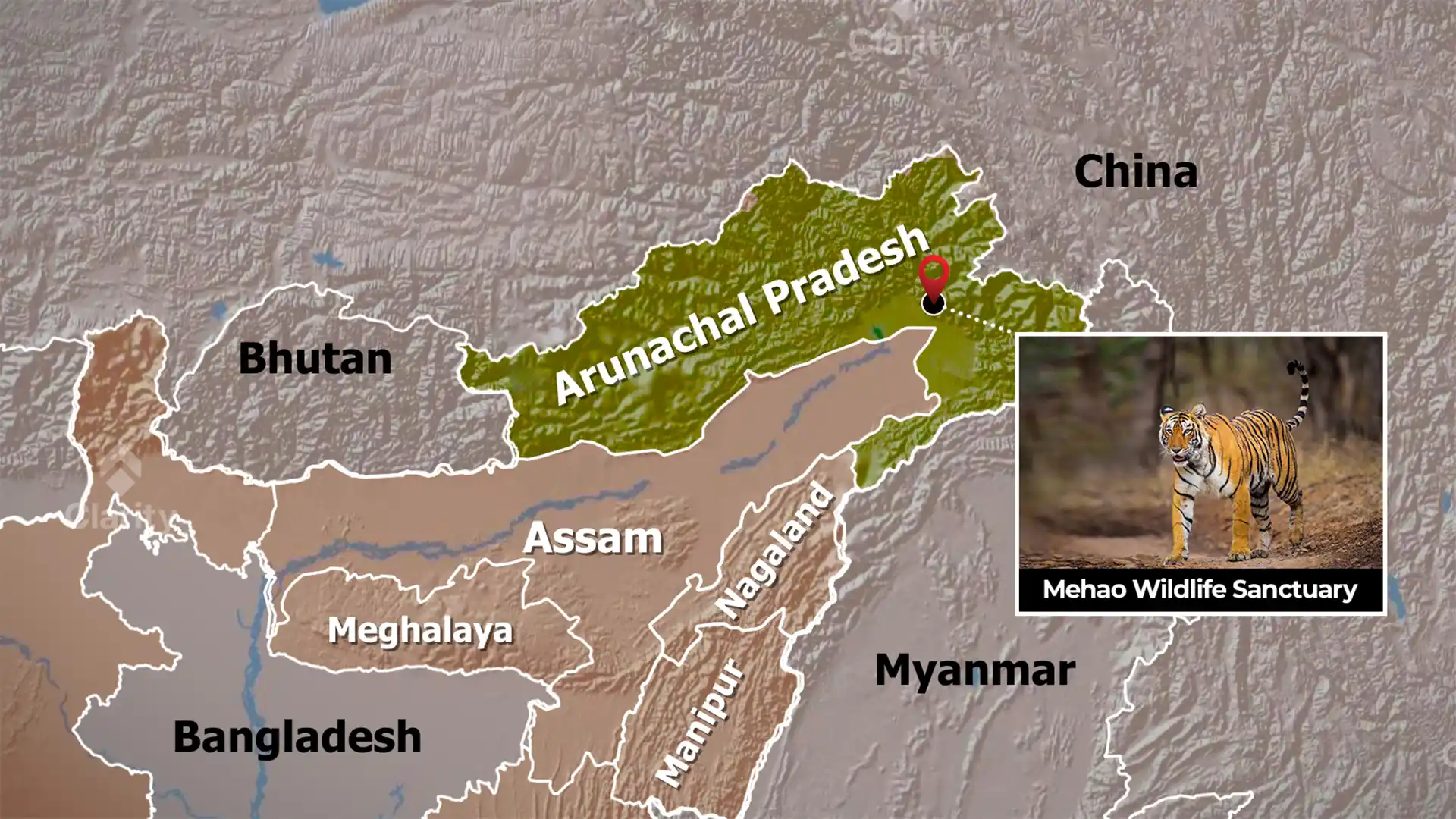
Why in news?
The government of Arunachal Pradesh has authorised the capture and relocation of a tiger that killed a head constable on the Roing–Mayodia road near Mehao Wildlife Sanctuary. Following the fatal attack, Forest Minister Wanki Lowang ordered expert veterinary teams and wildlife specialists to trap the animal humanely. He also announced an ex‑gratia payment of ₹10 lakh to the victim’s family and set up a committee to monitor the operation.
Background
Mehao Wildlife Sanctuary lies in the Lower Dibang Valley district of Arunachal Pradesh, about 17 km from Roing. Spread over roughly 281.5 km² and rising from 400 m to 3,568 m above sea level, the sanctuary encompasses evergreen, sub‑tropical and temperate forests. Its varied habitats support a rich diversity of flora and fauna.
Among the large mammals are tigers, leopards, clouded leopards, Asiatic black bears, wild pigs, gaurs, red pandas and primates such as hoolock gibbons. Elephants, musk deer and serow also roam the hills, while avian life includes hornbills, kingfishers, pheasants and numerous migratory birds. The sanctuary’s Mehao Lake, surrounded by dense forest, is a major attraction for tourists and researchers.
Recent incident and response
- Fatal attack: A head constable traveling on the Roing–Mayodia road was attacked and killed by a tiger. Such incidents are rare but raise concerns about human–wildlife conflict.
- Capture order: Forest Minister Wanki Lowang directed officials to capture the tiger using tranquilliser guns and cage traps, emphasising that the animal must not be harmed unnecessarily.
- Specialist team: Veterinarians and wildlife experts were deployed, and a technical committee was established to monitor the rescue operation and recommend further measures.
- Compensation and awareness: The minister announced ₹10 lakh as ex‑gratia relief for the victim’s family and urged local residents to follow safety advisories when traveling through forested areas.
Significance
- Balancing conservation and safety: The incident highlights the challenge of protecting endangered tigers while safeguarding local communities. Capturing and relocating problematic animals allows both goals to be pursued.
- Importance of biodiversity hotspots: Mehao Wildlife Sanctuary plays a crucial role in conserving rare species and maintaining ecological balance in the Eastern Himalayas.
- Community engagement: Encouraging public participation in wildlife monitoring and providing compensation for losses can build support for conservation initiatives.
Conclusion
By responding swiftly and ethically to human–wildlife conflict, authorities aim to protect both people and wildlife in Mehao. Long‑term solutions will require habitat conservation, awareness campaigns and careful management of animal movements.
Sources: HUB NETWORK