
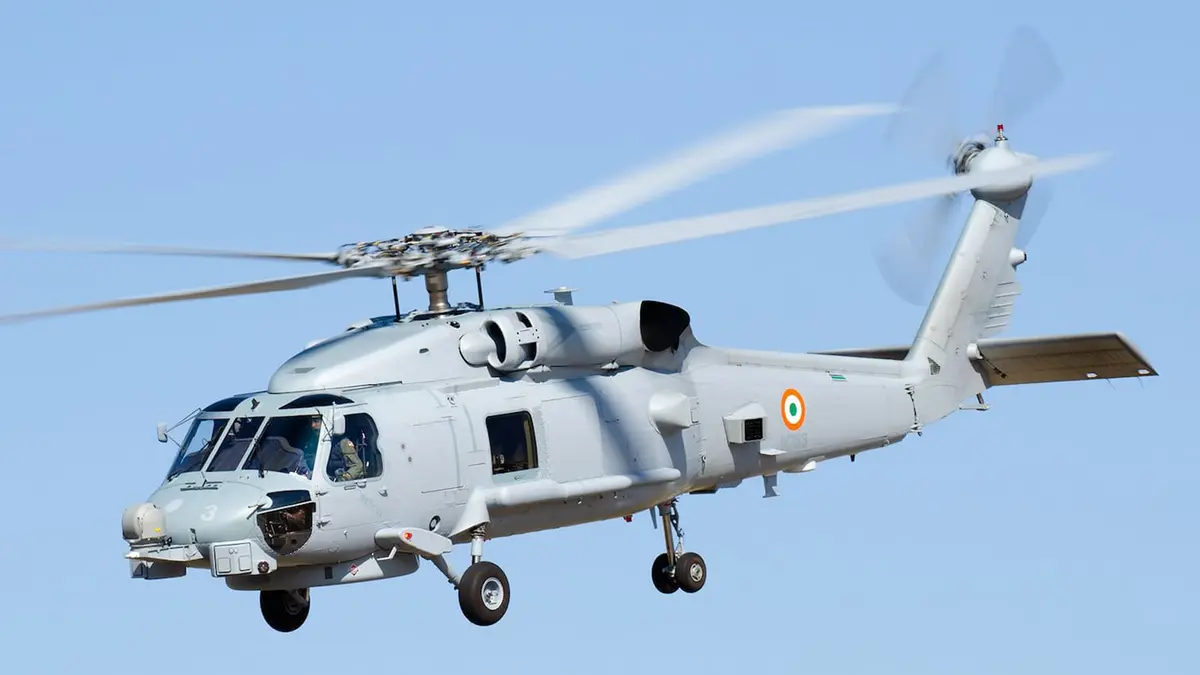
Why in news?
The United States confirmed another MH-60R Seahawk delivery to India. The helicopter reached the Indian Navy at Kochi. Two more aircraft were expected during the same week. The delivery moves India’s 24-helicopter order near completion.
Background
A submarine can threaten ships while remaining hidden below the sea.
Warships therefore need sensors that can search beneath the water.
A shipborne helicopter can cover a much wider area than its parent ship.
It can carry sensors and weapons far from the parent vessel; the MH-60R Seahawk was designed for this naval role.
What is the MH-60R Seahawk?
The MH-60R is a twin-engine, all-weather naval helicopter produced by Sikorsky, a Lockheed Martin company.
Lockheed Martin also supplies important mission systems; the aircraft belongs to the wider H-60 helicopter family.
It is a maritime development of the Black Hawk design.
Naval equipment allows it to operate from ships and coastal air stations.
The United States Navy uses it as a primary submarine and surface warfare helicopter.
What does the model name mean?
“MH” indicates a multi-mission helicopter in the American designation system; number 60 connects it with the H-60 family.
The letter R identifies this model; “Romeo” is the North Atlantic Treaty Organization phonetic word for R.
No invented expansion: “Romeo” is a phonetic word for R; it is not an acronym.
“Seahawk” is the name used for the maritime H-60 family.
How did India acquire the helicopters?
- India identified a need for modern shipborne helicopters and signed an American agreement in February 2020.
- The agreement covered 24 aircraft through the United States Foreign Military Sales route, shortened to FMS.
- The first three were handed over in the United States during 2021 for Indian crew training.
- The first squadron followed at Kochi in March 2024; a second followed at Goa in December 2025.
- The latest aircraft reached Kochi during July 2026.
Foreign Military Sales is a government-to-government American defence transfer programme.
The American Government manages the sale while companies provide equipment and support.
Which Indian squadrons operate the type?
Indian Naval Air Squadron 334 was the first Indian MH-60R squadron.
The Navy commissioned INAS 334, called the “Seahawks”, on 6 March 2024.
It is based at Indian Naval Ship Garuda in Kochi; Indian Naval Ship is shortened to INS.
INAS 335, called the “Ospreys”, became the second squadron.
The Navy commissioned it at INS Hansa, Goa, on 17 December 2025.
The two locations support operations on India’s western seaboard.
How many had arrived by the latest announcement?
The United States Embassy confirmed one delivery at Kochi during the previous week.
It also said two more aircraft would arrive during the same week.
The embassy gave no ordinal number for the latest aircraft; press reports used different running delivery counts.
Differences can arise when training handovers and Indian arrivals are counted differently.
The reliable conclusion is that the 24-aircraft order was near completion.
Count caution: Use the official wording: one more arrived, two were imminent, and the total order remains 24.
What is anti-submarine warfare?
Anti-Submarine Warfare is shortened to ASW; it involves finding, tracking, deterring or attacking hostile submarines.
Seawater makes this task difficult because submarines remain hidden below the surface.
The MH-60R carries several systems that work together during the search.
How does it search for a submarine?
- The helicopter flies ahead while its crew studies intelligence and the expected submarine location.
- Sonobuoys may be dropped into selected water areas.
- These floating sensors listen for underwater sound.
- A dipping sonar can be lowered directly from the hovering helicopter.
- The mission system combines acoustic information with other sensor data.
- The crew then classifies and tracks a possible contact.
- A lightweight torpedo may be launched after proper authorisation.
Sonar uses sound to detect underwater objects; sonobuoys spread the search across several points.
Dipping sonar lets the helicopter examine a chosen area more closely.
How does it find surface threats?
Anti-Surface Warfare is shortened to ASuW; it concerns hostile ships, boats and other surface targets.
A multi-mode radar searches a large area and tracks surface contacts.
An electro-optical and infrared sensor provides visual and heat imagery; the combined term is shortened to EO/IR.
Electronic support equipment identifies electromagnetic emissions; secure data links share the tactical picture with ships and aircraft.
Which weapons can the platform carry?
- Mark 54 torpedoes can engage submarines, while AGM-114 Hellfire missiles target suitable surface threats.
- Rockets can support selected surface missions.
- Crew-served guns can provide close-range protection and fire support.
AGM-114 is a weapon designation, not an abbreviation requiring a phrase expansion.
Exact Indian weapon carriage depends upon configuration, mission and approved integration.
Sensors often matter as much as weapons because an unseen target cannot be engaged.
What other missions can it perform?
- Surveillance: Sensors can build a wider picture of maritime activity.
- Search and rescue: Crews can locate and recover people in danger.
- Medical evacuation: Patients can be moved from ships or remote locations.
- Logistics: The helicopter can carry personnel and urgent stores.
- Vertical replenishment: Loads can move between ships without docking.
- Special operations: Trained personnel can be inserted or recovered.
- Command support: Data links can connect units during complex missions.
This mission range explains the “multi-mission” part of its designation.
What are its basic characteristics?
- The helicopter has two General Electric T700 turboshaft engines.
- Its published overall length is about 19.8 metres.
- Its height is about 5.2 metres.
- Its maximum gross weight is about 10.7 tonnes.
- A standard United States Navy crew has three people.
Mission equipment, weather and fuel affect performance; range and payload figures therefore need operating context.
How is it different from a normal Black Hawk?
The Black Hawk family was mainly developed for land operations; the MH-60R shares its H-60 design foundation.
However, it carries specialised naval sensors, software and weapons.
It also includes features required for shipboard handling and harsh maritime conditions.
Calling it merely a transport Black Hawk would ignore its main naval purpose.
What is sustainment support?
Buying an aircraft is only the first part of long-term operation.
The fleet needs spare parts, repairs, training, technical publications and supply support.
On 28 November 2025, India signed five-year sustainment arrangements with the United States, reportedly worth about ₹7,995 crore.
This amount concerns support for the fleet, not a fresh order for 24 helicopters.
Prelims distinction: The February 2020 agreement procured 24 aircraft; the November 2025 arrangements support their operation.
Why does the aircraft matter for India?
- It strengthens the Navy’s ability to detect submarines far from ships.
- It protects carrier groups and other important naval formations.
- It helps address capability gaps created by ageing Sea King helicopters.
- It can operate from suitable Indian warships and shore bases.
- Its data systems improve cooperation with other naval platforms.
- Its secondary roles support rescue, logistics and medical emergencies.
The Indian Ocean carries major trade and energy routes; better airborne surveillance therefore supports defence and maritime stability.
Conclusion
The latest delivery brings India’s 24-aircraft programme near completion; training, maintenance and ship integration will determine operational value.