

Why in news?
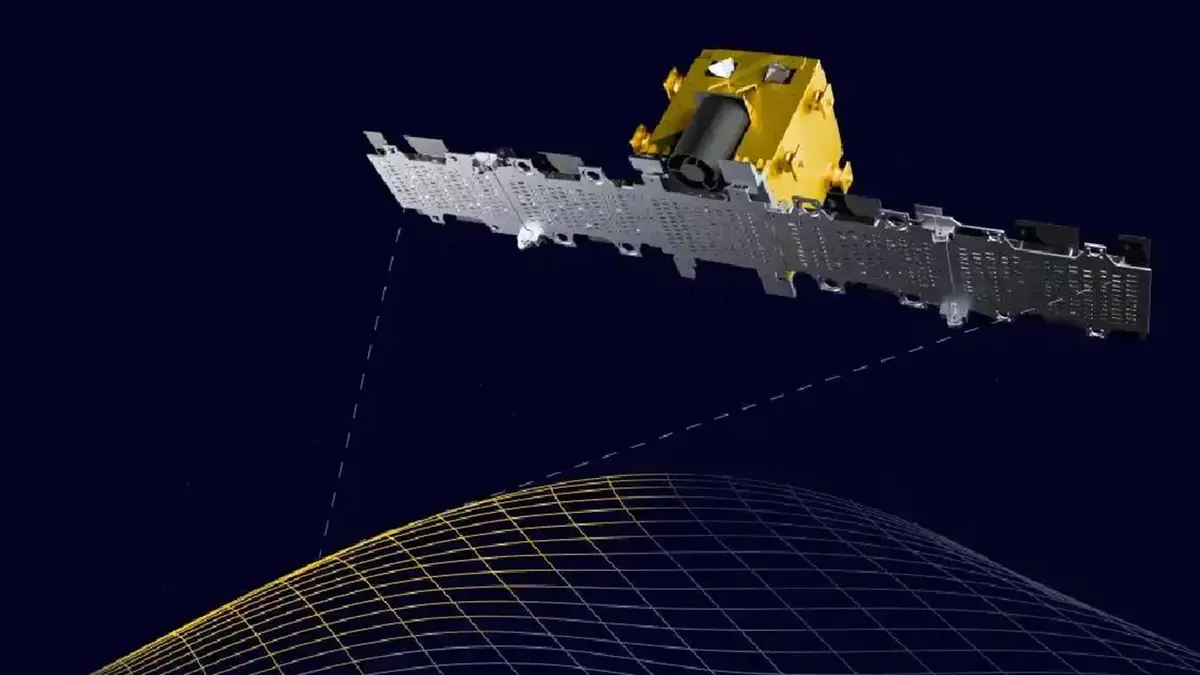
On 3 May 2026, start‑up GalaxEye successfully launched Mission Drishti – the world’s first OptoSAR satellite – aboard a Falcon 9 rocket. It is the largest privately built Earth‑observation satellite by an Indian company.
Background
Drishti is a 190 kg satellite that carries both multispectral optical cameras and a synthetic aperture radar (SAR) on one platform. Developed by a team of IIT Madras alumni, it demonstrates that the private sector can build sophisticated space technology.
- OptoSAR technology: optical sensors capture high‑resolution colour images but cannot penetrate cloud or darkness; SAR radar works through clouds and at night but has speckled images. By fusing both data streams, Drishti delivers clear, all‑weather, day‑night pictures.
- Orbit and resolution: it orbits about 500 km above Earth and offers a fused resolution of around 1.2–3.6 m, depending on imaging mode.
- Applications: the satellite will supply analysis‑ready imagery for crop monitoring, urban planning, disaster response and national security. It can help detect illegal construction, monitor floods and track ship movements.
- Significance: the mission demonstrates India’s growing private‑sector capabilities and supports the government’s goal of becoming a global commercial satellite provider. Prime Minister Narendra Modi congratulated the team for this milestone.
Mission Drishti ushers in a new era of Earth observation by combining complementary sensors on a single platform. Its success highlights the increasing role of start‑ups in India’s space sector.
Prelims MCQ Practice
Evaluate Your Retention
Assess your readiness with 4 high-yield multiple-choice questions on this article.
Mark your answers, submit, and see the key with explanations. Answers count only toward anonymous totals — nothing is linked to you, and it resets when you close this tab.
Your result
0 / 4
Only anonymous totals are kept — nothing is linked to you. This resets when the tab closes.
Mission Drishti is notable for being the world's first satellite to carry:
The advantage of combining optical and synthetic aperture radar sensors is that the satellite can:
With reference to Mission Drishti, consider the following statements:
Which of the statements given above is/are correct?
The significance of Mission Drishti for India's space sector lies chiefly in demonstrating that: